BLOG
The best energy-saving smart home devices in 2026
 By Nangyal Khan··Updated
 8 min read

Heating and cooling is where the money goes. In most homes it runs to roughly half the energy bill, which is why the energy-saving smart home devices that actually move the needle are the ones that manage climate, not the clever light bulbs. They all come back to one idea: stop spending energy on rooms and moments that don't need it. The differences are in how they pull that off, how much they cost, and whether they charge you every year to keep doing it.
This guide focuses on the devices that save real money. It groups the picks by the kind of home they fit and adds an honest line on each. The biggest single lever, worth saying at the top, is simple: don't heat or cool a room nobody is in. Everything below is a different way of getting at that.
What actually saves energy at home?
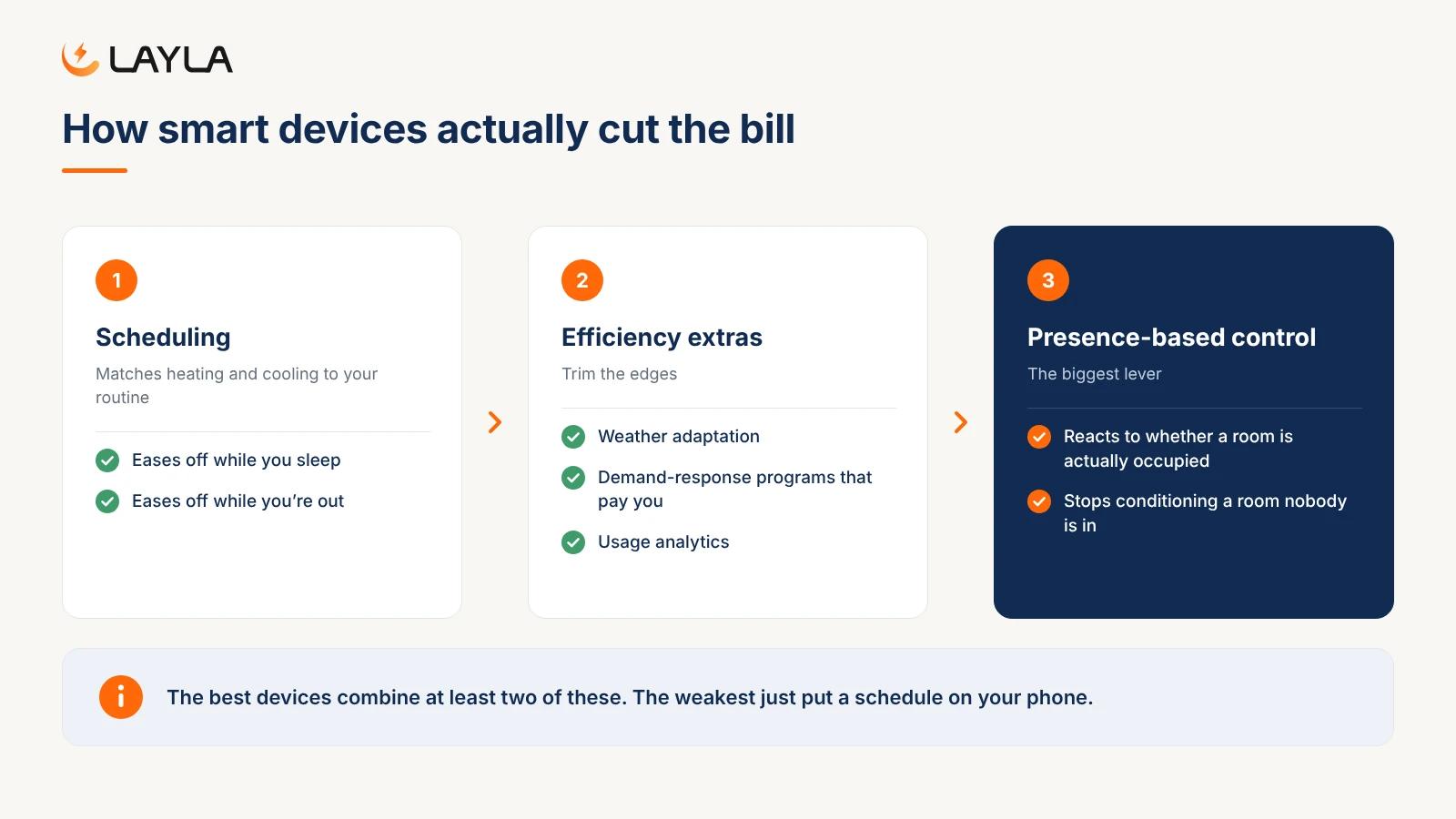
Three mechanisms do most of the work. Scheduling cuts waste by matching climate to your routine, so the system eases off when you're asleep or out. Presence-based control goes further, reacting to whether a room is actually occupied rather than just the time of day. Then there are the efficiency features that trim the edges: weather adaptation, demand-response programs that pay you to ease off at peak, usage analytics that show where the money leaks. The best devices combine at least two of these. The weakest just put a schedule on your phone.
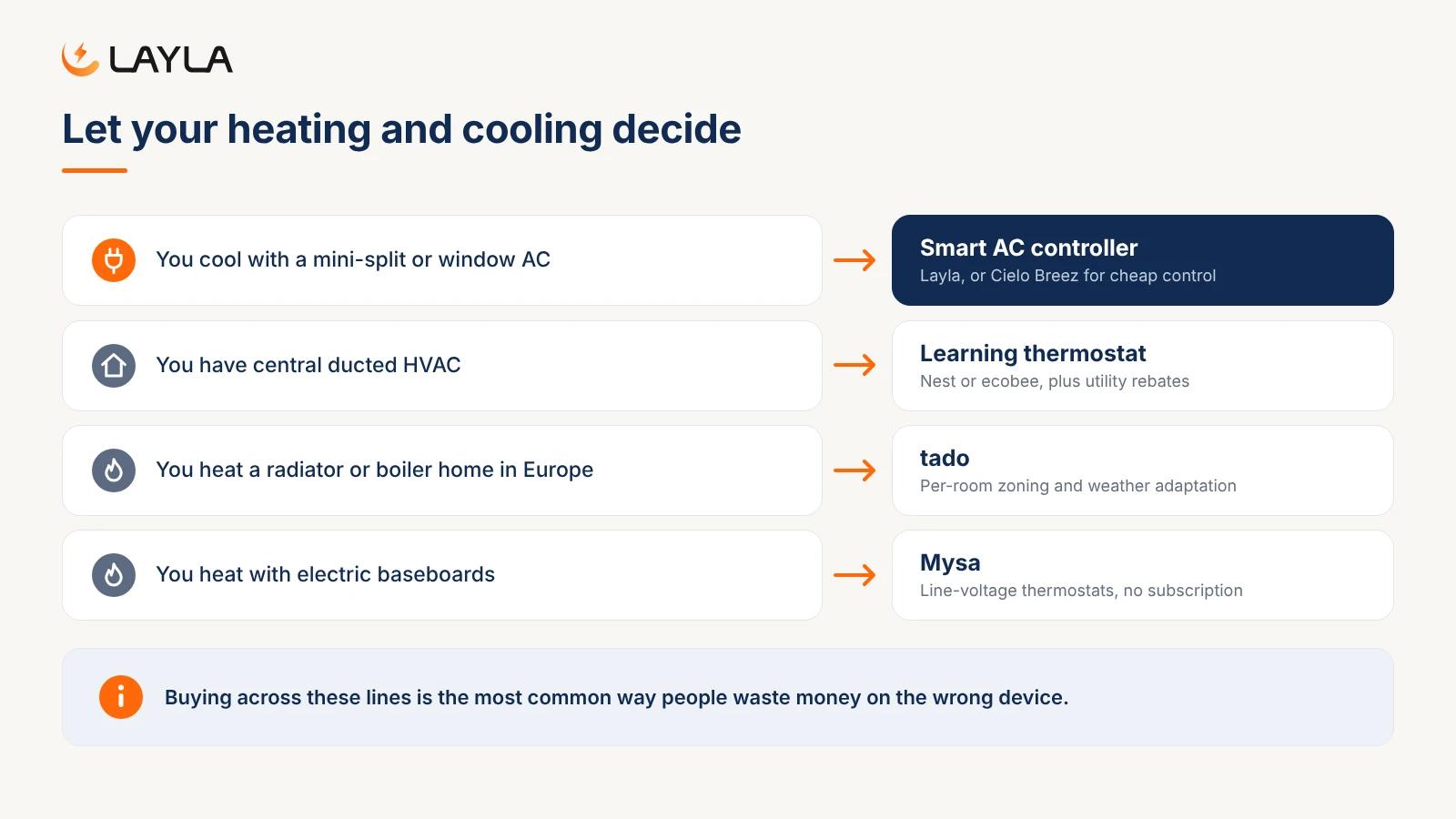
A quick reality check on fit, because it decides everything: if you cool with a mini-split or window AC, you want a smart AC controller; if you have central ducted HVAC, you want a wired thermostat; if you heat with electric baseboards, you want a line-voltage thermostat. Buying across those lines is the most common way people waste money on the wrong device.
Best for cooling and monitoring: Layla
If your energy spend is on air conditioning, Layla attacks the biggest waste directly. It controls heat pumps and AC units across 150+ brands over infrared, and its Eco Mode powers the unit down when a room is genuinely empty. Occupancy is sensed by radar rather than a schedule or your phone's location, so there's no camera and no microphone involved. That's the most dependable version of "don't cool an empty room," and it's why operators running Layla across busy properties have documented electricity reductions of up to 25%, with the same empty-room mechanism working just as well in a single room.
What sets it apart from a pure controller is that it also tells you what's happening. Layla 4.0 scores the room for Comfort, Sleep and Air quality in plain language, and it monitors CO2, VOCs, humidity and mould risk alongside the energy saving, all on the air quality page. There's no subscription. It's from $89 for AC Control & Energy, with air and the full stack above that on pricing. For a cooling-led home that also wants to understand its air, it's the standout.
Best for central HVAC: Nest and ecobee
If you have central ducted heating and cooling, a learning thermostat is your lever. The Nest Learning Thermostat builds a schedule from your routine, senses home and away, and (the genuinely valuable part) plugs into utility demand-response programs like Rush Hour Rewards that pay you to ease off at peak demand. The ecobee Smart Thermostat Premium does the scheduling and adds room sensors that heat and cool the rooms you're actually in, plus an onboard air-quality readout most thermostats don't have.
Both are strong energy savers on a central system, and both earn their rebates. Their limit for this list comes down to fit and scope. Neither works in a mini-split home, and neither monitors the room the way a dedicated monitor does. The Layla vs Nest and Layla vs ecobee comparisons cover where each lands.
Best for heating: tado and Mysa
Heating-led homes have their own best picks. In Europe, tado leads for boiler and radiator control, with per-room zoning and weather adaptation that genuinely cut gas use, though its best automations sit behind the Auto-Assist subscription. For electric heat, Mysa is the specialist. Its line-voltage thermostats control electric baseboard and in-floor heating that other smart thermostats can't touch, with real-time usage tracking, utility demand-response enrolment and no subscription. If your bill is a winter heating bill, one of these fits better than any cooling device.
Best for cheap, fee-free control: Cielo Breez and Sensibo
If you want to make an air conditioner smart without spending much, Cielo Breez gives you scheduling, Comfy mode, geofencing and energy history with no subscription, from the $60s. Sensibo does similar and adds the widest smart-home integration in the category, with its deeper energy optimisation behind a $30-a-year plan. Both save through scheduling and geofencing rather than true presence, so they sit a step behind a device that reads the actual room. For the money, though, they're effective at what they do.
Don't forget the basics
Two low-cost habits amplify any of these. Smart plugs and power strips kill the standby draw of electronics that sip power around the clock, which is small per device but adds up across a house. And whatever climate device you choose, the single highest-value setting is the one that stops conditioning empty space: a schedule at the least, real presence sensing at best. The hardware matters less than pointing it at that one goal.
At a glance
| Device | Best for | Subscription | Saves energy by |
|---|---|---|---|
| Layla | Cooling + room monitoring | None | Shutting AC off when the room is empty (radar) |
| Nest | Central ducted HVAC | None | Learned schedule + utility rebates |
| ecobee Premium | Central HVAC + room balancing | None for climate | Room sensors + eco+ optimisation |
| tado | European boiler/radiator heating | Auto-Assist for key features | Zoning + weather adaptation |
| Mysa | Electric baseboard/in-floor heat | None | Usage tracking + demand-response |
| Cielo Breez / Sensibo | Cheap AC control | None / $30-yr for advanced | Scheduling + geofencing |
Which energy-saving device should you buy?
Let your HVAC decide. Cool with a mini-split and want the room understood too? Layla, from $89, and it's the one that attacks empty-room waste most directly. Central ducted HVAC? A Nest or ecobee, with utility rebates to offset the price. Heating a European radiator home? tado. Electric baseboard heat? Mysa. Want cheap AC control and nothing else? Cielo Breez. The best energy-saving smart home device isn't a single product. It's the right class of device pointed at not conditioning space you aren't using.
Get Layla — from $89, no subscription
See Layla pricing — own it once →
Control the AC, cut the waste from empty rooms, and get the Comfort and Sleep scores that tell you what your home is actually doing. One device, one payment, free shipping, a one-year warranty, and 30 days to change your mind.
Frequently asked questions
What smart home device saves the most energy?
The one that manages heating or cooling, since that's roughly half the home energy bill. For cooling, Layla saves most directly by shutting the AC off when the room is empty, with documented reductions of up to 25%. For central HVAC, a learning thermostat with utility rebates; for heating, a zoning or electric-heat thermostat.
Do energy-saving smart home devices need a subscription?
Not necessarily. Layla, Nest, ecobee, Mysa and Cielo Breez all run their core energy features without one. tado and Sensibo put some of their best automations behind a subscription. It's worth checking before you buy, because a recurring fee changes the long-run cost.
What's the best energy-saving device for an apartment with a mini-split?
A smart AC controller, since there's no central thermostat to replace. Layla is the strongest because it adds presence-based shutoff and room monitoring; Cielo Breez is the cheapest fee-free option.
Does a smart thermostat really lower your bill?
Yes, on a home it fits. Scheduling, home-and-away sensing and utility demand-response programs genuinely cut heating and cooling costs on central HVAC. The savings are largest when the device reacts to real occupancy rather than only a clock.
How much can presence-based AC control save?
Layla's radar-based Eco Mode has been documented cutting electricity use by up to 25% in busy properties, since most AC waste comes from cooling rooms that sit empty. In a home the exact figure depends on how often rooms are unoccupied while the unit keeps running.
Keep reading
- Best smart AC controllers — the AC-controller category in depth
- Layla vs Nest · Layla vs Sensibo
- Air quality monitoring with Layla — the monitoring side

Best for: cutting the power bill
AC Control & Energy
Stop cooling empty rooms. Start saving on energy.
Included forever — no subscription
- Smart AC remote control (IR) — 150+ brands
- Occupancy-based AC auto-off — when no one's around
- Scheduling, timers & temperature-based automation
- Filter-health estimation & replacement alerts
- Energy usage insights
- Indoor temperature & humidity
No monthly fees. Ever.
AC is the biggest energy expense in any property.
It accounts for 16% of all U.S. household electricity use - and in hot states, 30-40% of vacation rental operating costs during summer. Monthly bills regularly hit $300-400+ in peak season.
Empty rooms are burning money.
Smart occupancy-based controls deliver 20-30% annual HVAC energy savings. Hotels using this approach save up to $20,000/year per property. If no one's in the room, the AC shouldn't be running.
Energy costs are rising faster than inflation.
U.S. residential electricity prices rose 4.3% in 2025 with another 4.1% projected for 2026 - more than double the rate of general inflation. What was marginal profit is now a loss for many rental hosts.
30-day money back guarantee