BLOG
Layla vs Mysa: heating thermostat or a monitored room?
 By Nangyal Khan·
8 min read
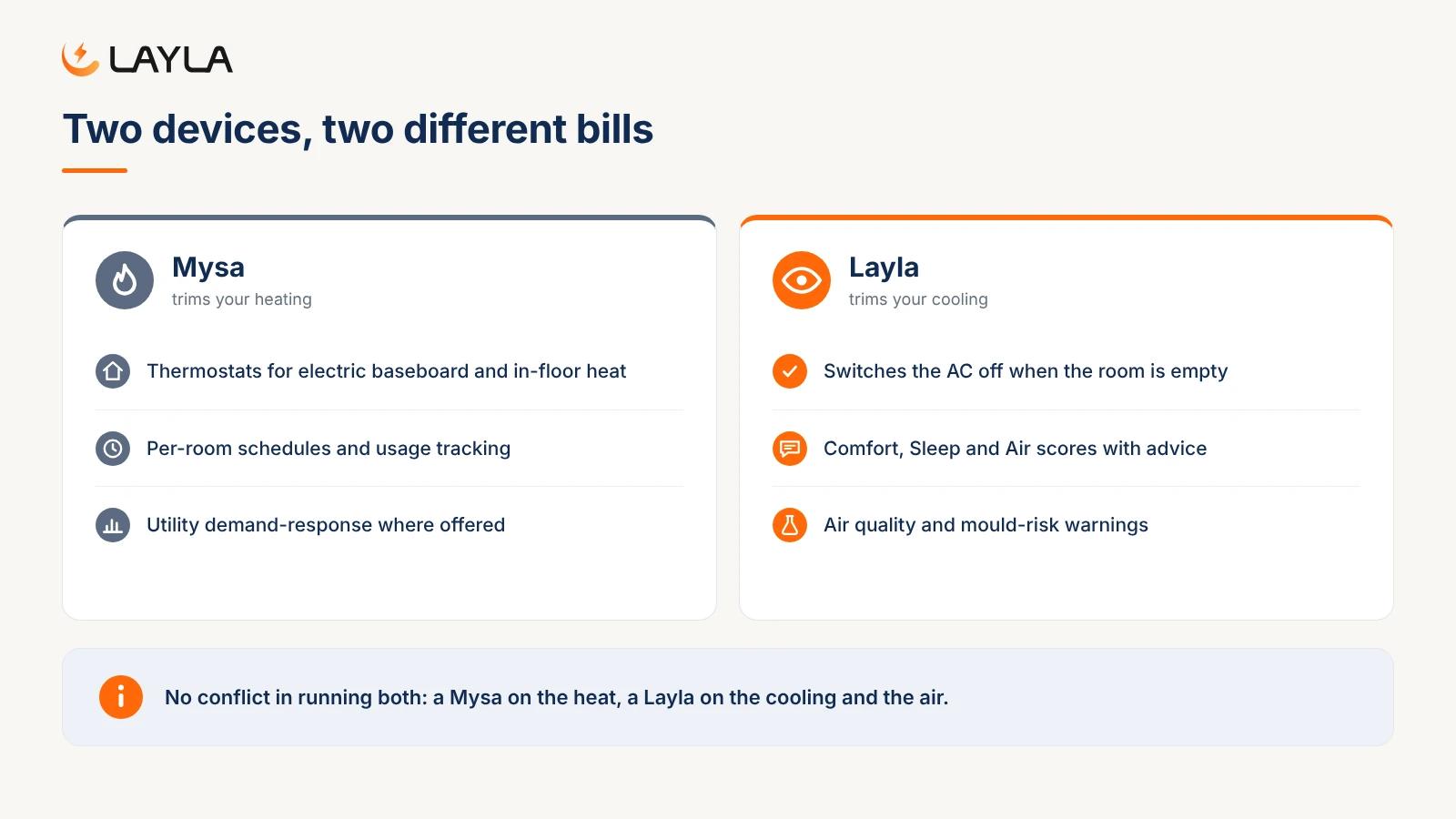
If you're weighing layla vs mysa, the first thing to settle is that these two devices mostly solve different problems. Mysa is a smart thermostat, and it's the best in the business at one thing in particular: controlling high-voltage electric heat (baseboards, in-floor, fan-forced), the kind of heating most smart thermostats can't touch. Layla is a home monitor that reads the room, scores it, and controls your air conditioner. Where they overlap is cooling and mini-splits. Everywhere else they're built for different jobs, so the honest comparison starts by naming which job is yours.
Let's give Mysa its due plainly. If your home runs on electric baseboard or in-floor heating, Mysa is genuinely the right tool, and Layla isn't a baseboard thermostat. Mysa handles line-voltage systems that Nest and Ecobee simply refuse, it charges no subscription, the hardware is beautifully designed, and it has real utility demand-response and energy reporting behind it. None of what follows is an argument against buying a Mysa to run your heat.
What does Mysa do?
Mysa makes a family of thermostats, and the distinction between them matters more than with most brands. The flagship Mysa for Electric Baseboard Heaters, around $159, and the In-Floor model at $199 are line-voltage thermostats: they wire into 120V or 240V electric heating circuits, which is exactly the niche most smart thermostats avoid. There's also a budget baseboard LITE at $99, a wired Mysa for Central Heating & Cooling at $129 for homes with standard ducted HVAC, and a Mysa for Mini-Split Heat Pumps at $139 that works over infrared like an AC controller.
Across all of them, Mysa keeps it clean: no subscription, free app, energy reporting, per-room schedules, and support for the main voice assistants, with the central model Matter-certified. The baseboard models even support enrolment in utility demand-response programs where they're offered, so you can stack grid rebates on top of the savings. For someone heating a cold-climate home with electric resistance heat, that's a genuinely strong package, and Mysa has earned its following in exactly those markets.
What Mysa doesn't do is monitor the room beyond temperature and humidity. There's no air-quality sensing, no noise, no smoke, and no real occupancy detection. The "proximity" sensor on the central model wakes the display rather than tracking the room. Mysa is a climate-control device, and a focused one.
What does Layla do that Mysa doesn't?
Layla reads the room and interprets it for you, which a thermostat doesn't try to do.
Instead of a temperature and a setpoint, Layla 4.0 gives you a Comfort score, a Sleep score and an Air quality score. Under each one sits a plain-language line that names what changed, suggests a fix, and shows the reading behind it. The room that drifts warm overnight, the humidity creeping toward the band where mould starts, the bedroom that never settles before sleep: Layla turns those into advice you can act on. On the air quality page you can see the wider set it watches, including CO2, VOCs, and a mould-risk warning that fires before damp becomes a wall problem.
On the cooling side, Layla and Mysa's mini-split model actually meet. Both control a ductless head over infrared. The difference is what sits around that control. Layla's AC Control & Energy tier runs heat pumps and AC units across 150+ brands and adds Eco Mode, which shuts the unit off once the room clears out. Presence is sensed by radar (no camera, no microphone), so the trigger is the room emptying, not a schedule or a guess. Mysa's mini-split controller switches the unit; it doesn't watch the room. That's the line between a controller and a monitor.
Layla's tiers are one-time purchases with no subscription: AC Control & Energy at $89, Smoke & Air Quality at $99, and the All-in-One at $299 for climate, air, noise and energy together. You can see how they stack up on pricing, and the climate set on the control and energy page.
How layla vs mysa compares on saving energy
Both save energy, and both do it without a subscription, so the interesting part is where the savings come from. Mysa's are heating savings: tighter scheduling, per-room control, real-time usage tracking, and demand-response enrolment that cold-climate utilities reward. On an electric-baseboard home, that's a meaningful dent in a bill that can run high all winter, and Mysa reports figures to match.
Layla's savings are cooling savings, and they come from presence. The most wasted energy in a cooled home is an AC running in an empty room, and radar auto-off attacks that directly, without a schedule and without your phone being the trigger. In busy real-world use, operators have logged electricity reductions of up to 25% with Layla, most of it from that empty-room shutoff. The two devices aren't really fighting over the same bill — Mysa trims your heating, Layla trims your cooling while also telling you what the room is doing.
Which matters more depends entirely on your home. A drafty house in a northern climate with electric baseboards spends its money on heat, and Mysa is the smarter buy there. A home that leans on air conditioning and wants the room understood (comfort, air, damp, presence) is Layla's case.
At a glance
| Layla (AC Control & Energy) | Mysa | |
|---|---|---|
| Primary job | Monitor the room + control AC | Control heating (and a mini-split AC model) |
| Electric baseboard / in-floor heat | No | Yes, best-in-class (line-voltage) |
| Controls AC / mini-split | Yes, 150+ brands over IR | Yes, on the Mini-Split model over IR |
| Reads the room as | Comfort, Sleep and Air scores with advice | Temperature and humidity |
| Empty-room shutoff | Eco Mode, radar presence (no camera/mic) | Scheduling; no occupancy sensing |
| Air quality + mould | On the $99 tier (scored, with warnings) | None |
| Subscription | None | None |
| Entry price | From $89 one-time | $99–$199 depending on heating type |
Which one should you buy?
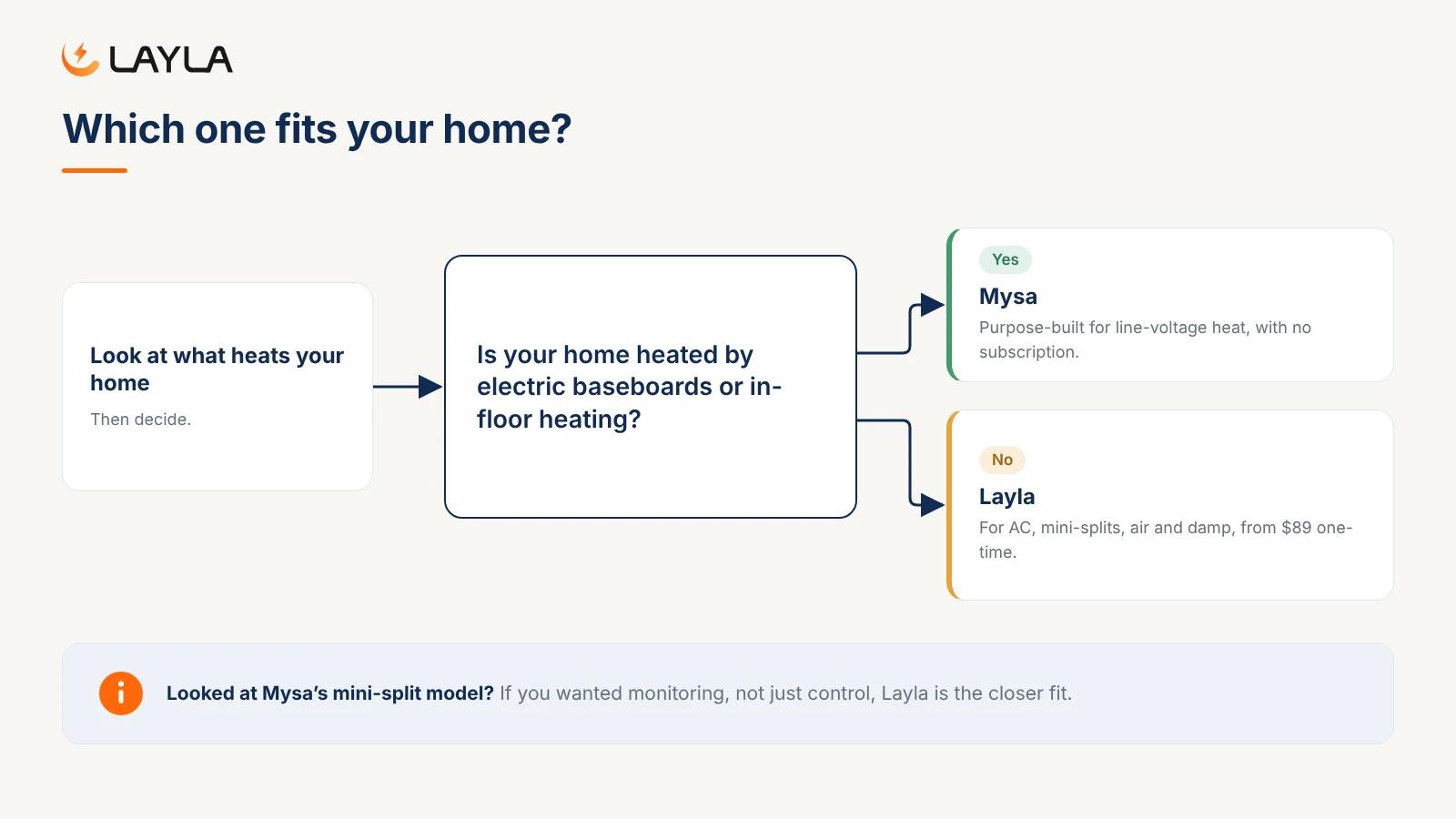
The split here is unusually clean, so pick by what's on your wall.
If your home is heated by electric baseboards, in-floor coils or fan-forced units, buy Mysa. It's purpose-built for line-voltage heat that other smart thermostats can't control, it charges nothing recurring, and the utility demand-response angle can pay you back. Layla doesn't compete for that job and I wouldn't pretend it does.
If your comfort problem is cooling, air and damp, and you run AC or mini-splits in a home you'd like to actually understand, buy Layla. You'll control the AC across 150+ brands, get a shutoff that reads real presence rather than a timer, and see the room as a Comfort, Sleep and Air score instead of a bare temperature. It's also the better mysa alternative for anyone who looked at Mysa's mini-split model and realized they wanted monitoring, not just control, from $89, paid once.
A lot of homes want both, and there's no conflict in running a Mysa on the heat and a Layla on the cooling and the air. But if you're choosing one device, let the heating type decide it.
Get Layla — from $89, no subscription
See Layla pricing — own it once →
Control the AC, cut the waste from empty rooms, and get the Comfort and Sleep scores that tell you what your home is actually doing. One device, one payment, free shipping, a one-year warranty, and 30 days to change your mind.
Frequently asked questions
Is Layla a good Mysa alternative?
It depends on the job. For controlling electric baseboard or in-floor heating, no: Mysa is purpose-built for that and Layla doesn't do line-voltage heat. For controlling an AC or mini-split and understanding the room, yes: Layla adds Comfort, Sleep and Air scores and presence-based shutoff that Mysa's controllers don't offer, from $89 with no subscription.
Does Layla control electric baseboard heating like Mysa?
No. Mysa's baseboard and in-floor thermostats wire into high-voltage electric heating circuits, which is its speciality. Layla controls air conditioners and heat pumps over infrared and monitors the room; it isn't a line-voltage heating thermostat.
Do Layla or Mysa need a subscription?
Neither. Both are one-time purchases with every feature included, which is a real strength they share.
Which saves more energy?
They save on different bills. Mysa trims heating on electric-heat homes through scheduling and utility demand-response. Layla trims cooling by shutting the AC off when the room is empty, with documented reductions of up to 25% on busy properties. Your heating and cooling mix decides which matters more.
Can Layla monitor air quality and mould?
Yes. Layla's Smoke & Air Quality tier at $99 tracks CO2, VOCs and humidity, turns them into an air-quality score and a mould-risk warning, and identifies smoke type. Mysa has no air-quality, noise or smoke sensing.
Keep reading
- Layla vs Sensibo — AC controller head-to-head
- Best smart AC controllers — the full category, ranked
- Best energy-saving smart home devices — the wider roundup

Best for: cutting the power bill
AC Control & Energy
Stop cooling empty rooms. Start saving on energy.
Included forever — no subscription
- Smart AC remote control (IR) — 150+ brands
- Occupancy-based AC auto-off — when no one's around
- Scheduling, timers & temperature-based automation
- Filter-health estimation & replacement alerts
- Energy usage insights
- Indoor temperature & humidity
No monthly fees. Ever.
AC is the biggest energy expense in any property.
It accounts for 16% of all U.S. household electricity use - and in hot states, 30-40% of vacation rental operating costs during summer. Monthly bills regularly hit $300-400+ in peak season.
Empty rooms are burning money.
Smart occupancy-based controls deliver 20-30% annual HVAC energy savings. Hotels using this approach save up to $20,000/year per property. If no one's in the room, the AC shouldn't be running.
Energy costs are rising faster than inflation.
U.S. residential electricity prices rose 4.3% in 2025 with another 4.1% projected for 2026 - more than double the rate of general inflation. What was marginal profit is now a loss for many rental hosts.
30-day money back guarantee