BLOG
How does a noise monitor work if no audio is recorded?
 By Nangyal Khan·
6 min read
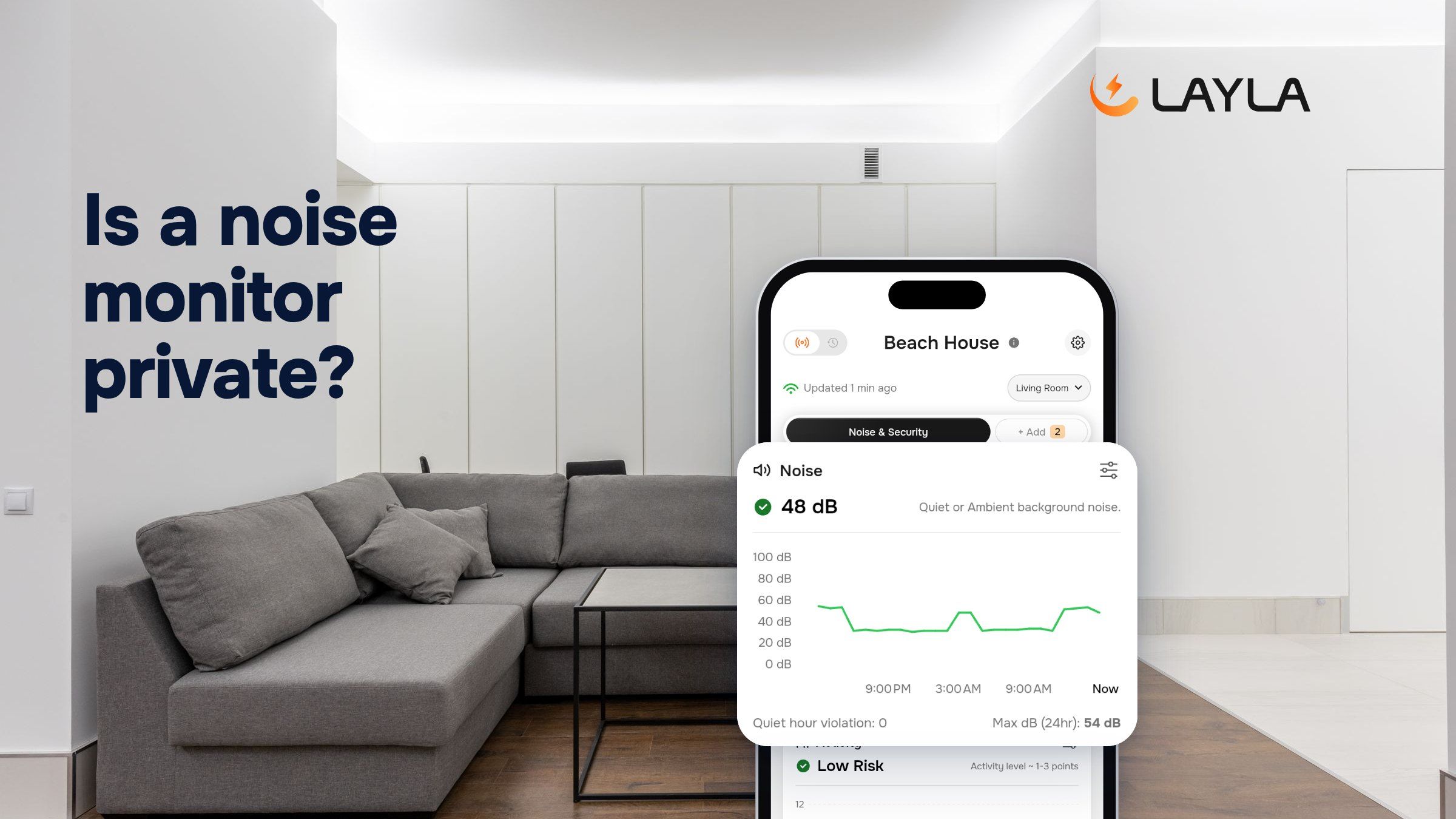
A noise monitor measures how loud a room gets, in decibels. It turns that into a number again and again, and it keeps each number with its time and room. No audio is recorded, so nothing anyone says is ever kept. What the host gets is a level, how long it lasted and where. Layla works exactly this way, and Noise & Security Pro is the plan built for it.
Layla Noise & Security Pro: noise levels, a people count and party alerts, $179 once
What does a noise monitor actually measure?
It measures loudness, and only loudness. Layla measures how loud it gets, in decibels, and turns each moment into a number. Over an evening those numbers become a line: quiet at 48 dB, louder at dinner, back down by midnight. The host sees the level and how long it stayed there. Words, voices and songs never reach the app, because no audio is recorded.
On Noise & Security Pro the readings come in real time. On Noise Basic, alerts still come in real time and readings update every 5 minutes.
Layla also tells you how many people are inside, and that uses no sound at all. It comes from a human presence radar plus a Wi-Fi signal algorithm. The result is a count, such as four people. It never says who they are.
What does it keep, and what never gets kept?
Layla keeps noise levels and people counts, each with its time. They go over Wi-Fi to the Layla cloud, encrypted and GDPR-compliant, so the host can see them in the app from anywhere.
| Layla keeps | Layla never keeps |
|---|---|
| Noise levels in decibels | Audio of any kind |
| The time and room of each | Pictures or video |
| How many people are inside | Who those people are |
There is no camera, and the count is anonymous: nobody is identified. How far back you can look depends on the plan. Noise Basic keeps 7 days of history. Noise & Security Pro gives charts for the last 30 days and incident reports for the last six months.
Here is the short version a host can give a guest: Layla keeps how loud it got and how many people were inside, with no camera and no audio recorded.
How do you choose when it alerts you?
For the noise alert, you pick one of three settings, and each one is a level and a length of time:
| Setting | Alerts when noise stays over | Suits |
|---|---|---|
| Strict | 70 dB for 1 minute | Apartments with close neighbors |
| Balanced | 70 dB for 5 minutes | Most rentals |
| Relaxed | 85 dB for 10 minutes | Detached homes, lively groups |
For the night, you set a limit for quiet hours anywhere from 65 to 75 dB. A host with neighbors through a shared wall might pick 65 dB from 22:00 to 07:00. A house with a big yard can leave more room. How to pick the hours and tell guests about them is in our guide to setting quiet hours in a vacation rental.
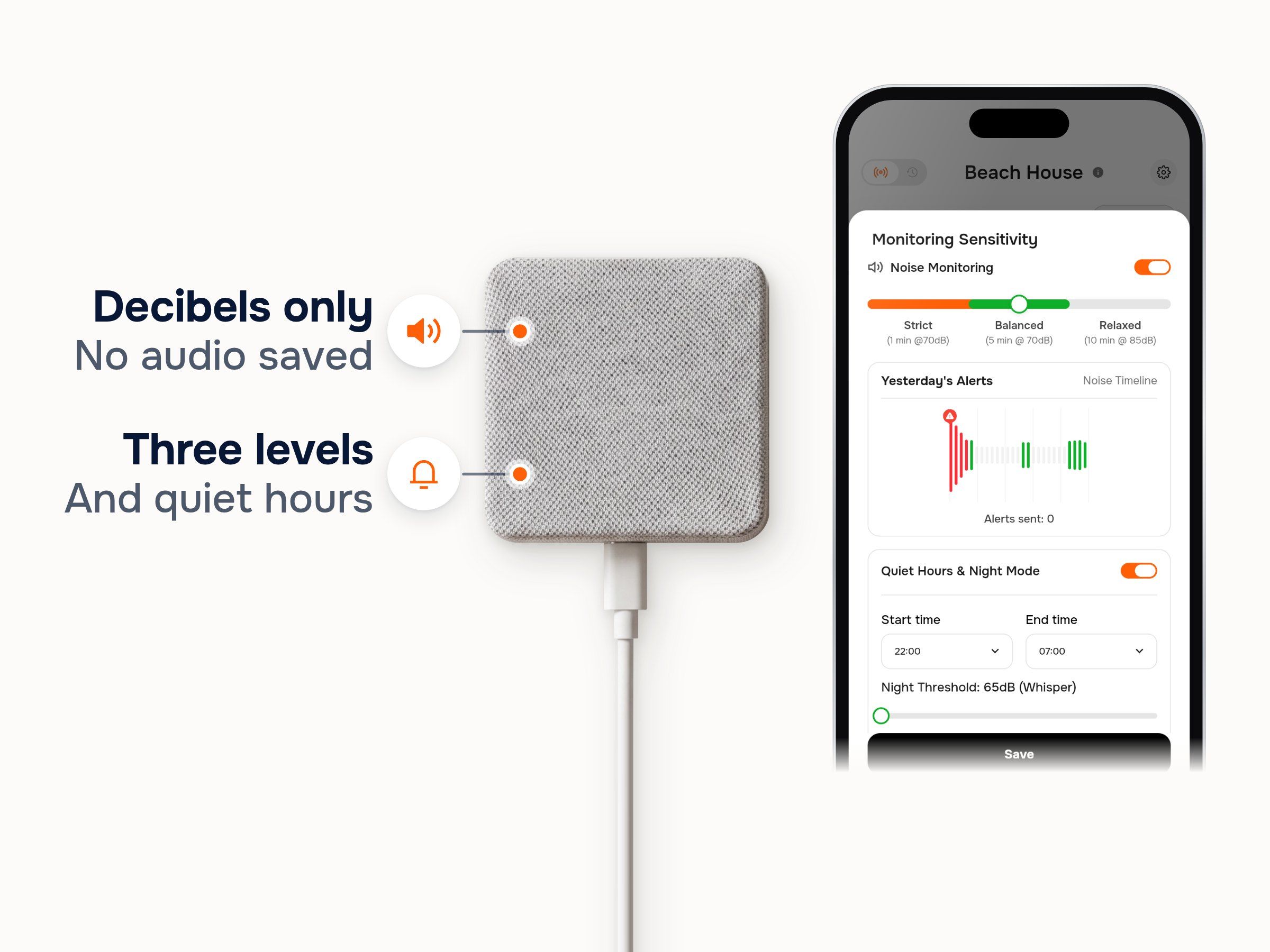
Layla's noise settings: three alert levels and quiet hours are all a host chooses
What do you see when it gets too loud?
You see a number, a time and a room. Say Beach House has quiet hours at 65 dB and the living room reaches 72 dB at 23:40. The host gets a phone notification: too loud for quiet hours, 72 dB in the Living Room at 23:40, over the 65 dB night limit. The Noise card in the app reads the same 72 dB. That is all the alert carries.
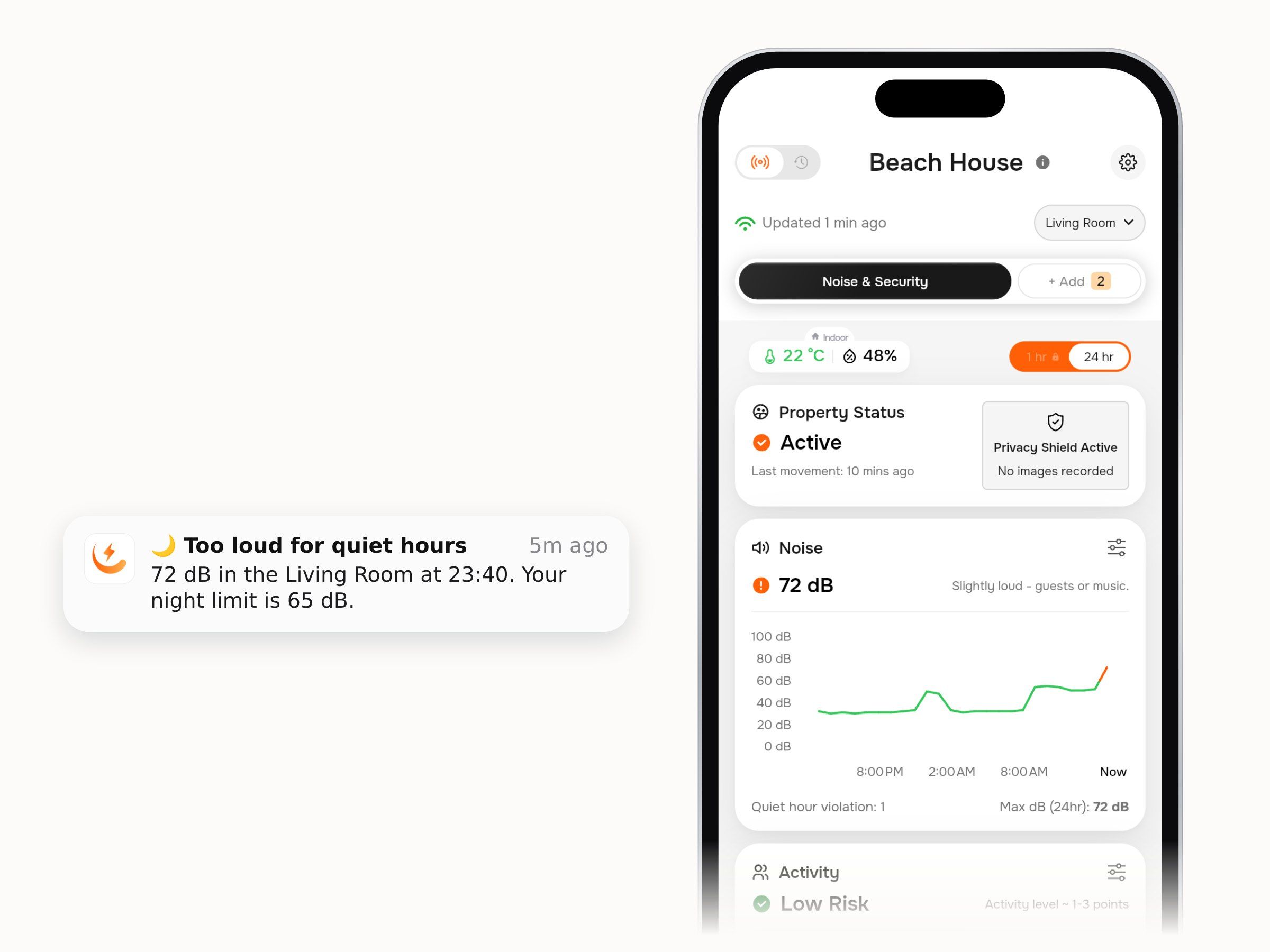
Layla's quiet hours alert: the level, the time and the room, nothing anyone said
On Noise & Security Pro, the AI Party Detector adds one more alert. It comes when noise and a crowd build at the same time, and it says how loud it is and about how many people are inside. It is on from the start, with nothing to switch on. Layla alerts you, and you decide what to do: a message to the guests, a call, or nothing at all.
Noise & Security Pro is $179 once, with no subscription. Noise Basic is the new plan for a host starting out, at $149 once. It has noise alerts, quiet hours, the people count and an alert when more guests are inside than the home allows.
Is a noise monitor allowed on Airbnb, and what do you tell guests?
Yes, inside the home, if it keeps no audio. Airbnb's help page on security cameras and other devices in homes, read 15 Nov 2026, allows noise decibel monitors inside a home. It describes them as devices that measure how loud it gets and for how long, without keeping any audio. They are never allowed in bedrooms, bathrooms or sleeping areas. You must tell guests that there is one, but you do not have to say where it is.
One honest line in your listing or house rules covers it: "This home has a noise monitor. It measures noise levels in decibels, and no audio is recorded." Our vacation rental house rules template has a place for it, next to your quiet hours.
What else can the same kind of sensor catch?
Smoking and vaping, the other complaint hosts get most. Smoke & Air Quality, $99 once, alerts you when someone smokes or vapes, with the time and the room, and with no camera in the home.
For a host with both worries, All-in-One is one sensor for $299 once. It has the same smoke and vape alerts, and the same noise levels and people count as Noise & Security Pro.
Keep reading
A noise monitor that keeps only a number lets you install it, tell guests plainly and still know when a night gets out of hand.
See Layla Noise & Security Pro for your rental
- How the noise monitors hosts use compare: Ready to choose one? How the noise monitors hosts use compare on price, fees and alerts.
- Acceptable decibel levels in a rental: What 50, 60, 70 and 80 dB actually sound like in a rental, by day and at night.
- How to know a guest vaped, without cameras: The other complaint hosts get: how to know a guest smoked or vaped, with no camera.

Best for: serious hosts
Noise Pro
Compliant with Airbnb's rules and local noise laws worldwide. Advanced protection for serious hosts.
Included forever – no subscription
- AI party detector
- Instant noise alerts with timestamps
- Live data feed, no 5-minute delay
- 180-day data history
- Radar intruder & vacant-home alerts
- Property status dashboard
- Outdoor temperature & humidity
- Automatic AI accuracy updates
- Daily & weekly summary reports by email
No monthly fees. Ever.
Your indoor air is 2-5x more polluted than outdoor air.
The EPA confirms it, but most people have no idea. You spend 90% of your time indoors breathing air you've never measured.
CO2 builds up silently.
A bedroom with two people can hit 2,500 ppm overnight. Harvard research shows decision-making drops 50% at 1,400 ppm. That brain fog and morning fatigue? It might not be bad sleep - it's bad air.
VOCs are off-gassing in every room.
New furniture, carpets, paint, cleaning products indoor VOC levels run up to 10x higher than outdoors. Some, like formaldehyde and benzene, are classified carcinogens. You can't smell most of them.
Mold starts in 24 hours.
When humidity exceeds 60%, mold begins colonizing within a day. 47% of U.S. homes show visible mold. Average remediation cost: $2,368 severe cases hit $30,000. A sensor that warns you before mold starts is orders of magnitude cheaper than cleanup.
Standard smoke detectors only catch fires.
They don't detect cigarette, vape, or marijuana smoke at low levels. For landlords and hosts, unauthorized smoking causes damage that goes unnoticed for weeks.
Post-COVID, people want data.
66% of Americans are more cautious about indoor air since the pandemic. 61% say they'd trust a space more if it monitored air quality. The awareness shift is permanent.
30-day money back guarantee