BLOG
New Year's Eve party prevention for Airbnb hosts: what to do before and on the night
 By Nangyal Khan·
8 min read
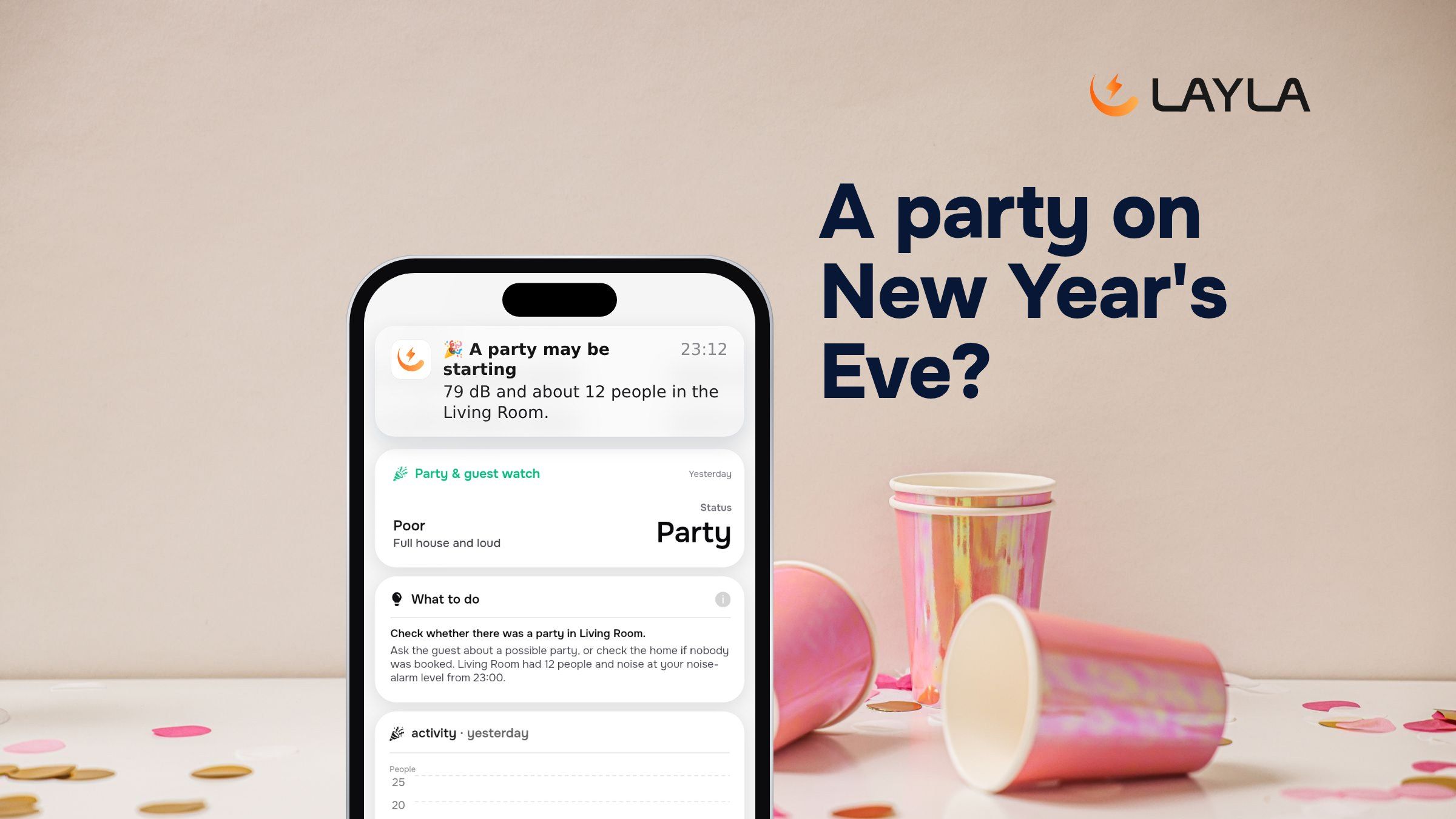
New Year's Eve is the night most hosts fear: a booking for four that turns into a crowd and loud music after midnight. Airbnb screens some risky New Year's Eve bookings, but a booking that passes its checks can still turn into a party. You can do four things to prevent one. Check the booking before you accept it, write a clear guest limit and quiet hours rule, get an alert the moment noise and a crowd build, and see what happened the next morning. Layla Noise & Security Pro covers the night and the morning after, for $179 once with no subscription. Its party alert gives you time to call the guest before things get out of hand.
See how Layla Noise & Security Pro alerts you when a party starts
What does Airbnb already do on New Year's Eve?
Last New Year's Eve, Airbnb ran its anti-party technology on New Year's Eve bookings. It flagged bookings that looked like a higher risk of a disruptive party, then blocked them or offered the guest a private room or a hotel instead. The measures ran in the US (including Puerto Rico), Canada, the UK, France, Spain and Australia. Third-party bookings and stays by anyone under 18 without an adult were not allowed. Source: Airbnb newsroom, 20 Dec 2025.
Airbnb says similar measures stopped over 20,000 people in the US from booking an entire home over New Year's Eve 2024. But the screening works on bookings, not on what happens in your home. A guest who passes it is still yours to manage on the night. As of 15 Nov 2026, Airbnb has not announced its measures for this New Year's Eve, so plan as if your own checks are the ones that count. For more on what Airbnb's party rules cover and what they leave to you, read our guide to Airbnb party prevention without cameras.
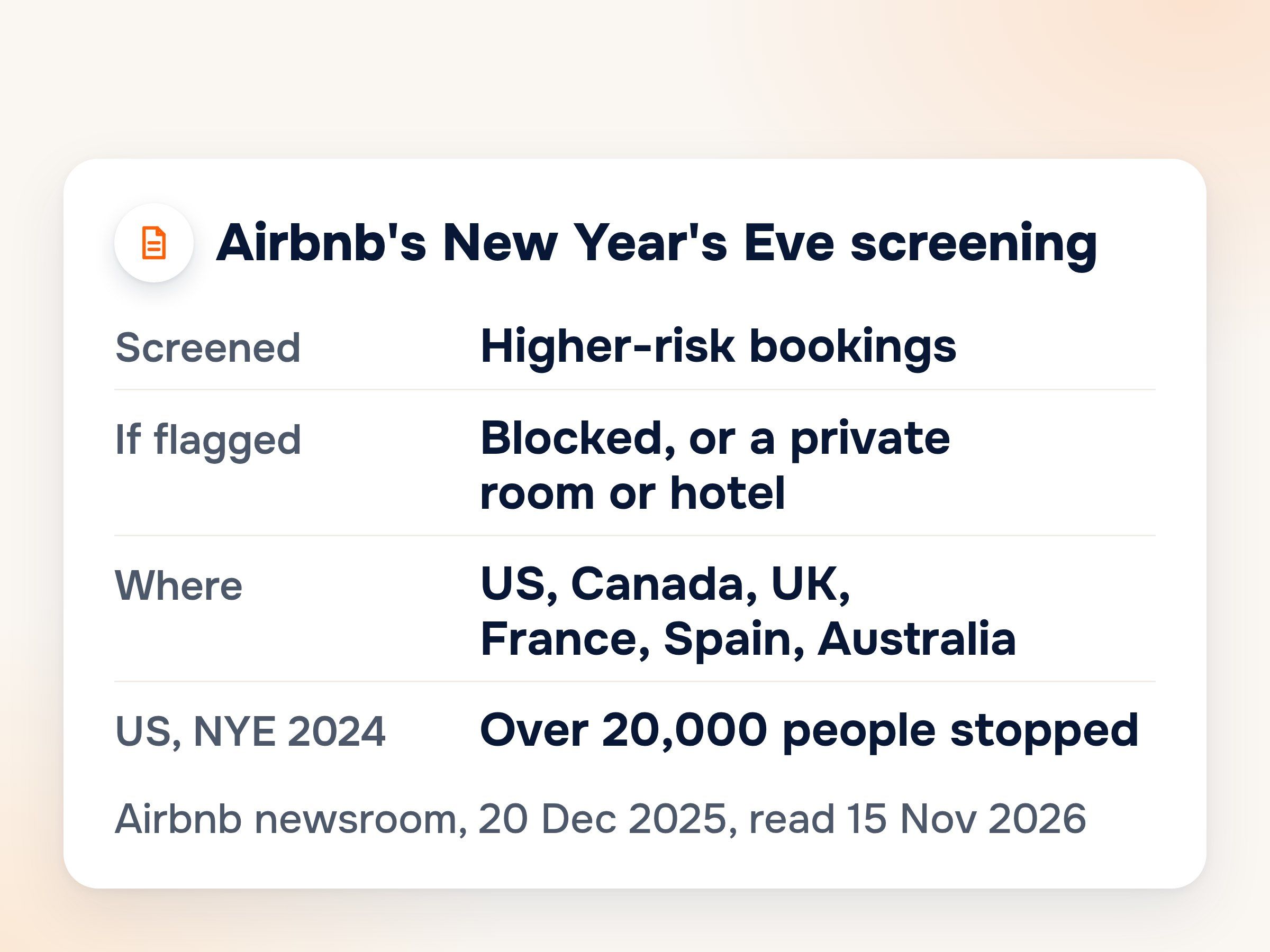
Airbnb's New Year's Eve screening, as its newsroom described it in December 2025
Which New Year's Eve bookings should you look at twice?
Airbnb has named the signals its screening looks at: trip length, how far the guest lives from the listing, the listing type and a last-minute booking. In earlier years it focused on one-, two- and three-night bookings of an entire home. You can run the same checks on your own calendar before you accept.
Look twice at a New Year's Eve request when you see:
- A one to three night stay in an entire home, over 31 Dec.
- A booking made in the last few days before the night.
- A guest who lives nearby, with no clear reason to stay in their own town.
- A new profile with no reviews.
- A vague reason for the trip, or none at all.
One sign alone is not proof. Two or three together are worth a message. Ask who is coming, how many people will stay, and what brings them to town. A guest with nothing to hide answers in a line. Keep it short and friendly, for example: "Happy to host you for New Year's! Just checking: how many of you will be staying, and what are your plans for the night?" A polite question works better than a refusal: an honest guest feels welcome.
What should your house rules say for New Year's Eve?
A rule you can point to is what makes the night enforceable. For New Year's Eve, your listing and house rules should say four things plainly:
- Guest limit: the number of people allowed in the home, day and night.
- Quiet hours: from 22:00, with no loud music or gatherings after that.
- No parties or events.
- A noise monitor in the home: Airbnb allows noise decibel monitors when guests are told about them, so say so in the listing.
Repeat it in a friendly line in your welcome message: "We hope you have a great New Year's Eve! Just a reminder that quiet hours start at 22:00 and the home is for up to 4 guests." For the usual quiet hours window and more ways to word it, see our post on quiet hours for vacation rentals.
With Layla, the same rule is also a setting. You set quiet hours with a night limit from 65 to 75 dB, and tell Layla how many guests the home allows. Layla measures how loud it gets in decibels, and no audio is recorded. At Elm House, our example home, quiet hours run from 22:00 to 07:00 with a night limit of 65 dB and a guest limit of 4.
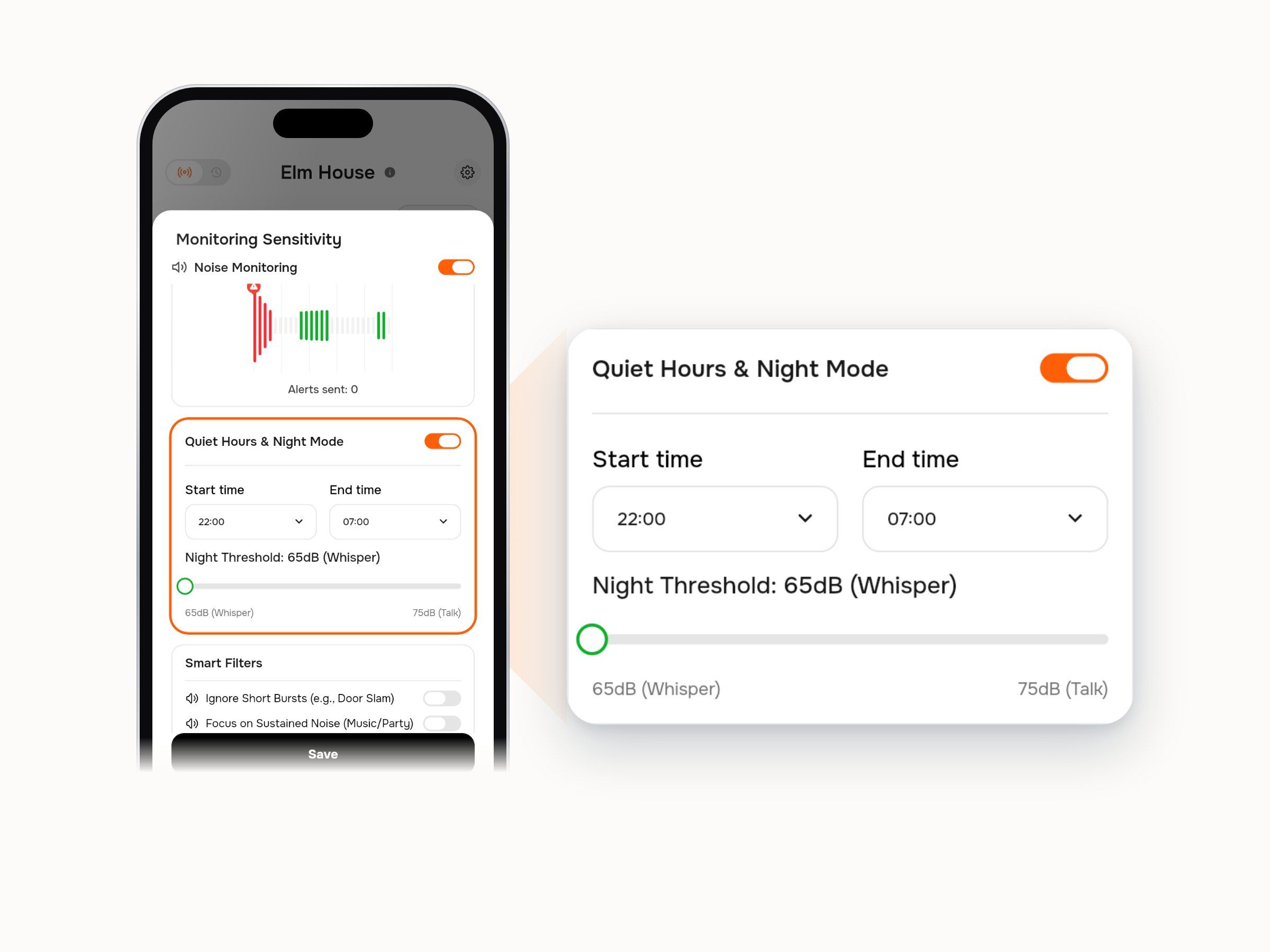
Quiet hours in the Layla app: 22:00 to 07:00, with a 65 dB night limit
How do you know a party is starting on the night?
You get an alert as it starts. Noise & Security Pro has a feature called the AI Party Detector: it alerts you when noise and a crowd build at the same time. It is on by default, and the alert says how loud it is and about how many people are inside. Layla alerts you, and you decide what to do.
Here is an example night at Elm House, on 31 Dec:
- 16:00: check-in, with 4 guests booked.
- 22:00: quiet hours start, with a 65 dB night limit.
- 23:00: more people arrive, and noise rises.
- 23:12: the party alert arrives: a party may be starting, 79 dB and about 12 people in the Living Room, against a guest limit of 4.
- 23:20: the host calls the guest.
- 00:10: noise is back under 65 dB, with about 4 people inside.
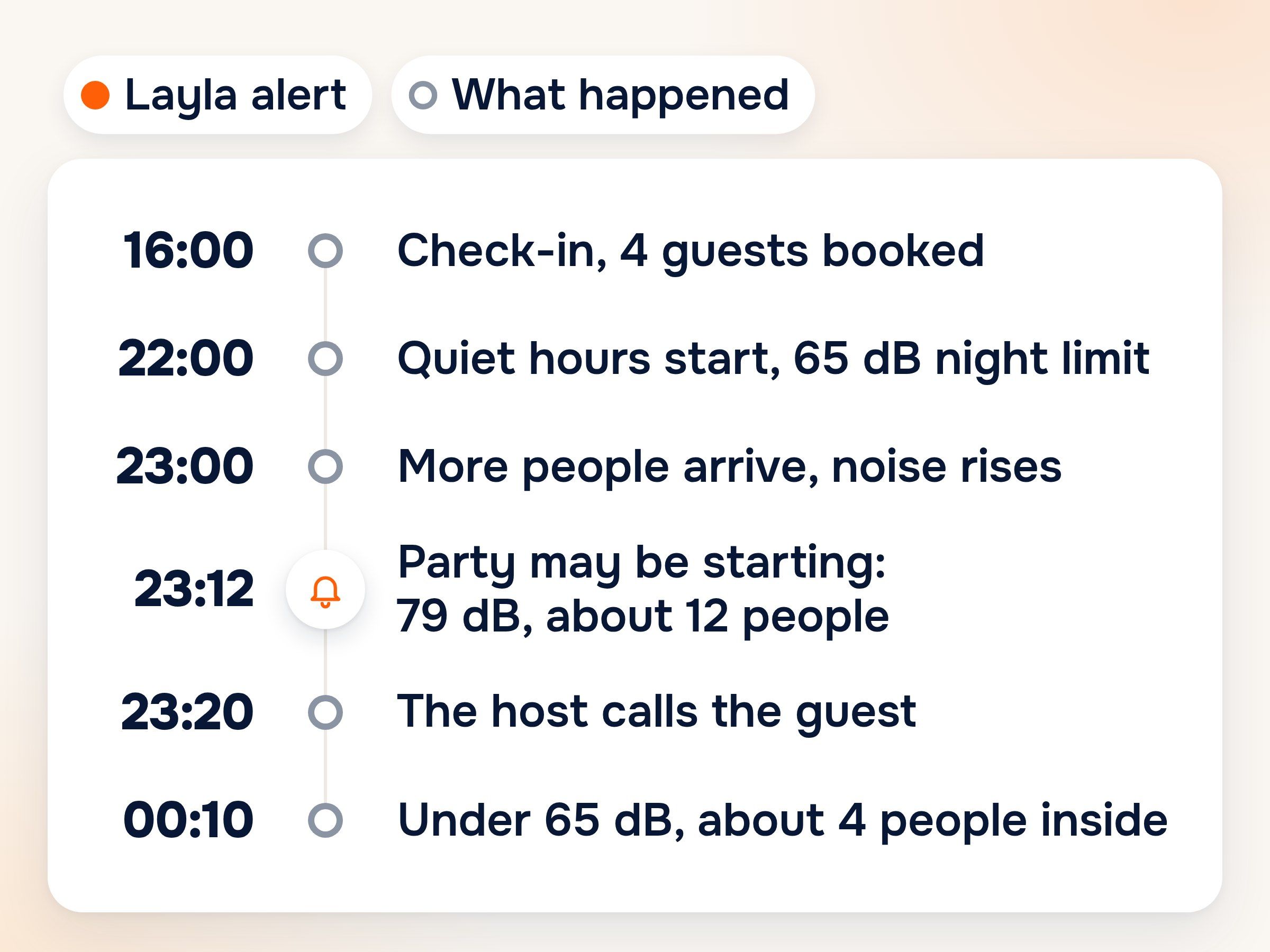
The example night at Elm House: one Layla alert at 23:12, quiet again by 00:10
The alert came early enough for one call to settle things before midnight, while it was still a few extra friends and not a full party. You know how loud it is and roughly how many people are there, so the call can be calm and specific: "We're seeing more people than the booking allows and it's getting loud. Can you bring it down and keep it to your group of four?"
Noise Basic, at $149 once, also measures noise, tells you how many people are inside and alerts you when there are more than the home allows. Noise & Security Pro adds the party alert, which joins noise and the crowd in one alert, and the morning-after view below. Neither has a camera, and no audio is recorded. Layla tells you how many people are inside, never who.
What does the morning after show?
On 1 Jan you don't have to ask anyone what happened. On Noise & Security Pro, Party & guest watch shows yesterday's status. At Elm House it reads Party, with about 12 people inside and noise over the limit at 23:00.
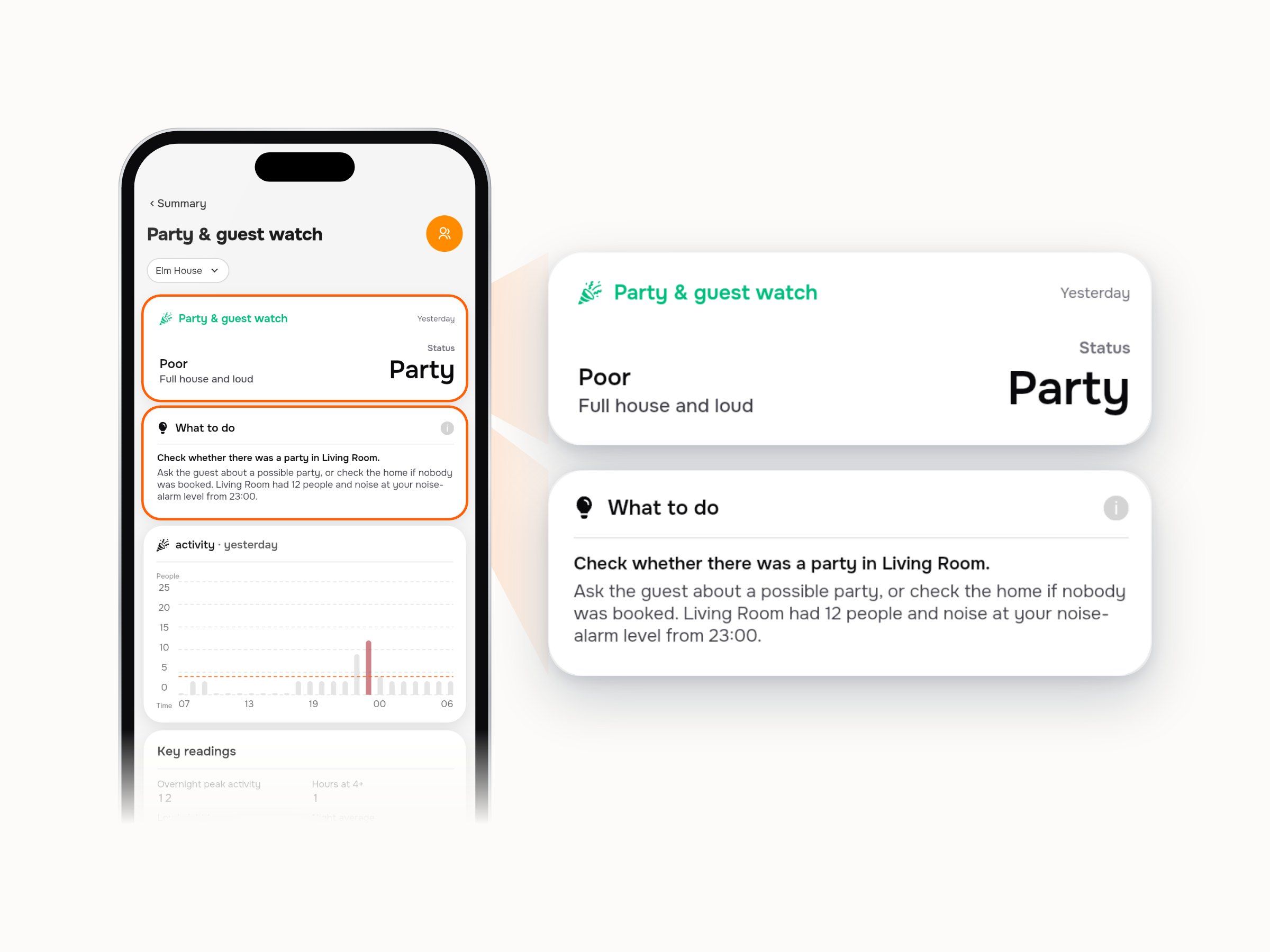
The next morning, Party & guest watch shows the party, 12 people and the time it got loud
That gives you facts to work from. You can send the guest a calm message about the house rules, write an honest review, or support a claim if something was damaged. For a claim, you can have an incident report emailed to you: a PDF for the whole home over the dates you choose, with charts of noise and of people over time. On Pro, charts cover the last 30 days and incident reports the last six months.
This is why the plan for New Year's Eve is Noise & Security Pro: the party alert on the night and Party & guest watch the next morning are both Pro features. It costs $179 once, with no subscription.
What else can a New Year's Eve party leave behind?
A party often brings smoking and vaping indoors. Layla Smoke & Air Quality, at $99, alerts you when someone smokes or vapes, with the time and the room. If you want parties and smoking covered by one sensor, All-in-One, at $299, has everything in Noise & Security Pro and Smoke & Air Quality.
Ready for a calm New Year's Eve?
New Year's Eve doesn't have to be the night you dread: check the booking, set the rule, and let Layla tell you the moment a party starts.
Get Layla Noise & Security Pro for $179 once, with no subscription
Keep reading
- How the party monitors for Airbnb compare: choosing a monitor before the holidays? See how they stack up.
- Airbnb guest screening: spot a party booking before you accept it: the booking checks, in more depth.
- How to catch vaping in a rental without a camera: parties often bring smoking and vaping indoors, and here is how to catch them.

Best for: serious hosts
Noise Pro
Compliant with Airbnb's rules and local noise laws worldwide. Advanced protection for serious hosts.
Included forever – no subscription
- AI party detector
- Instant noise alerts with timestamps
- Live data feed, no 5-minute delay
- 180-day data history
- Radar intruder & vacant-home alerts
- Property status dashboard
- Outdoor temperature & humidity
- Automatic AI accuracy updates
- Daily & weekly summary reports by email
No monthly fees. Ever.
Your indoor air is 2-5x more polluted than outdoor air.
The EPA confirms it, but most people have no idea. You spend 90% of your time indoors breathing air you've never measured.
CO2 builds up silently.
A bedroom with two people can hit 2,500 ppm overnight. Harvard research shows decision-making drops 50% at 1,400 ppm. That brain fog and morning fatigue? It might not be bad sleep - it's bad air.
VOCs are off-gassing in every room.
New furniture, carpets, paint, cleaning products indoor VOC levels run up to 10x higher than outdoors. Some, like formaldehyde and benzene, are classified carcinogens. You can't smell most of them.
Mold starts in 24 hours.
When humidity exceeds 60%, mold begins colonizing within a day. 47% of U.S. homes show visible mold. Average remediation cost: $2,368 severe cases hit $30,000. A sensor that warns you before mold starts is orders of magnitude cheaper than cleanup.
Standard smoke detectors only catch fires.
They don't detect cigarette, vape, or marijuana smoke at low levels. For landlords and hosts, unauthorized smoking causes damage that goes unnoticed for weeks.
Post-COVID, people want data.
66% of Americans are more cautious about indoor air since the pandemic. 61% say they'd trust a space more if it monitored air quality. The awareness shift is permanent.
30-day money back guarantee