BLOG
Vacation rental safety checklist: smoke, CO, noise, occupancy, humidity
 By Nangyal Khan··Updated
11 min read
Last updated: October 28, 2026
A vacation rental safety checklist starts with two devices: working smoke alarms in every bedroom, outside each sleeping area and on every level, and CO alarms on every level of the home and outside sleeping areas. The first is the U.S. Fire Administration's guidance, the second the Consumer Product Safety Commission's, and your state or city may set its own requirements on top. Beyond that, the checklist runs room by room: clear exits, a stocked first-aid kit, safe stairs and decks, and an emergency sheet with the address on it. The last layer covers what guests do, which means noise, occupancy, indoor smoking and humidity. The full checklist, by area, is below.
The legal minimums: smoke and CO alarms
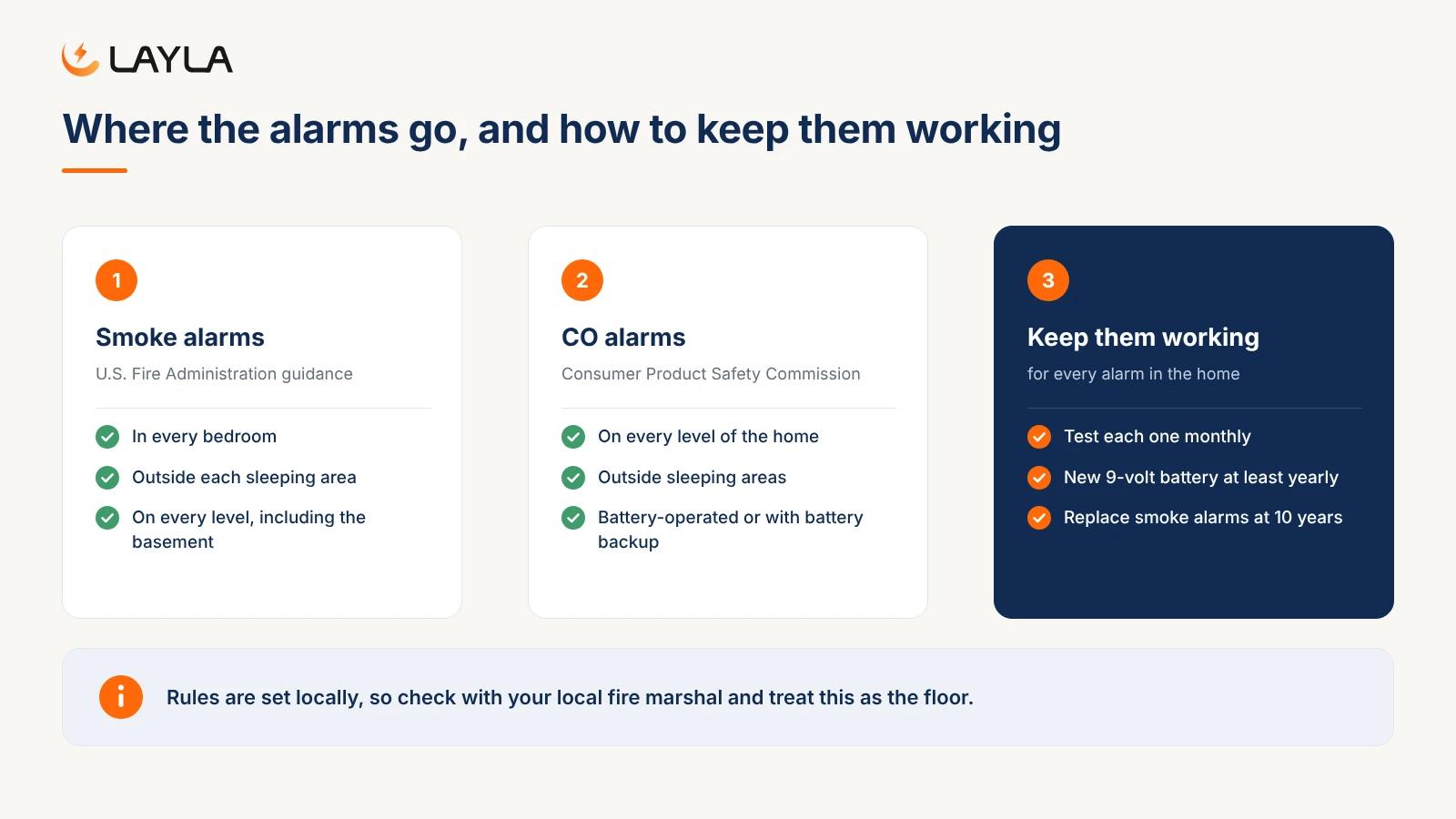
Rules on alarms are set locally, by your state, county or city, so the exact requirement depends on where the property is. The U.S. Fire Administration puts it plainly: "Your city, county or state may require a specific type of alarm. Please check with your local fire marshal" (USFA, Smoke Alarms, page last reviewed October 13, 2026, checked October 28, 2026). Treat the federal guidance below as the floor, then check your local code on top.
Smoke alarms. The USFA says installing smoke alarms "in every bedroom, outside each separate sleeping area, and on every level of a home — including the basement" is a precaution "all homeowners and landlords" need to take. It recommends interconnected alarms, "so that when one sounds, they all sound", and advises testing them monthly and replacing every alarm 10 years from its manufacture date. Battery-powered alarms with a 9-volt battery need a new battery at least once a year; hardwired alarms need their backup battery replaced yearly.
Carbon monoxide alarms. The CPSC advises installing "battery-operated CO alarms or CO alarms with battery backup on every level of the home and outside sleeping areas", says interconnected alarms are best, and recommends checking the batteries regularly. It also notes that "more than 200 people in the United States die every year from accidental non-fire related CO poisoning" (CPSC, Carbon Monoxide Information Center, checked October 28, 2026). Whatever your local code says, every rental with fuel-burning appliances needs a working CO alarm, whether that's a gas boiler, a gas stove, a fireplace, a wood stove or an oil furnace. If your rental has a generator for outages, the same page says never to run it inside a home or garage, and to keep it at least 20 feet from the house with the exhaust facing away.
Guests can't check any of this for themselves, so making sure every alarm works is on you.
The checklist, area by area
Print this, or copy it into whatever your cleaners already use. "Each turnover" means between every pair of stays.
| Area | What to check | How often |
|---|---|---|
| Every bedroom | Smoke alarm inside the room, tested; window opens; a clear route to the door | Test monthly; route each turnover |
| Hallways outside sleeping areas | Smoke alarm and CO alarm; night light or lit path | Test monthly |
| Every level, including basement | At least one smoke alarm and one CO alarm | Test monthly; replace smoke alarms at 10 years |
| Kitchen | Fire extinguisher mounted and in date; fire blanket; no frayed cords; stove knobs and hood working | Visual each turnover; extinguisher per its label |
| Bathrooms | Non-slip mat; extractor fan working; no standing water; hot water not scalding at the tap | Each turnover |
| Living areas | No trailing cables; furniture and TVs anchored where children may stay; noise and occupancy monitor in place and disclosed | Each turnover |
| Entry and exits | Exits unblocked; lock works from inside without a key; door codes reset | Each turnover |
| Stairs, decks and balconies | Handrails solid; no loose boards; outdoor lighting working | Monthly; after storms |
| Pool or hot tub (if any) | Gate self-closes and latches; cover in place; any pool requests written into the listing | Each turnover |
| Utilities | Gas appliances and water heater serviced; stopcock and fuse box labelled; generator (if any) stored outdoors | Service yearly; labels once |
| Guest information | Emergency sheet with the full address, local emergency number, nearest hospital, your contact and the local contact | Check yearly and when anything changes |
| First aid | Stocked kit in a known place, listed on the emergency sheet | Restock each turnover |
The living-areas row assumes a monitor is already in place. If it isn't, All-in-One, $299 once is the single-sensor option that covers noise, occupancy, smoke and humidity; the monitoring section below explains why each one counts as safety.
Two of those rows deserve a word. The emergency sheet sounds trivial until a guest is on the phone to an operator and doesn't know the street name. Put the full address on it, in large type, on the fridge. And the lock that works from inside without a key matters more than it seems — in a fire, nobody should be hunting for a key to get out.
Rules guests need to follow belong in the House rules and requests section of your listing. Airbnb's new house-rules policy, which takes effect November 20, 2026, says you "shouldn't write additional rules elsewhere on your listing, in messages, or on signs in your home" (Airbnb, Important changes to house rules, October 20, 2026). "Smoking, vaping, and e-cigarettes" and maximum overnight guests are among its seven standard rules, and guests are required to follow those. Something like candles or pool use goes in as a reasonable request, which guests are encouraged to follow, and only a broken rule lets you cancel without fees (Airbnb, article 472; both pages checked October 28, 2026). A welcome book is for the practical side, like the Wi-Fi, the appliances and who to call, and it points guests back to the house rules in the listing. Our vacation rental house rules template has wording that fits that structure.
The monitoring layer: what guests do
Alarms protect guests from the building. The other half of safety is protecting the building, the neighbours and the next guest from what happens during a stay. The monitoring layer is the set of sensors that report what is happening inside during a stay, as opposed to alarms that react to fire or gas. Four signals are worth watching, and each belongs on a safety checklist as much as on a nuisance list.
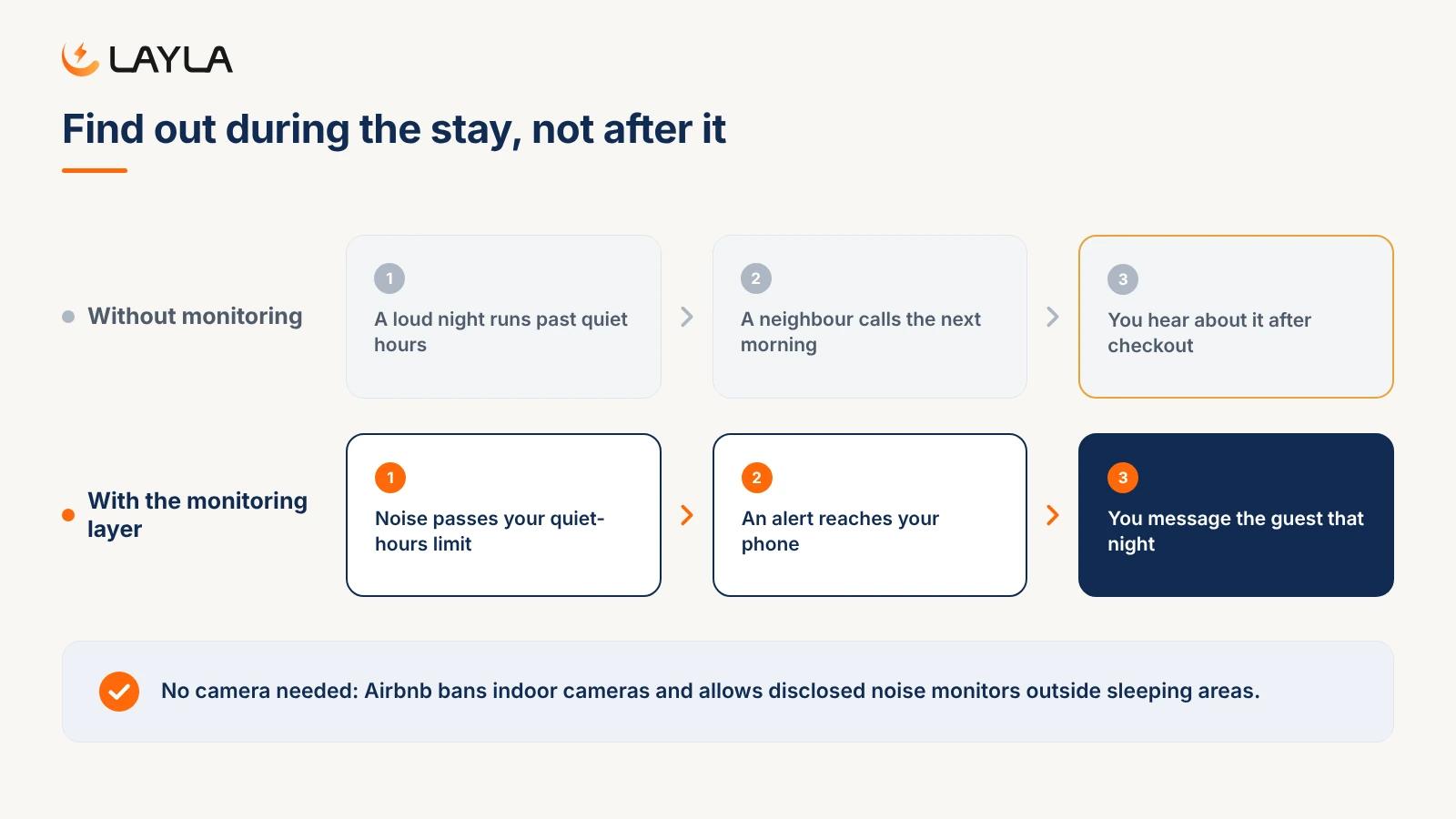
Noise. Set quiet hours in your listing, then find out when they're broken while it's happening rather than from a neighbour the next morning. If a late night gets loud, that's the moment to message the guest, not after checkout.
Occupancy. Your guest cap is also an evacuation number, because it sets how many people have to get out of the house quickly. Twelve people in a home sized for six means blocked hallways and a crowded stairwell. Knowing how many people are inside, without a camera, is the safety check you can't do in person.
Smoking and vaping. Your smoke alarms are there for fire. The monitoring layer is for the smoking itself. If your listing's smoking rule says no smoking or vaping inside, you want to know when it's broken while you can still talk to the guest, not when the next one walks in.
Humidity. Above 60% for long stretches, mold becomes a real risk, and mold is a health issue for guests with asthma or allergies. The EPA's advice is to keep indoor humidity "below 60 percent (ideally between 30 and 50 percent)" (EPA, mold and moisture guide, last updated February 18, 2026, checked October 28, 2026).
None of these needs a camera, and under Airbnb's rules indoor cameras aren't an option anyway. Airbnb allows noise decibel monitors inside the home as long as you disclose them and keep them out of bedrooms, bathrooms and sleeping areas; other smart home devices are encouraged, but not required, to be disclosed (Airbnb, article 3061, checked October 28, 2026).
The simplest way to cover all four at once is one camera-free sensor per key room. All-in-One turns on every signal in this section: noise and quiet hours, radar occupancy, smoke detection, humidity and mold risk, plus AC control, with no subscription. Only need smoke? Smoke & Air Quality, $99 once.
Between stays and over the year
A checklist works when it's tied to a calendar, not a memory. Split it three ways.
- Each turnover: exits clear, door codes reset, first-aid kit restocked, pool gate checked, a quick look at the alarms' indicator lights.
- Monthly: press the test button on every smoke and CO alarm; walk the stairs, decks and handrails.
- Yearly: service the gas appliances and water heater; replace 9-volt alarm batteries; check the manufacture date on every smoke alarm and replace any at 10 years; reread your local fire code in case it changed.
Empty weeks bring their own risks: frozen pipes, failed AC, humidity building behind closed windows. Our guide on how to protect a vacant rental property between stays covers that side. And if you run the place from another city, the monthly tests have to be someone's job; managing a vacation rental remotely shows how to hand them off.
One sensor for the monitoring layer: All-in-One
Once the alarms are in and tested, the remaining safety questions are about the stay itself. Is the house louder than it should be at 1 a.m.? Are there more people inside than the booking says? Is someone smoking or vaping in the living room? Is one room creeping toward mold weather?
All-in-One answers all four from the same small device. Noise is read as a decibel level only, with stricter limits overnight. Radar presence sensing counts people without an image or recording, and the AI party detector flags when the number of people, the noise level and the time of night add up to a party. Smoke detection picks up even faint traces and tells cigarette, vape and cannabis apart, with alerts at a threshold you set. Humidity and temperature feed a mold-risk early warning once the sensor has about three weeks of readings. Eco Mode turns the AC down when rooms are empty. One sensor covers one room, and most hosts put two or three in the main living areas.
It's a one-time purchase, $299, with 180 days of history and incident reports for the times you need to show a platform or a neighbour what happened.
FAQ
What should be on a vacation rental safety checklist?
Working smoke alarms in every bedroom, outside each sleeping area and on every level; CO alarms on every level and outside sleeping areas; a fire extinguisher and first-aid kit; clear exits and locks that open from inside without a key; safe stairs, decks and pool gates; and an emergency sheet with the full address and local contacts.
Do short-term rentals need smoke and carbon monoxide alarms?
The exact rule depends on your state, county or city, and the USFA advises checking with your local fire marshal. Its guidance is smoke alarms in every bedroom, outside each separate sleeping area and on every level. The CPSC advises CO alarms on every level of the home and outside sleeping areas. Any rental with fuel-burning appliances needs a working CO alarm.
How often should I test the smoke alarms in my rental?
The U.S. Fire Administration says to test smoke alarms monthly. Replace 9-volt batteries at least once a year, replace the backup battery in hardwired alarms yearly, and replace the whole alarm 10 years from its manufacture date. In a rental, make the monthly test a named person's job, with the date logged, rather than relying on guests.
Where should a CO alarm go in a vacation rental?
The CPSC recommends battery-operated CO alarms, or CO alarms with battery backup, on every level of the home and outside sleeping areas, and says interconnected alarms are best so they all sound together. As a host, treat a working CO alarm as non-negotiable in any rental with a gas boiler, gas stove, fireplace or oil furnace.
How can hosts monitor guest safety without cameras?
Use sensors that read signals rather than images. A decibel-only noise monitor shows when the house gets too loud, radar occupancy counts how many people are inside, smoke detection flags cigarettes or vaping, and humidity tracking warns of mold risk. Airbnb allows disclosed noise monitors outside bedrooms, bathrooms and sleeping areas, and bans indoor cameras.

Best for: full property coverage
All-in-One
Noise monitoring, smoke detection and smart AC control for complete coverage.
Everything included
Everything in Noise & Security Pro
AI party detector, noise alerts, intruder & break-in, occupancy, 180-day history, indoor + outdoor climate
Everything in Smoke & Air Quality
Air quality index (IAQ), CO2, bVOC, mold & smoke — full indoor + outdoor climate
Everything in AC Control & Energy
Smart AC (150+ brands), Eco Mode, schedules, filter health
Plus exclusive
- Advanced reports & insights
- Priority support
- Priority support
No monthly fees. Ever.
One sensor. Full coverage
One sensor. Full coverage.* Layla 3.0 monitors noise, air quality, motion, occupancy, temperature, humidity, pressure, VOCs, CO2, and controls your AC - from a single device on your shelf.
No subscription means no surprise costs.
Pay once. Every feature unlocked. Forever. No monthly fees eating into your rental margins or household budget.
The smartest buy is the one you make once.
Other solutions charge per-feature monthly subscriptions that exceed the device cost within a year. Layla's all-in-one pays for itself compared to any subscription alternative.
30-day money back guarantee