BLOG
How to protect a vacant rental property between stays
 By Nangyal Khan··Updated
11 min read
Last updated: October 28, 2026
Between one guest's checkout and the next guest's arrival, a vacant rental property has nobody inside to notice a problem. Protecting it comes down to five habits. Reset the door code after every stay. Walk through and lock every entry. Leave the heating or cooling on at safe settings (the Red Cross says no lower than 55°F in cold weather). Keep indoor humidity under 60%, as the EPA advises. And have a way to know, from wherever you are, if someone walks in or the temperature drifts. Below are six risks worth planning for, followed by a checklist you can hand to your cleaner.
The six risks of an empty rental
An empty rental isn't empty in the way your own home is when you go to work. Its codes have been shared with strangers, its address is public on a listing, and it can sit unwatched for a week in the off-season. These are the risks worth planning for.
Break-ins and theft. A dark house with no car in the drive for days is easy to read. In a furnished rental, the smart TV, the speakers and the bikes all sit in plain view.
Unauthorised entry. The person who walks in doesn't have to be a stranger with a crowbar. It can be the last guest who kept the door code, a friend of a contractor who knows the lockbox, or someone who books one night and then comes back the next. If your codes don't change between stays, the house is only as secure as the least careful person who ever had them.
After-checkout parties. A close cousin of the above: a guest checks out on Saturday morning, the code still works, and the house fills up that night with nobody booked in. You hear about it from a neighbour on Sunday.
Leaks and burst pipes. A dripping supply hose under a sink becomes a ruined floor if nobody looks for six days. In winter, a heating failure puts the pipes at risk of freezing, which is why the Red Cross tells anyone going away in cold weather to leave the heat on.
HVAC failures. An air conditioner that dies in July or a boiler that trips in January means a repair bill. If nobody notices in time, it also means the next guest walks into a 90°F flat, and that becomes a review.
Humidity and mold. Closed windows and no airflow let moisture build up. The EPA says to keep indoor humidity "below 60 percent (ideally between 30 and 50 percent)" and to dry anything that gets wet "within 24-48 hours to prevent mold growth" (EPA, A Brief Guide to Mold, Moisture and Your Home, last updated February 18, 2026, checked October 28, 2026).
| Risk | What it looks like | How to prevent it | What remote monitoring shows |
|---|---|---|---|
| Break-in | Forced entry, missing electronics | Lock and check every entry; lights on timers; no valuables on show | Movement and people in a house that should be empty |
| Unauthorised entry | Old code reused, someone "just dropping by" | New code for every booking | Occupancy when no stay is booked |
| After-checkout party | Noise and a full house the night after checkout | Code expires at checkout time | Occupancy plus noise outside a booking |
| Leak or burst pipe | Water on floors, damp walls | Check under sinks and behind the toilet; know where the stopcock is | An alert from a separate water-leak sensor |
| HVAC failure | Room far too hot or cold | Annual service; thermostat left at safe settings | Indoor temperature drifting out of range |
| Humidity and mold | Musty smell, condensation, spots | Keep humidity under 60%; ventilate after cleaning | Humidity trend; mold-risk warning on air plans |
The right-hand column is what a monitor in the house can tell you. Noise & Security Pro ($179 once) covers the occupancy, noise and temperature rows, and its vacant-home alerts are built for the first three.
The between-stays checklist
Give this to whoever turns the property over, and ask them to send a photo or a quick "done" for the items marked with an asterisk. The photos are there so you hear about a problem on Tuesday rather than when the Friday guest arrives.
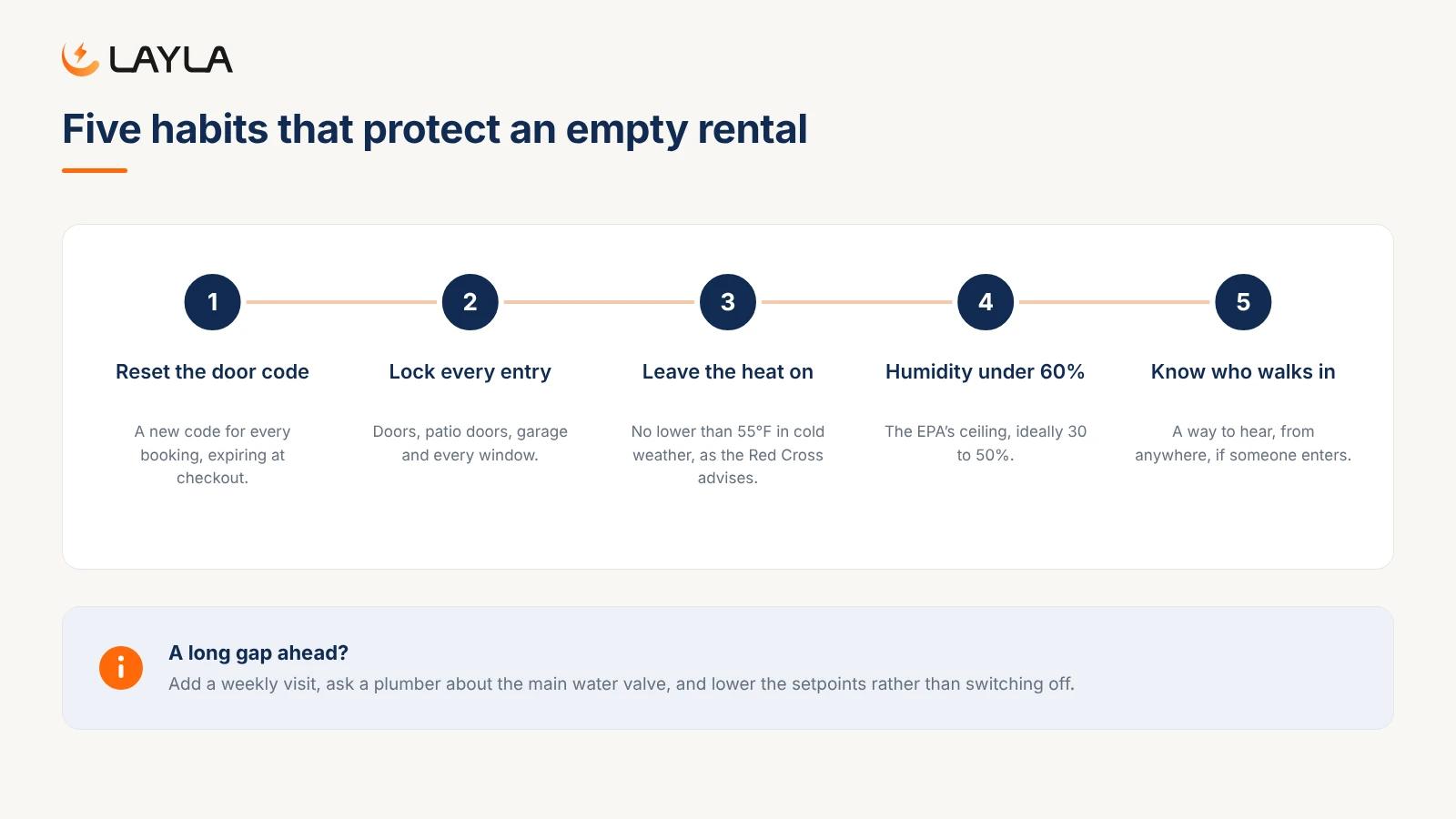
- Change the door code*. Every booking gets its own code, set to start at check-in and expire at checkout. If your smart lock can't schedule codes, change it manually as part of the turnover.
- Walk every entry*. Front and back doors, patio doors, garage, every window, including the small bathroom one guests open and forget.
- Set the climate*. In cold weather, leave the heat on and no lower than 55°F, the Red Cross's advice for anyone going away (American Red Cross, frozen pipes, checked October 28, 2026). In hot, humid weather, don't switch the AC fully off; a higher setpoint or a dehumidify mode keeps moisture down.
- Look for water. Under the kitchen and bathroom sinks, around the toilet base, behind the washing machine. Feel the floor by the dishwasher.
- Check humidity. A reading over 60% in an empty home is your cue to ventilate or run the dehumidifier.
- Test the smoke and CO alarms. Press the test button on each one. Our vacation rental safety checklist covers where each should be and how often to replace them.
- Make the house look lived-in. Lights on timers, blinds at half rather than fully shut, packages and flyers off the doorstep.
- Put valuables away. Lock the owner's closet. Anything you'd hate to lose shouldn't be on display between stays.
- Take the trash out. Bins left full for a week attract pests and tell everyone the house is empty.
- Confirm the local contact. Someone within 30 minutes who has a key and knows they might get a call.
In your Airbnb listing, turn on the standard "Lock up at checkout" rule, and add a short note in the same "House rules and requests" section that the door code stops working at checkout time. Airbnb launched its seven standard rules on October 20, 2026, and the new policy takes effect on November 20. Guests have to follow those rules. Anything beyond them is a reasonable request that guests are encouraged to follow, and all of it lives in the listing rather than in messages or on signs. A vacation rental house rules template gives you wording you can paste straight in.
What remote monitoring catches
Most of the risks above share one problem: by the time you find out, the damage is done. Remote monitoring shortens that gap, and each signal tells you something different about an empty house.
Occupancy. The most useful single fact about a vacant rental is whether anyone is inside it. A radar presence sensor counts people without a camera, so you can use it in living areas without filming anyone. If it shows two people at 11 p.m. on a night with no booking, you know before any damage is visible.
Noise. A decibel reading on its own won't spot a quiet intruder. Combined with occupancy, it's how you spot a house that has turned into a party with nobody booked in.
Temperature. A room that climbs to 88°F in summer tells you the AC has failed. One that falls toward freezing in winter tells you the heating has. You can't stop the failure from far away, but you can send someone before the next guest arrives.
Humidity. A steady climb in one room tells you moisture is building up there, for example when the windows stay shut. On plans that include air quality, the trend feeds a mold-risk warning, which needs about three weeks of readings to settle.
For the occupancy, noise and climate side, Noise & Security Pro covers it from one camera-free sensor with no subscription: noise monitoring, AI occupancy detection, radar intruder and vacant-home alerts, indoor and outdoor temperature and humidity, and 180 days of history. If mold is your bigger worry, the mold-risk early warning sits in Smoke & Air Quality ($99 once) and in All-in-One ($299 once), which also adds Eco Mode for the AC between stays.
One sensor covers one room, and most hosts use two or three in key areas, usually the living room and common spaces. For water, add a separate leak sensor under the sink that worries you most.
Longer gaps: off-season and owner breaks
Two days between guests is one thing. Six weeks in February is another. For long gaps, add three things to the checklist above.
- A weekly visit. Run every tap for a minute, flush toilets, check the fridge and freezer, open the post. Have the person send a photo of the thermostat.
- A shut-off decision. In freezing climates, closing the main water valve and draining the lines is one option for a long empty spell. Ask a local plumber whether your system suits it.
- Lower setpoints, not off. Keep the heat at a safe minimum, no lower than the Red Cross's 55°F, and keep humidity under control.
If you're running the place from another city, this all fits inside a bigger system of cleaners, codes and messages. Our guide on how to manage a vacation rental remotely walks through a full week of it.
Vacant-home alerts: knowing the house is still empty
Everything above reduces the odds of a problem. None of it tells you, at 1 a.m. on a Wednesday, that someone has just walked into a house that should be empty. That's what vacant-home alerts are for. A vacant-home alert is a notification sent the moment a sensor picks up people or movement in a property that should be empty.
On Noise & Security Pro and All-in-One, you switch on radar movement detection when the property is between stays. If the sensor picks up movement or people while it's armed, you get an alert straight away, with no camera involved and nothing recorded. You can then check the live occupancy reading, call your local contact, or call the police if it's a break-in. When the next guest checks in, you switch it off again, and the same sensor goes back to watching noise, occupancy and quiet hours for the stay.
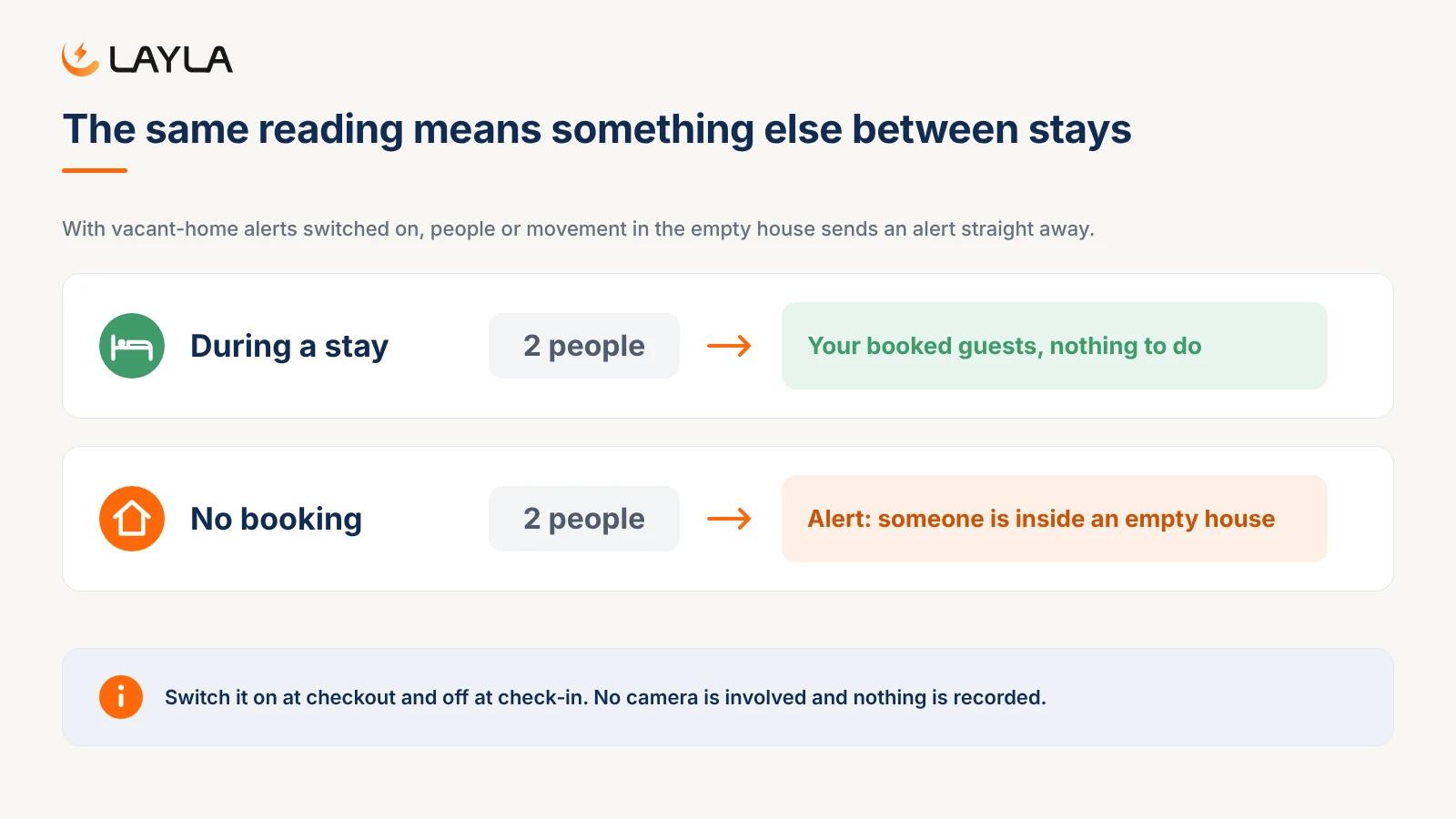
It's a small thing — and also the difference between hearing about an after-checkout party on Sunday from a neighbour and hearing about it on Saturday night from your phone.
FAQ
How do you protect a vacant rental property?
Change the door code after every stay, check every door and window, and leave the heating on no lower than 55°F in cold weather. Keep indoor humidity under 60%, make the house look lived-in with lights on timers, and have a local contact with a key. Remote occupancy, noise and climate monitoring tells you when something changes while nobody is there.
What are the biggest risks for a vacant rental property?
Six are worth planning for: break-ins, unauthorised entry by someone who kept an old code, parties after checkout, leaks and burst pipes, heating or AC failure, and humidity that leads to mold. Unauthorised entry deserves extra care, because door codes and lockbox combinations pass through many hands over a year of bookings.
How can I monitor an empty rental remotely?
Use a sensor that reports occupancy, noise, temperature and humidity to your phone. Occupancy tells you if anyone is inside, noise plus occupancy flags a party, temperature shows a failed heater or AC, and rising humidity shows moisture building up and a higher mold risk. Radar-based occupancy works without cameras, so it can sit in living areas.
What should I check between guests at a short-term rental?
Reset the door code, check every entry, set the thermostat to safe levels, look under sinks and around toilets for water, check humidity, and test the smoke and CO alarms. Then put valuables away, take the trash out, and confirm your local contact is available. Ask your cleaner to confirm the code, entries and climate settings each turnover.
Should I turn the AC off when my rental is empty?
Not fully, in a humid climate. With the AC off and windows shut, indoor humidity can rise above the 60% the EPA recommends staying under, which raises the risk of mold. A higher setpoint, a dehumidify mode, or automation that turns the AC down when rooms are empty is safer than switching it off for days.

Best for: serious hosts
Noise Pro
Compliant with Airbnb's rules and local noise laws worldwide. Advanced protection for serious hosts.
Included forever – no subscription
- AI party detector
- Instant noise alerts with timestamps
- Live data feed, no 5-minute delay
- 180-day data history
- Radar intruder & vacant-home alerts
- Property status dashboard
- Outdoor temperature & humidity
- Automatic AI accuracy updates
- Daily & weekly summary reports by email
No monthly fees. Ever.
Your indoor air is 2-5x more polluted than outdoor air.
The EPA confirms it, but most people have no idea. You spend 90% of your time indoors breathing air you've never measured.
CO2 builds up silently.
A bedroom with two people can hit 2,500 ppm overnight. Harvard research shows decision-making drops 50% at 1,400 ppm. That brain fog and morning fatigue? It might not be bad sleep - it's bad air.
VOCs are off-gassing in every room.
New furniture, carpets, paint, cleaning products indoor VOC levels run up to 10x higher than outdoors. Some, like formaldehyde and benzene, are classified carcinogens. You can't smell most of them.
Mold starts in 24 hours.
When humidity exceeds 60%, mold begins colonizing within a day. 47% of U.S. homes show visible mold. Average remediation cost: $2,368 severe cases hit $30,000. A sensor that warns you before mold starts is orders of magnitude cheaper than cleanup.
Standard smoke detectors only catch fires.
They don't detect cigarette, vape, or marijuana smoke at low levels. For landlords and hosts, unauthorized smoking causes damage that goes unnoticed for weeks.
Post-COVID, people want data.
66% of Americans are more cautious about indoor air since the pandemic. 61% say they'd trust a space more if it monitored air quality. The awareness shift is permanent.
30-day money back guarantee