BLOG
Spring Break Airbnb Party: How Hosts Stop It Before the Neighbors Call
 By Nangyal Khan·
7 min read
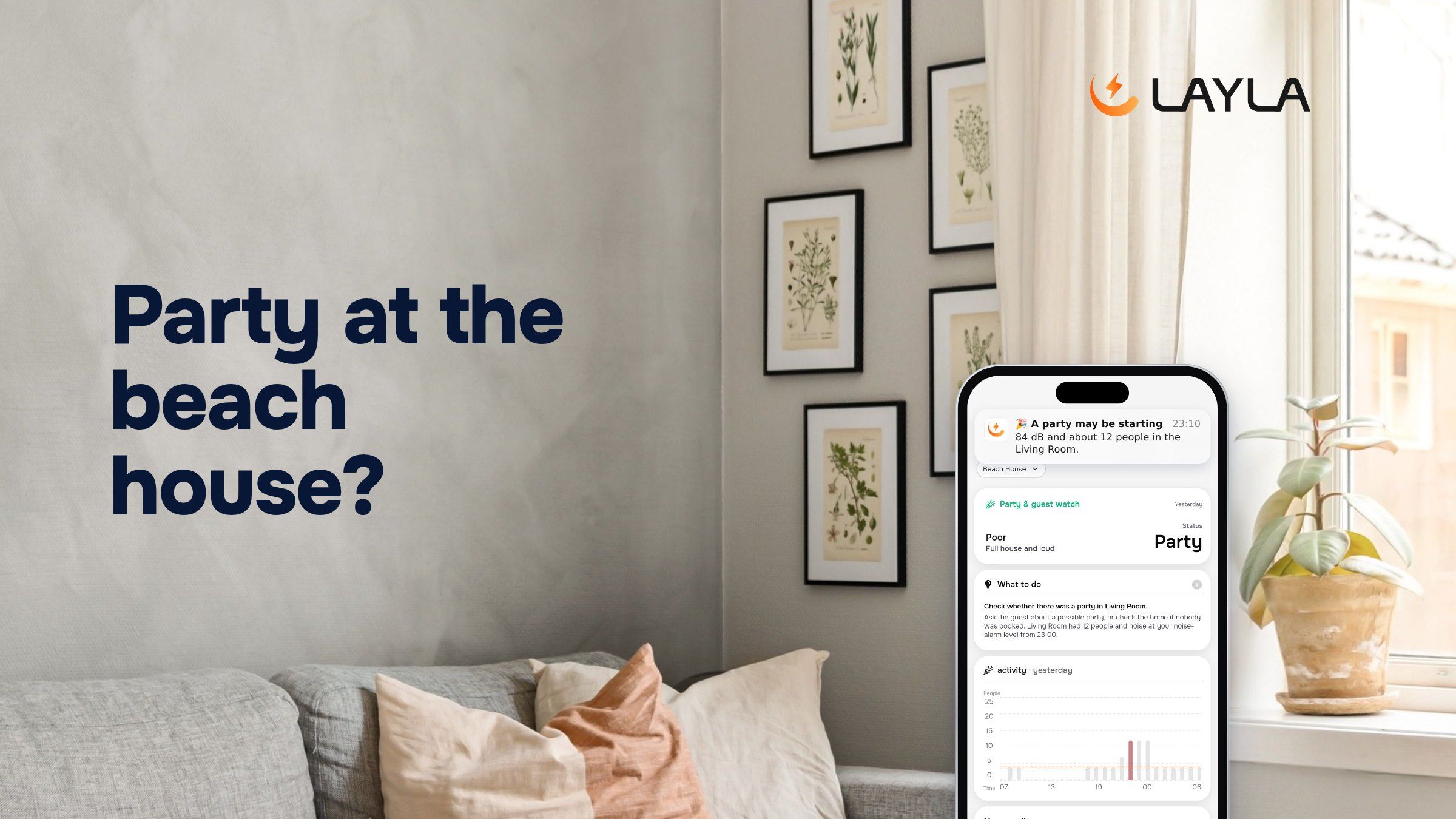
To stop a spring break party at your beach rental, put a maximum overnight guest count and quiet hours in your house rules. Then get an alert the moment either one is broken. Layla alerts you when more people are inside than your listing allows, and when it gets too loud. You can message the guests before the music takes over and before the neighbors call. This guide is for hosts who take spring break bookings, not for guests looking for a party house.
See how Layla's Noise & Security Pro alerts you to parties and extra guests
What makes spring break bookings different for a beach rental?
A group books a week by the beach. Six names are on the booking. By the second evening, friends from the next rental and the bar down the street are on their way over.
Airbnb made its party ban official on 28 Jun 2022. Disruptive parties and events, including open-invite gatherings, are not allowed, and guests who try to break the ban face anything from account suspension to removal from the platform (Airbnb's newsroom, checked 15 Nov 2026). But the ban does not stop a group from arriving. When the noise starts, the neighbors do not call Airbnb. They call you, or the city. So you need to know first.
Which house rules and guest limit stop a spring break party?
Airbnb advises hosts to use house rules to set the maximum number of overnight guests and quiet hours (Airbnb's tips to help prevent parties at your property, checked 15 Nov 2026). Write both as plain numbers, such as "6 guests overnight" and "quiet hours 22:00 to 07:00". A party is then a clear breach of the rules the guests agreed to, not a matter of opinion. For the booking itself, see how to screen guests and spot a party booking on Airbnb.
Say in your listing that you use a noise monitor. Airbnb allows noise decibel monitors indoors when they are disclosed in the listing, and never in bedrooms, bathrooms or sleeping areas (Airbnb's Help Center article on devices, checked 15 Nov 2026). Put Layla in the living room, where groups gather.
Then give Layla the same guest limit you wrote in the listing. Layla tells you how many people are inside, and when more people are inside than the home allows, it sends you a crowd alert. Your alert then matches your own house rules.
Which alert comes first, people or noise?
Usually people. A crowd is often inside before the music gets loud, so the crowd alert tends to reach you first.
Picture a beach house with a guest limit of 6. Six guests checked in, and from 20:30 more people arrive. At 21:40, Layla shows 9 people inside, while the noise is still only 58 dB. That is well under the 70 dB where a Strict noise alert starts. The crowd alert has already told you that 9 people are in a home booked for 6, before the noise would have set off any alert.
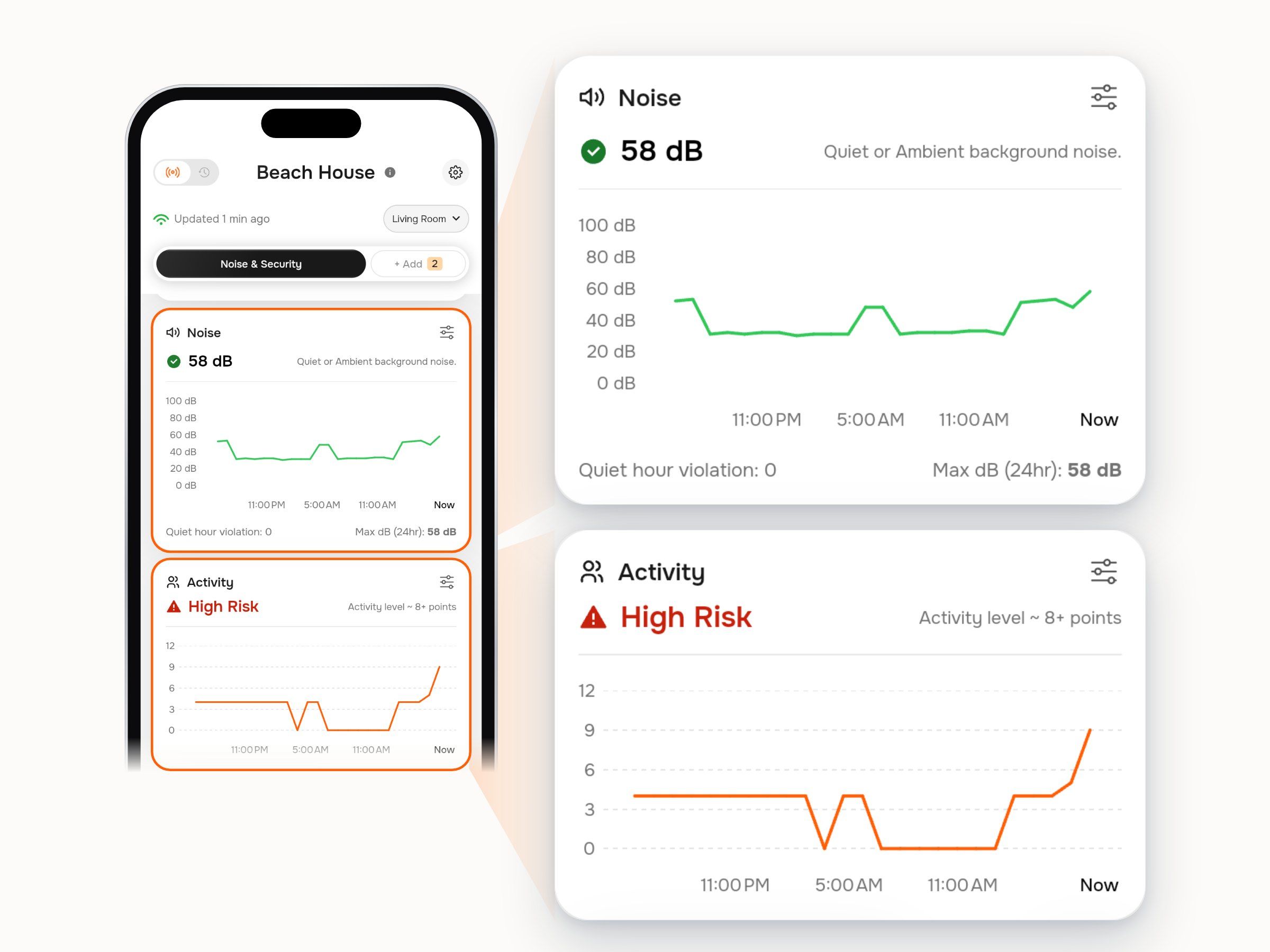
Layla at 21:40: 9 people inside while the noise is still 58 dB
Noise alerts come next, once it stays loud. On Noise & Security Pro, the AI Party Detector alerts you when noise and a crowd build at the same time, and the alert says how loud it is and about how many people are inside. At this beach house, that alert came at 23:10: 84 dB and about 12 people in the living room. Layla alerts you, and you decide what to do.
Which noise setting fits a spring break week?
Choose Strict for spring break. Strict alerts you when noise stays at 70 dB for 1 minute. Balanced (70 dB for 5 minutes) and Relaxed (85 dB for 10 minutes) suit quieter weeks, like a family booking in June.
Then set a night limit for your quiet hours. It can be anywhere from 65 to 75 dB. For a week with house rules that say quiet from 22:00 to 07:00, set those hours with a 65 dB night limit, the strictest one, so the evening's noise and the night's noise each have their own limit.
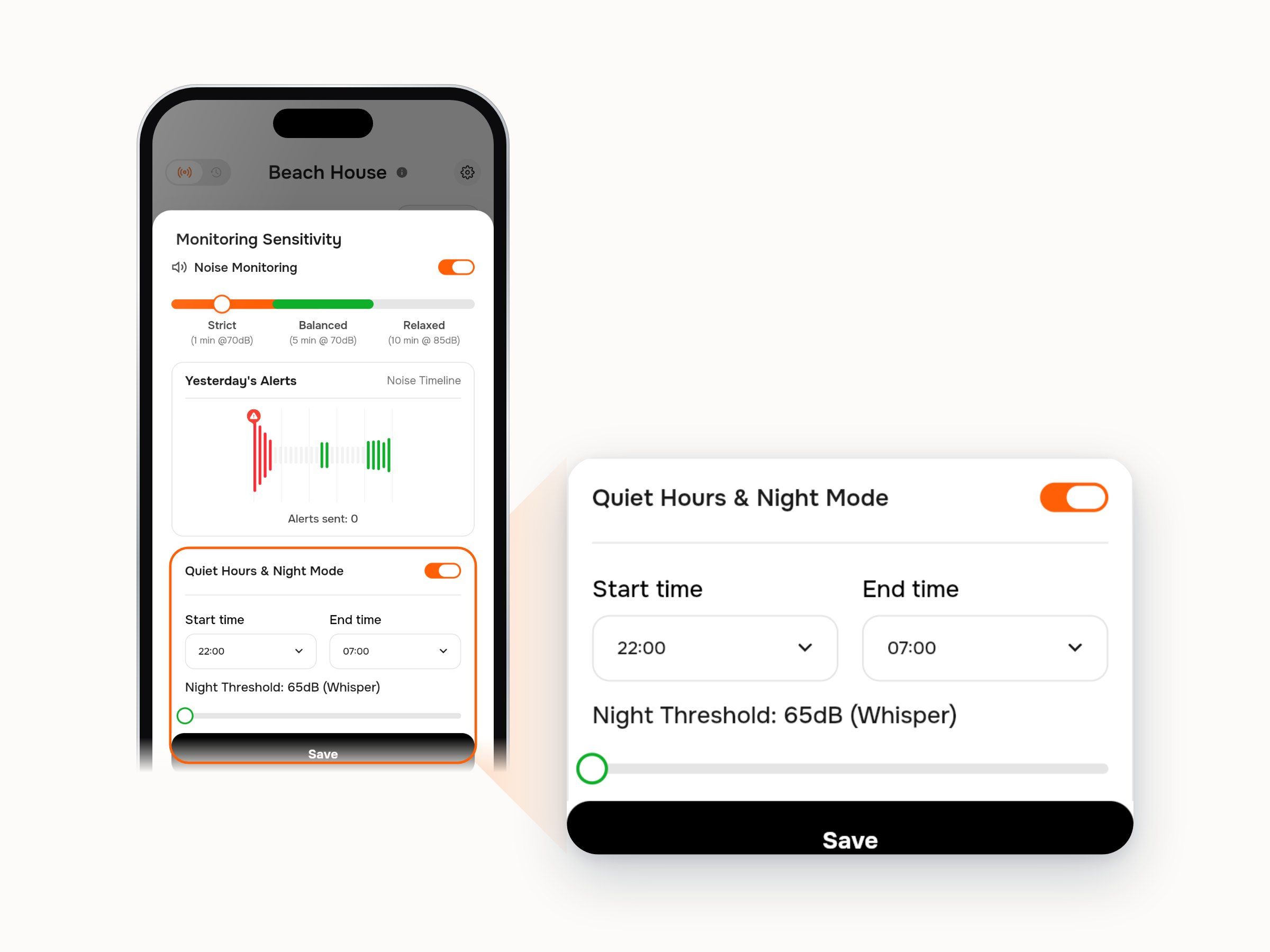
Layla's noise settings: Strict, with quiet hours from 22:00 to 07:00 at 65 dB
Both choices sit on the same noise settings sheet in the app. Layla measures noise in decibels, and no audio is recorded, so guests' conversations stay private.
What should you do when the alert comes in?
Act on the first alert, while it is still a few extra guests. Airbnb's advice is not to confront guests in person. Message them in the Airbnb Messages tab, remind them of the guest limit and quiet hours in your house rules, and contact Airbnb Support. If anyone is at risk, call emergency services first (Airbnb's tips to help prevent parties at your property, checked 15 Nov 2026).
Airbnb asks for evidence, such as texts from neighbors or noise monitor readings. On Noise & Security Pro, the next morning Party & guest watch shows yesterday's status, such as Party, with about how many people were inside and the hour noise went over your limit. You have the facts in hand when you write to Airbnb Support or reply to a neighbor.
What do $149 and $179 each give a beach host?
Noise Basic, new, is $149 once. It covers noise levels in decibels, quiet hours with a night limit, the people count and crowd alerts. For a host who only needs to know when it gets loud or too many people are inside, that is the start.
Noise & Security Pro is $179 once. It has everything in Basic and adds the AI Party Detector, the alert a spring break host most needs. It also adds radar security for when the home should be empty, live readings in real time (Basic updates every 5 minutes), and Party & guest watch the morning after. You also get charts for the last 30 days and incident reports for the last six months, where Basic keeps 7 days. That is $30 more for the party alert, security and the evidence the next morning.
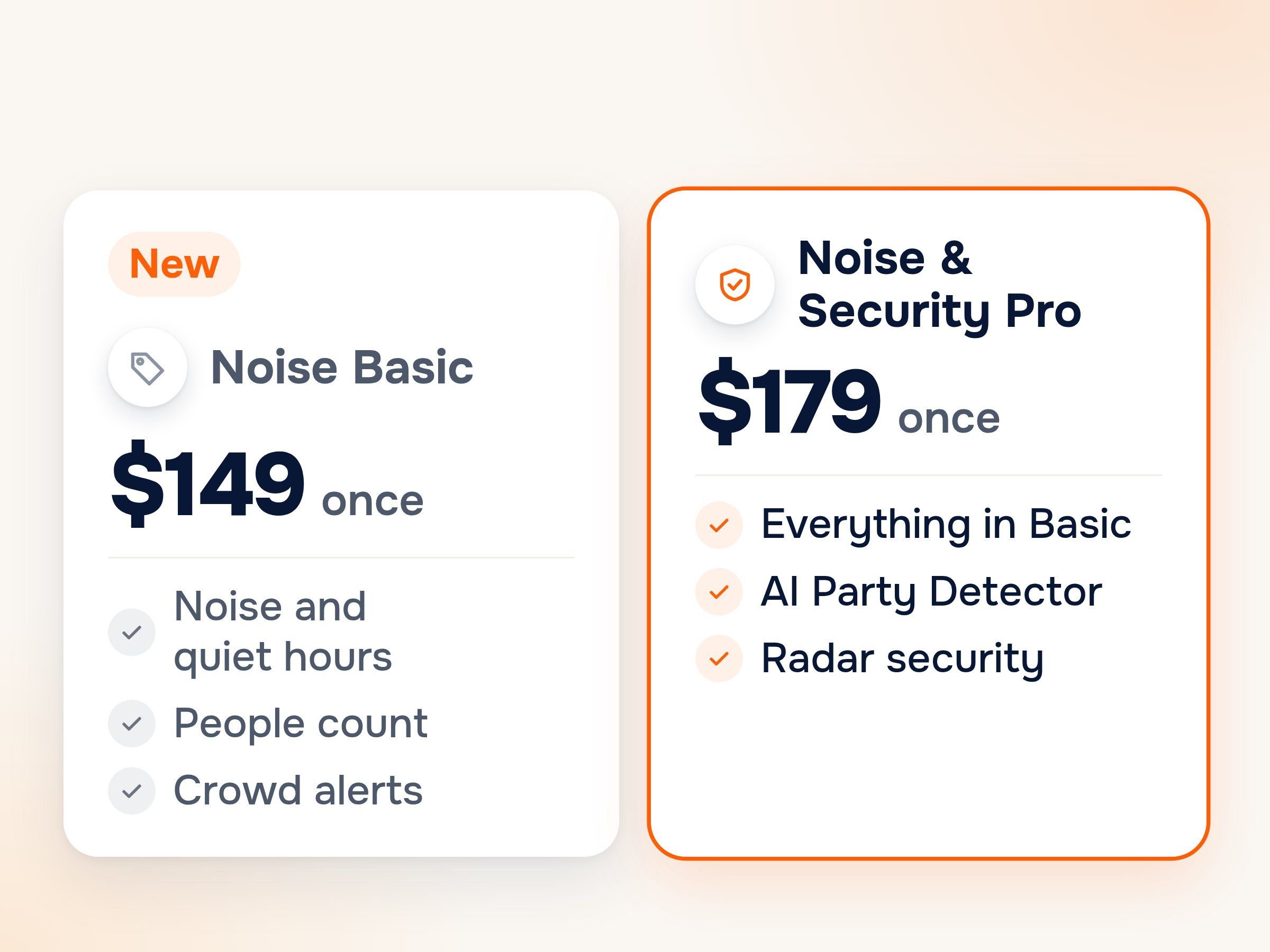
Layla Noise Basic at $149 and Noise & Security Pro at $179, each paid once
Both plans are paid once, with no subscription. Compare every plan on the Layla pricing page.
Will spring break guests also smoke or vape inside?
Groups that party often smoke or vape inside too, and noise and a people count will not tell you about it. Layla All-in-One, $299, is one sensor with the same smoke and vape detection as Smoke & Air Quality and the same noise and people count as Noise & Security Pro. When someone smokes or vapes, the alert tells you smoke was detected, with the time and the room.
How do you hear about the party before the neighbors do?
With the guest limit set and Strict noise alerts on, the first you hear of a party is Layla's alert on your phone, not the neighbor's call.
Get party and crowd alerts for your beach rental with Noise & Security Pro
Keep reading
- Quiet hours for vacation rentals: The usual quiet hours window, the house rule wording, and how to enforce it without a camera.
- How to catch extra guests in a short-term rental: How to tell when more guests are inside than you allowed, and what to do about it.
- How to detect cannabis smoke in a rental: Spring break groups smoke too: how to know when cannabis smoke shows up in your rental.

Best for: serious hosts
Noise Pro
Compliant with Airbnb's rules and local noise laws worldwide. Advanced protection for serious hosts.
Included forever – no subscription
- AI party detector
- Instant noise alerts with timestamps
- Live data feed, no 5-minute delay
- 180-day data history
- Radar intruder & vacant-home alerts
- Property status dashboard
- Outdoor temperature & humidity
- Automatic AI accuracy updates
- Daily & weekly summary reports by email
No monthly fees. Ever.
Your indoor air is 2-5x more polluted than outdoor air.
The EPA confirms it, but most people have no idea. You spend 90% of your time indoors breathing air you've never measured.
CO2 builds up silently.
A bedroom with two people can hit 2,500 ppm overnight. Harvard research shows decision-making drops 50% at 1,400 ppm. That brain fog and morning fatigue? It might not be bad sleep - it's bad air.
VOCs are off-gassing in every room.
New furniture, carpets, paint, cleaning products indoor VOC levels run up to 10x higher than outdoors. Some, like formaldehyde and benzene, are classified carcinogens. You can't smell most of them.
Mold starts in 24 hours.
When humidity exceeds 60%, mold begins colonizing within a day. 47% of U.S. homes show visible mold. Average remediation cost: $2,368 severe cases hit $30,000. A sensor that warns you before mold starts is orders of magnitude cheaper than cleanup.
Standard smoke detectors only catch fires.
They don't detect cigarette, vape, or marijuana smoke at low levels. For landlords and hosts, unauthorized smoking causes damage that goes unnoticed for weeks.
Post-COVID, people want data.
66% of Americans are more cautious about indoor air since the pandemic. 61% say they'd trust a space more if it monitored air quality. The awareness shift is permanent.
30-day money back guarantee