BLOG
Layla vs Eve Room: an Apple Home accessory, or a fuller monitor
 By Nangyal Khan··Updated
 7 min read
One fact decides most of this comparison. The Eve Room's air-quality reading is VOC only. It doesn't measure carbon dioxide, so a stale, badly ventilated room never registers as a problem. Layla, at about the same price, detects carbon dioxide alongside VOCs and humidity, and turns the lot into plain-language scores. The question is whether you want a well-integrated Apple accessory that reads one air signal, or a fuller monitor that reads several and explains them.
The Eve Room is still one of the tidiest sensors in the Apple Home world. It has a clean e-ink display, a rechargeable battery that lasts weeks, Thread support, and the deep HomeKit integration that lets your air trigger an automation with no cloud account. For an Apple household that wants air-driven automations, those are real strengths, and Layla doesn't try to match them. The catch is what its air reading actually covers, and whether you live inside Apple's ecosystem.
What the Eve Room measures
The Eve Room reports a VOC-based air-quality score, temperature and humidity, on a small e-ink display and in the Eve app or Apple Home. It uses Bluetooth and Thread, works through Apple HomeKit, and recharges over USB with a battery good for six weeks or more. There's no subscription, and data stays local in the HomeKit privacy model rather than in a vendor cloud. For nudging a fan or purifier when VOCs climb, it fits an Apple smart home beautifully, and it usually sells for around $100.
Two limits shape who it's for. The air reading is VOC only, so a stuffy, carbon-dioxide-heavy bedroom doesn't show up as an air-quality event at all. And it's an Apple device through and through: setup needs an iPhone or iPad, there's no Android, and remote use leans on a HomePod or Apple TV as a hub. For an all-Apple home none of that bites. Outside one, it rules the Eve Room out before the sensing even matters.
What Layla measures, and what it adds
Layla detects carbon dioxide, VOCs, temperature and humidity. On top of that it watches the humidity that precedes mould and recognises the signature of smoke so it can tell vaping from cannabis from a cigarette. Carbon dioxide is the big one the Eve Room skips, and it's the clearest read on ventilation a home can give. Layla scores it across the day.
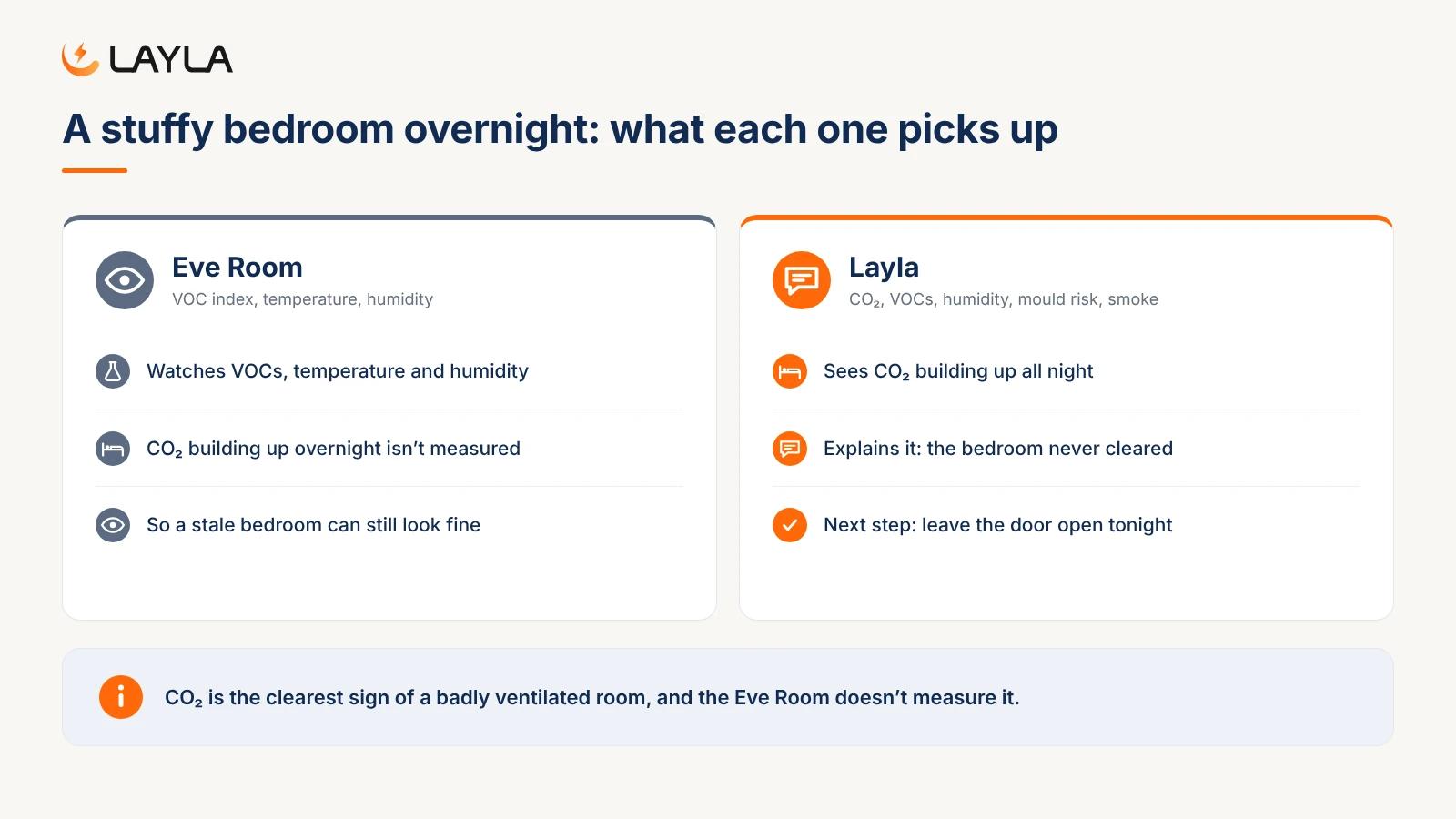
Instead of a single VOC index, each signal becomes a score with a plain line under it. The bedroom filled with carbon dioxide overnight, so leave the door open. Humidity has been drifting into the band where mould takes hold, so here's what to change. Our guides on CO2 levels in your home and VOCs in your home explain why carbon dioxide belongs alongside the VOCs the Eve Room tracks.
Layla also isn't tied to one phone. It works across platforms, keeps a running history, and messages you when something crosses a line, smoke included, flagged in seconds. For homes and rentals it reaches past air: the higher tiers add noise scoring and radar presence sensing, with no camera or microphone, and roll several rooms or properties into one view. The Eve Room is a single-home Apple accessory. Layla is built to watch a whole space and tell you about it wherever you are.
On its own ground the Eve Room still scores. Inside Apple Home its native automations and local-first privacy are cleaner than Layla's setup, and the e-ink display is the nicer thing to glance at. If HomeKit automation is the whole reason you're buying, that counts for a lot.
At a glance
| Layla (Air Quality) | Eve Room | |
|---|---|---|
| Air signals | CO2, VOC, temp, humidity, mold conditions, smoke signature ID | VOC index, temp, humidity |
| Measures CO2 | Yes | No |
| Reads as | Plain-language scores and what to do | VOC index and graphs |
| Ecosystem | Cross-platform, phone alerts | Apple HomeKit only (iPhone or iPad) |
| Display | App | E-ink screen |
| Beyond air | Noise and radar occupancy on higher tiers | Air only |
| Subscription | None | None |
| Price | From $99 one-time | Around $100 |
Which one is right for you
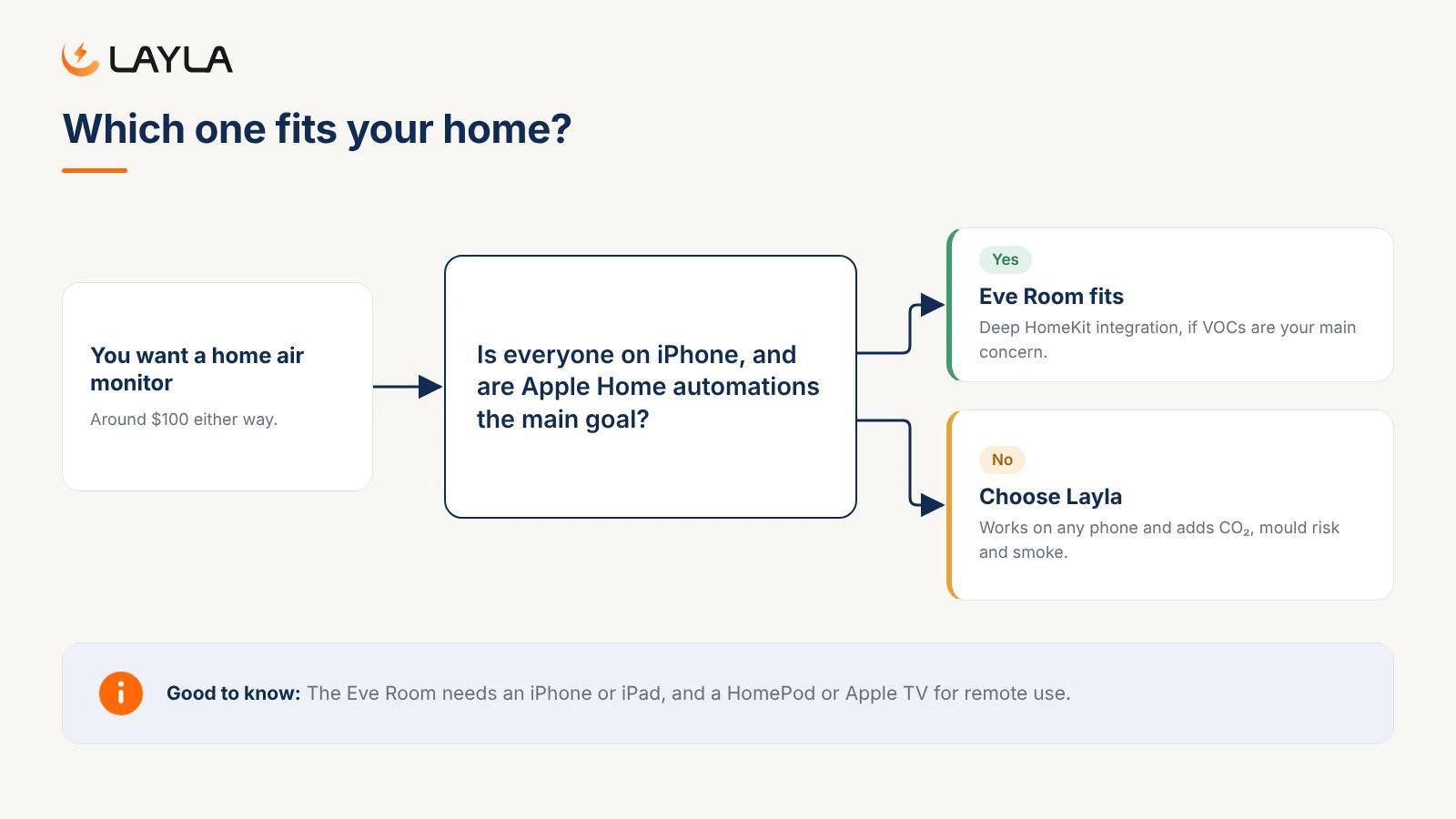
Buy the Eve Room if you're committed to Apple Home and want a privacy-first accessory that drives automations, with a nice display and no cloud account. If your air concern is mostly VOCs and you value tight HomeKit integration over breadth, it's a well-made fit. Just know the air reading is VOC only and the device won't serve a non-Apple household.
Buy Layla if you want your air read more fully and explained, whatever phone you carry. The Air Quality tier is $99 one-time, about the same as an Eve Room, and it adds the carbon dioxide the Eve Room doesn't measure, plus VOCs, humidity, mould-risk conditions and smoke, all scored with clear next steps and alerts that reach you when you're out. For homes and rentals, the higher pricing tiers add noise and presence sensing up to the $299 All-in-One, while the $99 tier covers the full air side. The complete picture is on the Layla air quality page. At the same price, you're choosing between one signal with deep Apple integration, and carbon dioxide, mould and smoke scored and cross-platform.
Mapping the category? Layla vs Airthings and the Awair Element alternative piece cover the rest.
Who each one suits
If your home already runs on Apple and your main worry is off-gassing from furniture, cleaning sprays or fresh paint, the Eve Room reads VOCs cleanly and can drive a HomeKit purifier on its own. That reader is well served.
If you want to know why a bedroom feels stuffy by morning, the picture changes. Stuffiness is carbon dioxide, which the Eve Room doesn't measure. Layla scores it overnight and tells you to crack the door, and it does the same for mould risk and smoke, on whatever phone you carry.
Frequently asked questions
Is Layla a good Eve Room alternative?
Yes, especially if you want more than VOCs or you're not tied to Apple Home. For about the same $99 one-time, Layla adds carbon dioxide, mould-risk conditions and smoke, scores everything, and works across platforms. The Eve Room is the better choice only if deep Apple HomeKit automation is your main aim.
Does the Eve Room measure carbon dioxide?
No. Its air-quality reading is VOC only, with temperature and humidity. Layla detects carbon dioxide and scores it for ventilation across the day.
Does Layla work without an iPhone?
Yes. Layla is cross-platform and isn't tied to Apple Home. The Eve Room needs an iPhone or iPad, plus a HomePod or Apple TV for remote use.
Do either require a subscription?
No. Layla's Air Quality tier is $99 one-time, and the Eve Room has no recurring fee.
Can Layla detect smoke and mold risk?
Yes. It recognises the signature of smoke, telling vaping from cannabis from a cigarette, and alerts fast, and it warns about the humidity conditions that lead to mould before it shows. The Eve Room does neither.
Is the Eve Room worth it?
Inside an Apple Home, for VOC-driven automations, it's a tidy, well-built sensor with a nice display. If you want carbon dioxide, mould and smoke covered too, or you're not on Apple, Layla does more for about the same price.
Does the Eve Room work with Android?
No. The Eve Room needs an iPhone or iPad, and remote use leans on a HomePod or Apple TV. Layla is cross-platform and works whatever phone you carry.
Why does carbon dioxide matter if the Eve Room skips it?
Carbon dioxide is the clearest sign a room is poorly ventilated, which is what makes a sealed bedroom feel stuffy and hurts sleep. A VOC-only monitor misses that entirely. Layla scores carbon dioxide across the day.
Related reading

Best for: health-conscious homes
Smoke & Air Quality
Air quality, mold and smoke monitoring for healthy homes and smoke-free rentals.
Included forever — no subscription
- Mold-risk early warning
- Smoke & cigarette detection
- Air quality score (IAQ) with alerts
- CO₂ & bVOC monitoring
- AI air insights & recommendations
- Allergy-comfort monitoring
No monthly fees. Ever.
30-day money back guarantee