BLOG
California Short-Term Rental Laws 2026: State Rules, City by City
 By Nangyal Khan··Updated
13 min read
Last updated: October 28, 2026. Sources last checked: October 28, 2026. This guide is informational, not legal advice.
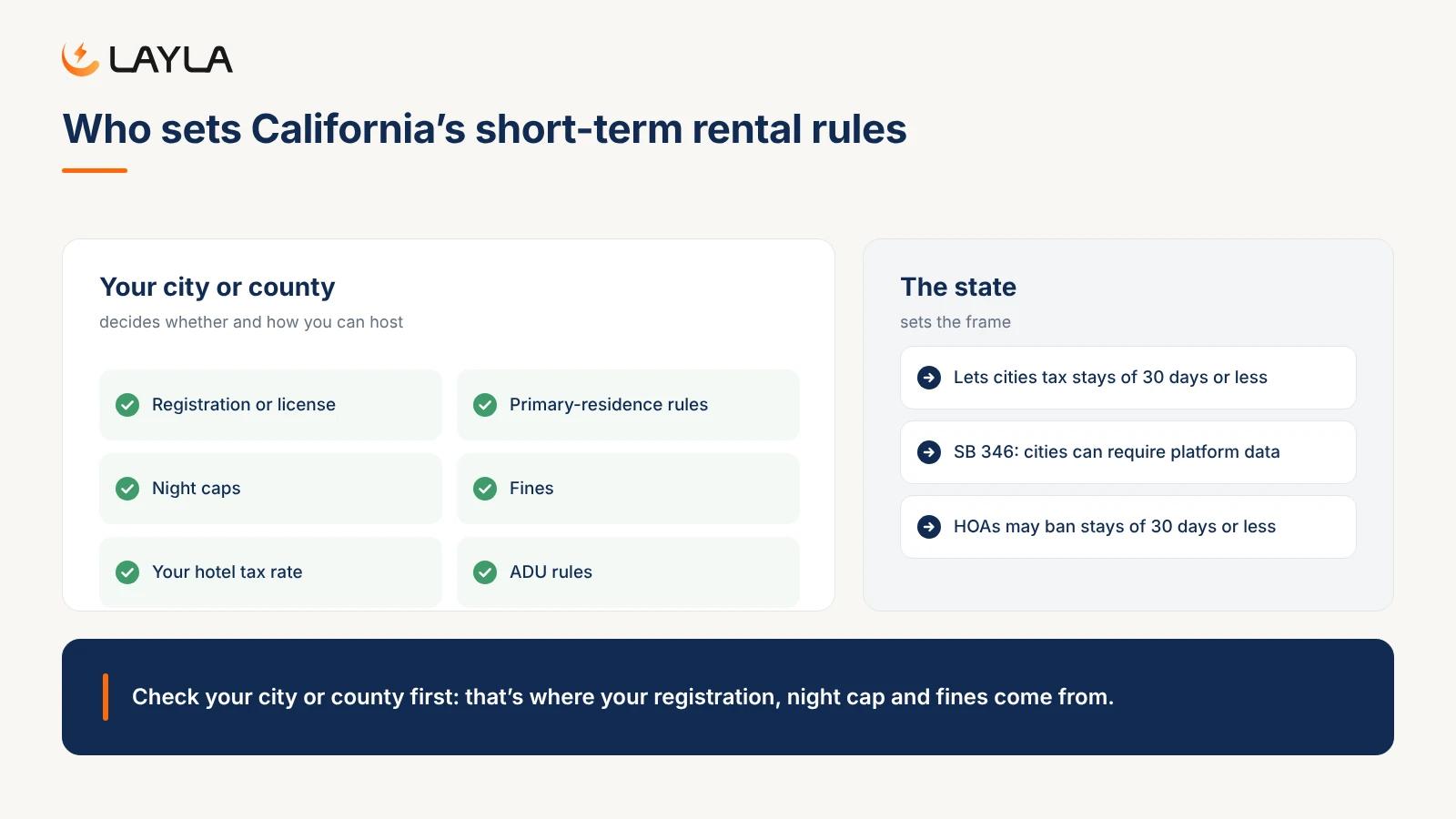
Short-term rentals are legal in many parts of California, but the rules that decide whether you can host come from your city or county. California short-term rental laws at state level mostly deal with tax and platform data. The registrations, night caps and fines come from local ordinances. In Los Angeles you can only rent your primary residence, for up to 120 nights a year. San Diego licenses every rental in four tiers and caps whole-home licenses outside Mission Beach at 1% of the city's housing units. San Francisco requires you to live in the unit at least 275 nights a year.
Are short-term rentals legal in California?
Mostly yes, on local terms. San Francisco's Office of Short-Term Rentals sums up the legal basis in its FAQ: a charter city can "make and enforce all local laws and regulations that are not in conflict with general state laws" under Article XI, Section 7 of the California Constitution. Cities use that power very differently — some register and cap, some require you to live on site, and some allow only stays of 30 days or more in certain units.
In practice, a short-term rental in California means a stay of 30 days or less. The state's own definition in its 2025 platform law uses "a period of 30 consecutive days or less," per the State Controller's summary of SB 346. Los Angeles uses 30 days or less, and San Diego and San Francisco use "less than one month" and "less than 30 nights."
The state layer: tax, platform data, HOAs and ADUs
Two pieces of state law cover tax and platform data, and two more decide who else can limit short stays.
Transient occupancy tax is local. As the State Controller's Office puts it, "many cities and counties impose a transient occupancy tax on guests" who stay in short-term rentals. The power comes from Revenue and Taxation Code section 7280, which lets a city or county tax a stay "unless the occupancy is for a period of more than 30 days." The rate, the registration and the filing schedule are set by your city or county, which is why the numbers in the city sections below differ so much.
The Short-Term Rental Facilitator Act of 2025. Senate Bill 346 was approved by the Governor on October 13, 2025 and added Government Code sections 50990 onward. According to the State Controller's FAQ, it lets a city or county require platforms to:
- report the physical address, with nine-digit ZIP code, of every short-term rental they facilitate, and if needed the parcel number or listing URL
- report on a schedule no more frequent than quarterly, or monthly if the city requires monthly tax remittance
- show any local license number and TOT certificate in each listing
- open their records to audit where they collect the tax
It only applies where a city or county adopts an ordinance opting in, and failure to report can carry an administrative fine under Government Code section 53069.4. For a host, the practical effect is that an unregistered listing gets much easier to find wherever the city opts in.
HOAs and ADUs. Civil Code section 4741 limits how far a homeowners' association can restrict renting, but subdivision (c) still lets it prohibit "transient or short-term rental of a separate property interest for a period of 30 days or less." If you're in an HOA, read your governing documents before you read your city's ordinance. For accessory dwelling units on a single-family lot, Government Code section 66315 lets the city require that the property be used for rentals of "terms 30 days or longer." Each city's own ADU rule is in its section below.
California short-term rental laws by city
| Los Angeles | San Diego | San Francisco | |
|---|---|---|---|
| Permit | Home-Sharing registration, 12 months | STRO license, Tiers 1–4, 2 years | OSTR certificate plus Business Registration Certificate |
| Primary residence | Required, more than 6 months a year | Tier 2 only (at least 275 days) | Required, at least 275 nights a year |
| Night limit | 120 nights; more with Extended registration | Tier 1: 20 days or less; Tiers 3–4: at least 90 days of use | 90 unhosted nights a year |
| Tax | 14% TOT plus a per-night fee ($3.30; $3.42 from Oct 29, 2026) | 11.75%, 12.75% or 13.75% TOT by zone | Administered by the Treasurer & Tax Collector |
| Headline fine | $647.61 a day for unlawful advertising (from Oct 29, 2026) | Civil penalties and license revocation | $484 a day per unit for hosting after a denial |
Sources for each figure are linked in the sections below.
Los Angeles
The City of Los Angeles allows home-sharing only in your primary residence, meaning the home where you live more than six months a year (City Planning requirements). A Regular registration covers up to 120 days a calendar year, and Extended Home-Sharing opens up more once you've been registered six months or hosted 60 days. Rent-stabilized units are out.
The Office of Finance charges 14% TOT on stays of 30 days or less, and a separate per-night fee, $3.30 a night as of September 1, 2025, rises to $3.42 on October 29, 2026 (City Planning memo). Fines rise 3.6% the same day, to $647.61 a day for unlawful advertising and $2,590.44 a day for each night past the 120-day cap (fine memo). City Planning's overview page gives October 28 for both increases, while both signed memos say October 29. Revised Administrative Guidelines took effect on September 28, 2026.
There's more detail, including the two-guests-per-room limit and the 10:00 pm amplified-sound rule, in our guide to Los Angeles short-term rental laws. Those two rules are also the ones a camera-free sensor such as All-in-One, $299 one time can keep an eye on, as the monitoring section at the end explains.
San Diego
San Diego requires a license for every short-term residential occupancy (STRO), meaning any stay of less than one month, and it has been unlawful to operate without one since May 1, 2023 (City Treasurer STRO page, updated October 23, 2026). A host can hold one license and run one unit at a time. Licenses can't be transferred.
The four tiers:
- Tier 1, part-time: an aggregate of 20 days or less a year. You don't need to live on site.
- Tier 2, home sharing: rooms in your home for more than 20 days a year while you live there. You can be away for up to 90 days a year, and the home must be your primary residence for at least 275 days.
- Tier 3, whole home outside Mission Beach: capped at 1% of the city's housing units outside the Mission Beach community planning area. As of October 23, 2026, 4,854 licenses had been issued and 807 remained.
- Tier 4, whole home in Mission Beach: capped at 30% of Mission Beach's housing units. All 1,099 are issued, and the application period is closed.
Tier 3 and 4 hosts must use the license at least 90 days a year, require a two-night minimum stay and file quarterly reports. The city's FAQ is blunt about the gap in between — whole-home renting for 21 to 89 days a year isn't allowed.
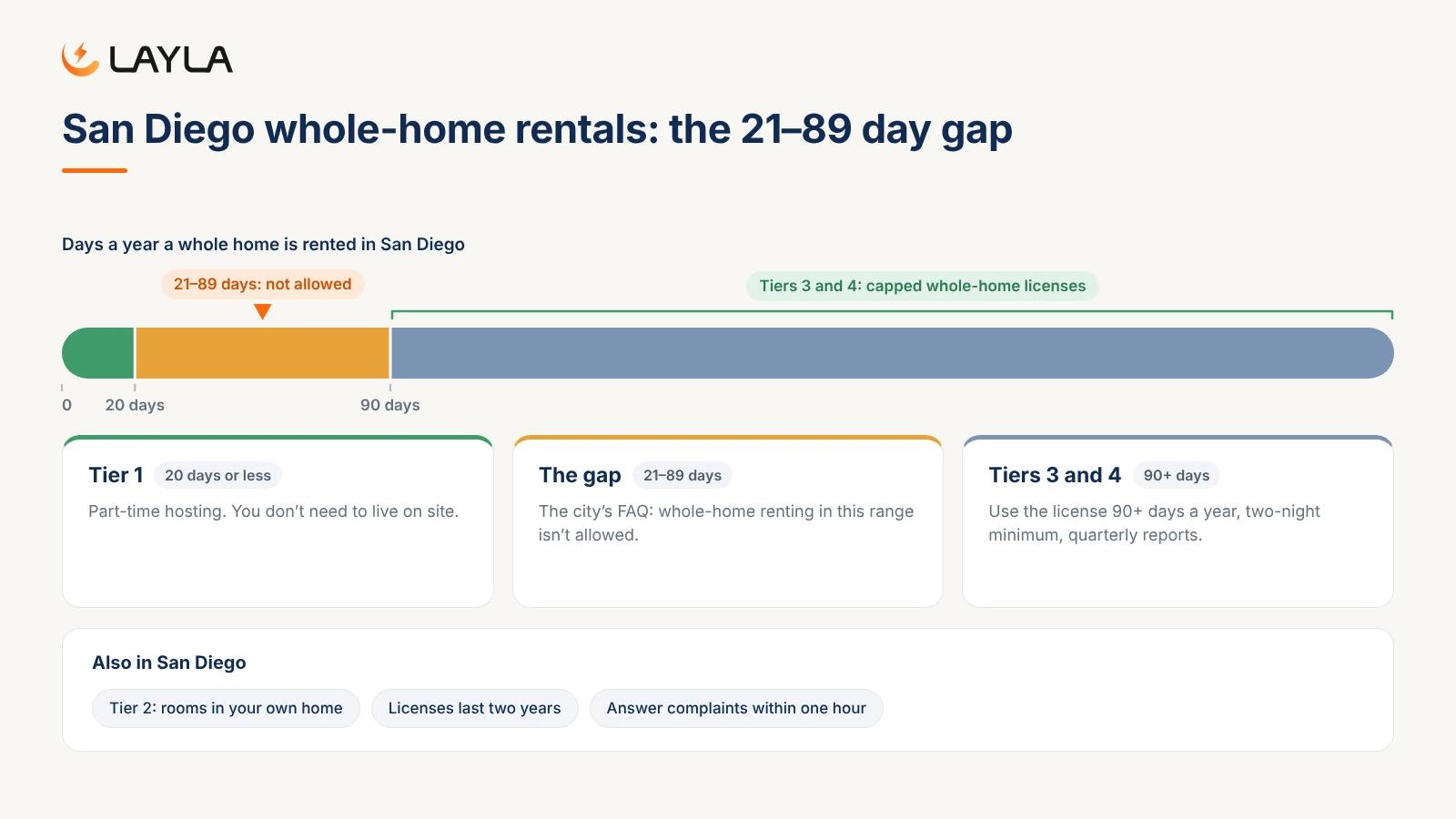
Fees since March 1, 2025 are a $33 application fee plus $193 (Tier 1) or $284 (Tier 2), and $41 plus $1,129 for Tiers 3 and 4. Licenses last two years. You also need a TOT certificate and a paid-up Rental Unit Business Tax account before applying.
The Host Operating Requirements checklist adds the day-to-day rules. You or your local contact must respond to complaints within one hour, in person or by phone. An exterior sign visible from the sidewalk must show your TOT and STRO numbers and contact details, and both numbers go in every ad. Guests get a Good Neighbor Policy. Separately, the STRO page's FAQ says ADUs can't be used as short-term rentals, except companion units permitted before October 15, 2017.
On tax, San Diego split itself into three TOT zones on May 1, 2025, at 11.75%, 12.75% and 13.75% (TOT page). Platforms that collect rent from guests must collect and remit the TOT, and they may not complete a booking for an unlicensed unit. Hosts who break the rules risk "civil penalties and license revocation."
San Francisco
San Francisco allows short-term rentals of less than 30 nights only by the unit's permanent resident (OSTR FAQ). You must spend at least 275 nights a year in the unit, and you can rent it for no more than 90 un-hosted nights a year. In a multi-unit building, you can only register the unit you live in.
Before listing, you need a Business Registration Certificate from the Treasurer & Tax Collector and either a certificate from the Office of Short-Term Rentals, with its number on every listing, or a complete application pending review while you live in the unit and no City complaints or enforcement actions are pending against the property. The application fee is $925 and is valid for two years from approval. If you offer both hosted and un-hosted stays, each needs its own listing. ADUs and junior ADUs can only be rented for 30 days or longer.
Approved hosts file quarterly reports at the end of January, April, July and October. The next deadline is October 31, 2026 (Office of Short-Term Rentals). Keep hosting after a denial and the city can issue a notice of violation at $484 a day per residential unit. Platforms must verify that a unit is registered before they take a booking fee and file a monthly affidavit with the city.
Hotel tax is administered by the Treasurer & Tax Collector, not OSTR, so confirm your rate and filing schedule there.
Palm Springs
Hosting in the desert instead? We cover registration, limits and enforcement in our Palm Springs vacation rental ordinance guide. Check the current figures with the City of Palm Springs before you book your season.
What changed for 2026
Only changes with a date on a government source are listed here.
- State: SB 346, approved October 13, 2025, lets cities and counties require platforms to report rental addresses and show local license numbers (State Controller).
- Los Angeles: revised Home-Sharing Administrative Guidelines effective September 28, 2026, and a 3.6% rise in fines and the per-night fee from October 29, 2026.
- San Diego: no 2026-dated rule change on the city's pages. The current fee schedule dates from March 1, 2025 and the three-zone TOT from May 1, 2025.
- San Francisco: no 2026-dated rule change on OSTR's pages.
What this means for monitoring your listing
The rules that matter between visits are the day-to-day ones. San Diego wants your local contact responding to complaints within one hour. Los Angeles bans amplified sound after 10:00 pm and runs a 24/7 line for neighbors. San Francisco counts un-hosted nights against a 90-night limit. If you can't see what's happening inside while you're away, the first you hear of a problem may be a neighbor's call or a letter from the city.
What you can put inside the home is set by the platform. Airbnb's policy, in force since April 30, 2024, says: "We do not allow hosts to have security cameras or recording devices that monitor indoor spaces in homes… even if these devices are turned off." Noise monitors are allowed: "Noise decibel monitors are devices that assess sound levels and their duration but do not record audio," and hosts can use them indoors "as long as the host discloses their presence and they are not located in bedrooms, bathrooms, or sleeping areas." Our guide on whether monitoring sensors are allowed in Airbnb covers the details.
Layla fits that line. It measures a decibel level only and never records audio, and it counts people with radar presence sensing instead of a camera. You set a strict overnight threshold and a looser one for daytime. The party detector looks at how many people are inside, how loud it is and what time it is.
All-in-One adds smoke detection and AC control to that for $299 one time, with no subscription. To weigh it against other devices, start with our best noise monitor for Airbnb comparison, and see our quiet hours guide for wording that matches your city's rules.
FAQ
What are the California short term rental laws in 2026?
California leaves most rules to cities and counties. At state level, transient occupancy tax is local, and SB 346, approved in October 2025, lets cities require platforms to report rental addresses and show license numbers. Registration, primary-residence rules, night caps and fines come from your city, such as Los Angeles, San Diego or San Francisco.
Are short term rentals legal in California?
Yes in many places, on local terms. Los Angeles allows them only in your primary residence for up to 120 nights a year without Extended registration. San Diego licenses them in four tiers with caps on whole-home licenses. San Francisco requires you to live in the unit 275 nights a year. Check your own city or county first.
Do you need a license for a short term rental in San Diego?
Yes. Since May 1, 2023 every stay of less than one month in the City of San Diego needs an STRO license. Tier 1 covers 20 days or less a year, Tier 2 home sharing, Tier 3 whole homes outside Mission Beach and Tier 4 Mission Beach. Licenses last two years, and Tier 4 is closed.
What are the short term rental rules in San Francisco?
You must be the permanent resident, living in the unit at least 275 nights a year, and you can rent it un-hosted for no more than 90 nights. You need a Business Registration Certificate and an Office of Short-Term Rentals certificate (or a complete application under review), with the number on every listing. The application fee is $925, valid for two years.
Can I rent my ADU as a short term rental in California?
It depends on the city, and the big ones mostly say no. San Diego prohibits short-term rental of ADUs except companion units permitted before October 15, 2017. San Francisco allows only 30-day-plus stays in ADUs. Los Angeles blocks ADUs whose permit application was filed from 2017 onward unless the ADU is your primary residence. State law lets a city require ADU rentals of 30 days or longer.

Best for: full property coverage
All-in-One
Noise monitoring, smoke detection and smart AC control for complete coverage.
Everything included
Everything in Noise & Security Pro
AI party detector, noise alerts, intruder & break-in, occupancy, 180-day history, indoor + outdoor climate
Everything in Smoke & Air Quality
Air quality index (IAQ), CO2, bVOC, mold & smoke — full indoor + outdoor climate
Everything in AC Control & Energy
Smart AC (150+ brands), Eco Mode, schedules, filter health
Plus exclusive
- Advanced reports & insights
- Priority support
- Priority support
No monthly fees. Ever.
One sensor. Full coverage
One sensor. Full coverage.* Layla 3.0 monitors noise, air quality, motion, occupancy, temperature, humidity, pressure, VOCs, CO2, and controls your AC - from a single device on your shelf.
No subscription means no surprise costs.
Pay once. Every feature unlocked. Forever. No monthly fees eating into your rental margins or household budget.
The smartest buy is the one you make once.
Other solutions charge per-feature monthly subscriptions that exceed the device cost within a year. Layla's all-in-one pays for itself compared to any subscription alternative.
30-day money back guarantee