BLOG
Los Angeles Short-Term Rental Laws 2026: Registration, Caps, Fines
 By Nangyal Khan··Updated
12 min read
Last updated: October 28, 2026. Sources last checked: October 28, 2026. This guide is informational, not legal advice.
Short-term rentals are legal in the City of Los Angeles, but only in your own primary residence and only with a city Home-Sharing registration. Los Angeles short-term rental laws limit a regular registration to 120 nights a year, require the registration number on every listing, add a 14% transient occupancy tax plus a per-night fee, and fine advertising that breaks the ordinance at $647.61 a day or twice the nightly rate, whichever is greater, from October 29, 2026. If the home you want to list isn't where you live for more than six months of the year, you can't rent it for stays of 30 days or less.
Is Airbnb legal in Los Angeles?
Yes, inside a fairly narrow lane. The city's Home-Sharing Ordinance was adopted on December 11, 2018, took effect on July 1, 2019, and has been enforced since November 1, 2019, according to City Planning's Home-Sharing fact sheet. The 2026 Administrative Guidelines identify it as Ordinance No. 185,931.
In plain terms, home-sharing is renting all or part of the home you live in to visitors for 30 consecutive days or less. That's the city's definition of a short-term rental in the 2026 Home-Sharing Administrative Guidelines, which also exclude city-approved hotels, motels, bed and breakfasts and transient occupancy residential structures.
One thing to settle first — these are the City of Los Angeles rules. If your address sits in another city within LA County, or in an unincorporated area, a different set of rules applies, so confirm your jurisdiction before you read any further.
Who the Los Angeles rules apply to
City Planning's Home-Sharing requirements page sets out who can register. You need all of the following:
- It's your primary residence. That means the home where you live for more than six months of the year. You prove it with a California driver license or ID card showing the address, plus two documents from the city's list, such as a property tax bill, an LADWP electricity bill, a vehicle registration or a voter registration.
- The unit isn't rent-stabilized or income-restricted. Units under the Rent Stabilization Ordinance, an affordability covenant or a low-income restriction are not eligible.
- The zone and structure are residential. Home-sharing isn't allowed where residential use isn't permitted by right, or in a vehicle, shed, trailer or temporary structure.
- There are no open citations. The host, unit and property can't have any open or unresolved code violations from any city enforcement agency.
- Tenants need the owner's sign-off. If you rent, the property owner must sign the Property Owner Authorization form in front of a notary, within 30 days of your application.
Accessory dwelling units carry an extra catch. An ADU whose building permit application was submitted on or after January 1, 2017 can't be home-shared unless it is your primary residence (Administrative Guidelines, Section VI).
Primary residence, hosted stays and the 120-night cap
The city doesn't split hosted and unhosted stays. The fact sheet says plainly that you can rent your entire home while you're out of town, as long as it's the place you live for more than six months a year.
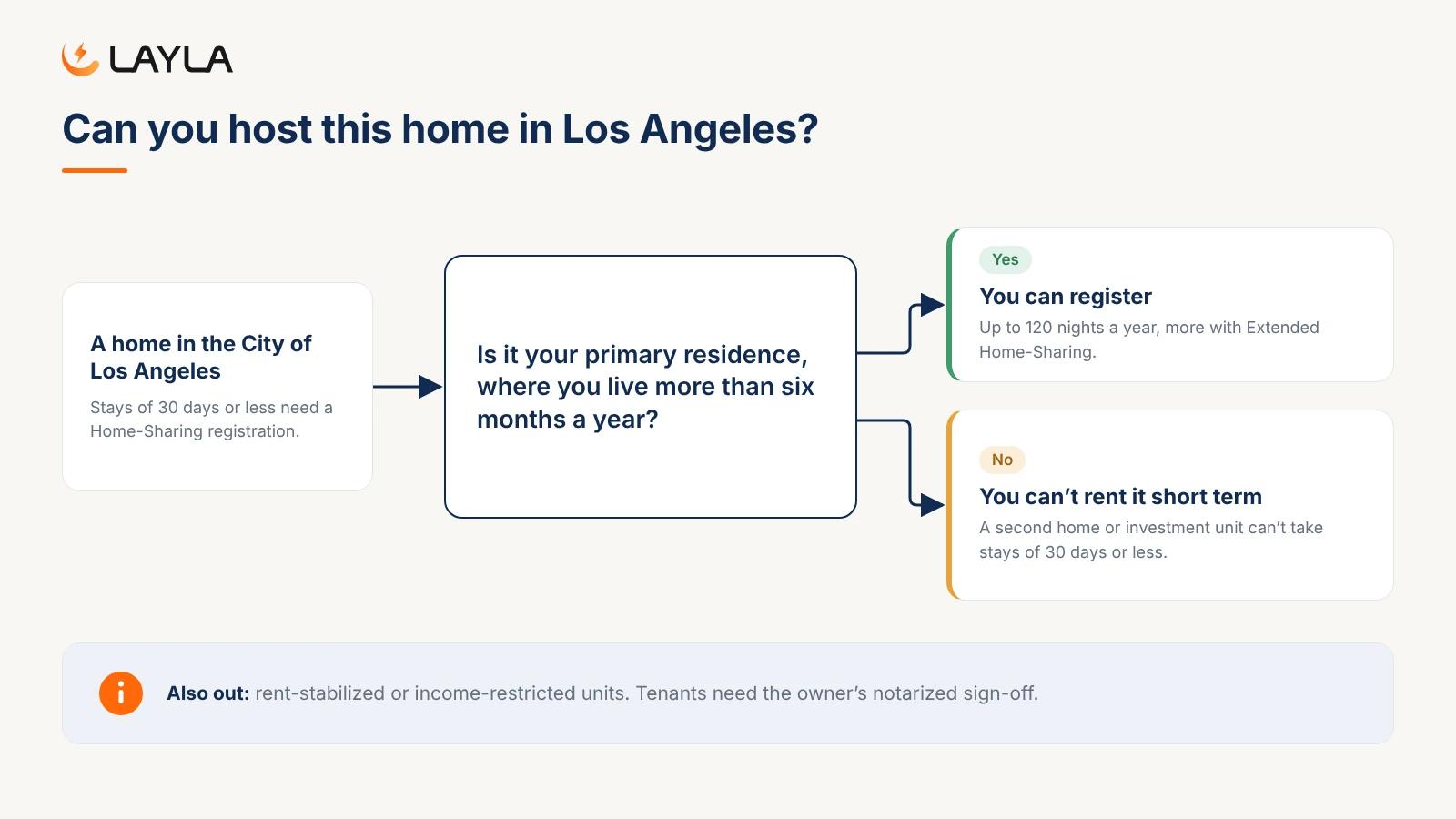
What it does limit is the number of nights. A Regular Home-Sharing registration allows up to 120 days in a calendar year, January 1 to December 31. Every night booked for a listing counts toward the cap, including nights booked without a valid registration number (Administrative Guidelines, Section VI).
To go past 120 nights you need Extended Home-Sharing. Per the requirements page, you can apply once you've held a Regular registration for at least six months or hosted for at least 60 days. Ministerial approval needs no more than one citation in the prior three years; with more, you go through discretionary review, which can include a public hearing. Adjacent and abutting neighbors are notified by mail, at your cost.
Two more limits catch hosts with several listings. Only one listing can be booked at a time, and you can't host more than one group of guests under separate bookings at the same time, even if you list individual rooms.
Registration: how it works
You apply through the city's Home-Sharing Application and Registration Portal (HARP). The Home-Sharing overview page and the 2026 Administrative Guidelines set the rules:
- Registrations are valid for 12 months, can't be transferred, and must be renewed. Renewal applications are accepted from 60 days before expiry.
- Your city-issued registration number must appear on every listing. If it becomes invalid, all listings come down immediately.
- If you add a listing URL after approval, you must report it through the portal within 24 hours.
- You need a Business Tax Registration Certificate with the right TOT classification from the Office of Finance before you operate as a host.
- You keep records of every stay for at least three years, and you hand them over at renewal unless you list only on a platform whose Platform Agreement covers data sharing.
- You authorize your platforms to share your listing, activity and contact details with the city.
The application fee is set by ordinance and adjusted for inflation every year, according to the city's Regular and Extended comparison chart. The portal asks for it when you submit.
The operating rules you sign up to
Registration also binds you to a set of house rules the city writes for you. Two of them, the 10:00 pm amplified-sound rule and the two-guests-per-room limit, are things a camera-free sensor such as All-in-One, $299 one time can watch for you, which the monitoring section at the end explains. The full list is in the Administrative Guidelines, Sections III, VI and VII:
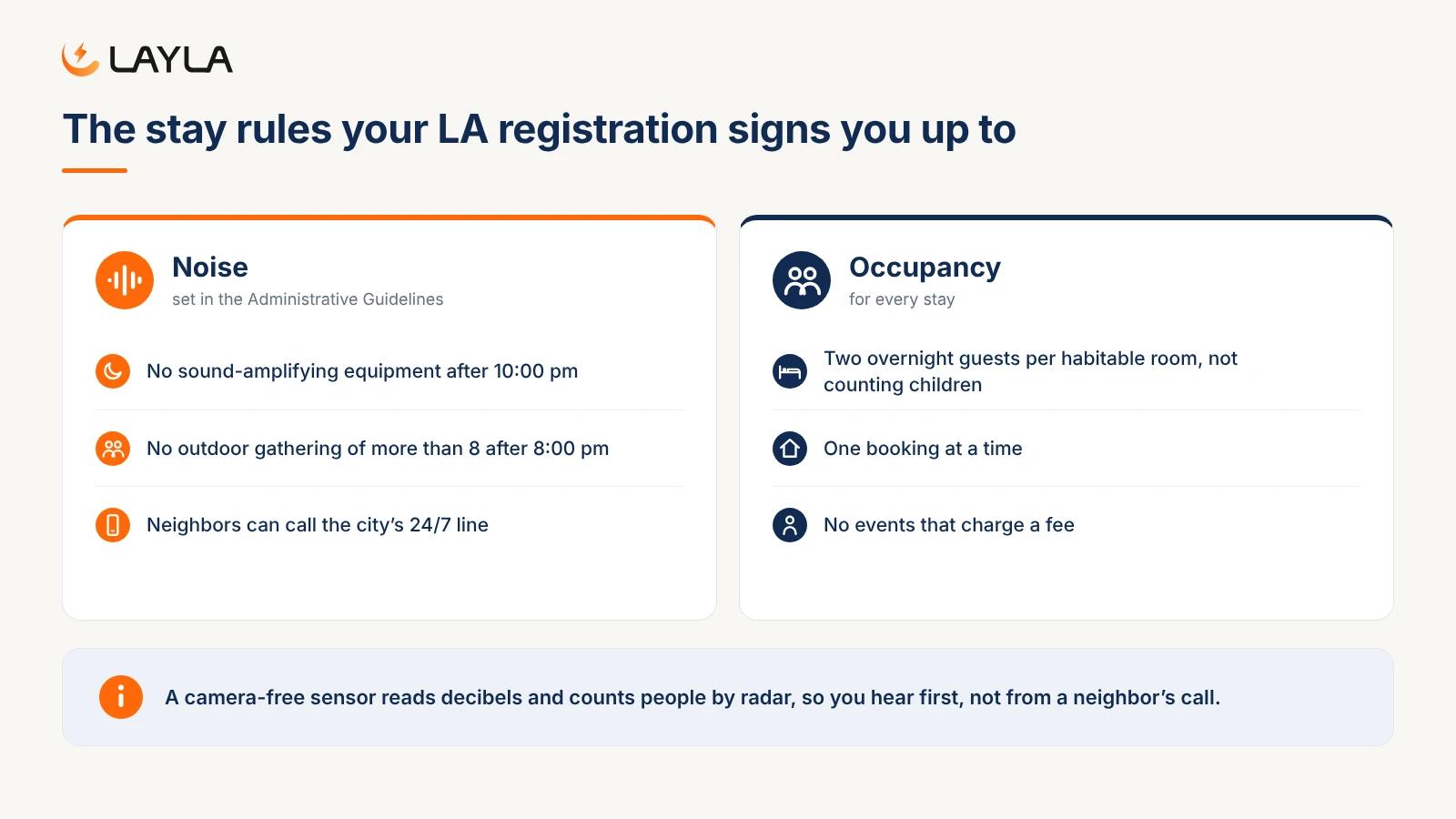
- Occupancy: no more than two overnight guests per habitable room, not counting children.
- Noise: no sound-amplifying equipment after 10:00 pm, and no outdoor gathering of more than eight people (excluding children) after 8:00 pm. The city's general noise rules apply on top.
- Nuisance: you may be held responsible for nuisance violations at the property during a stay, even when guests cause them.
- Safety: working fire extinguishers, smoke detectors and carbon monoxide detectors, plus emergency exit information for guests.
- Fire zones: in a Very High Fire Hazard Severity Zone, every listing and every patio or deck must say that smoking is not allowed outdoors.
- Conduct: every guest gets the city's Guest Code of Conduct, and no events that charge a fee.
Taxes and the per-night fee
The Office of Finance puts the city's transient occupancy tax at 14% on any stay of 30 days or less. You must register for a TOT certificate within 30 days of starting. Airbnb has collected and remitted TOT for its LA hosts since August 1, 2016, but only on bookings made through Airbnb. Anything you book directly or through another site is on you, remitted monthly (Administrative Guidelines, Section VII).
The per-night fee sits on top of the tax. City Planning's per-night fee memo puts it at $3.30 a night as of September 1, 2025, rising to $3.42 on October 29, 2026. Platforms with a Platform Agreement collect it for you (Administrative Guidelines, Section VII). If you use one without an agreement, you report your nights and pay through the portal every month, even when the number is zero.
Platform rules
Platforms carry their own obligations. The ordinance fines a platform that completes a booking for a listing without a valid or pending registration number, for a host whose registration the city has suspended or revoked, or for a unit past its 120-day limit without Extended approval (Final Ordinance, Section 12.22 A.32). The Resources page lists the Platform Agreements in effect, including Airbnb's.
Los Angeles short-term rental fines
Fines are set in the ordinance and adjusted each year for inflation. The fine memo dated September 28, 2026 applies a 3.6% increase:
| Violation | Daily fine as of July 1, 2025 | Daily fine from October 29, 2026 |
|---|---|---|
| Host or owner advertising a short-term rental in violation of the ordinance | $625.11 | $647.61 |
| Host or owner, each day of home-sharing beyond 120 days without Extended registration | $2,500.42 | $2,590.44 |
| Hosting platform violations | $1,250.09 | $1,295.09 |
For hosts, the ordinance text sets each of these as the daily amount or two times the nightly rate charged, whichever is greater.
Citations also put the registration itself at risk. Two sustained citations within your 12-month registration period can bring a suspension of at least 30 days. Three can bring revocation and a one-year ban on home-sharing. An Extended registration can be revoked after two (Administrative Guidelines, Section V). The city doesn't have to warn you before it enforces, and anyone can look up a property's registration and citation history on the Home-Sharing Records Portal.
What changed for 2026
Three dated changes matter this year:
- New Administrative Guidelines. City Planning issued a second edition on July 14, 2026, effective September 28, 2026 (Administrative Guidelines, cover), alongside the new HARP portal. Applications filed on or after September 28 are reviewed under the new rules (overview page). The revisions clarify primary-residence requirements, open renewals 60 days before expiry, and make clear that an open citation from any city agency blocks eligibility.
- Higher fines. Up 3.6%, to the amounts in the table above, from October 29, 2026.
- Higher per-night fee. $3.30 to $3.42, also from October 29, 2026.
The overview page gives October 28 as the effective date for both increases, while both signed memos say October 29. Plan around the earlier date.
What this means for monitoring your listing
The city runs a 24/7 Home-Sharing line, (213) 267-7788, where neighbors can report concerns or complaints about a short-term rental (fact sheet), and your registration asks for an emergency contact who can reach the property at any hour (Administrative Guidelines, Sections III and XI). If guests break the 10:00 pm amplified-sound rule or the two-per-room limit, you want to hear about it from your own phone first, not from a neighbor's call.
Cameras aren't the answer inside. Airbnb's policy, in force since April 30, 2024, says: "We do not allow hosts to have security cameras or recording devices that monitor indoor spaces in homes… even if these devices are turned off." Noise monitors are a different category — "Noise decibel monitors are devices that assess sound levels and their duration but do not record audio," and hosts may use them indoors "as long as the host discloses their presence and they are not located in bedrooms, bathrooms, or sleeping areas." For the full breakdown, see are monitoring sensors allowed in Airbnb.
A compliant setup measures loudness and presence without recording anyone. Layla reads a decibel level only, with no audio recorded, and counts people with radar presence sensing rather than a camera. You set a strict threshold for the overnight hours and a looser one for the day, so the late-night alert does the job the city's 10:00 pm rule asks of you. The party detector on the higher plans looks at how many people are inside, how loud it is and what time it is, so a late-night crowd shows up as an alert.
If you want noise, occupancy, smoke and AC control from one sensor, All-in-One covers all of it for $299 one time, with no subscription. To compare devices first, read our guide to the best noise monitor for Airbnb. Rules elsewhere in the state are in our California short-term rental laws guide, and our quiet hours guide shows how to set your listing's quiet hours to match the 10:00 pm rule.
FAQ
What are the Los Angeles short term rental laws in 2026?
In the City of Los Angeles you can only rent your primary residence, where you live more than six months a year, for stays of 30 days or less. You need a Home-Sharing registration, its number on every listing, and a TOT certificate. Regular registrations cap you at 120 nights a year, and you pay 14% TOT plus a per-night fee.
Is Airbnb legal in Los Angeles?
Yes, for hosts who register their primary residence under the Home-Sharing Ordinance and post the registration number on every listing. Renting a second home or investment unit for 30 days or less isn't allowed. Units under rent stabilization or an affordability covenant are excluded, and tenants need the owner's notarized authorization.
What is the 120-day rule in Los Angeles?
A Regular Home-Sharing registration lets you host for up to 120 days in a calendar year, and every booked night counts. To host more, you apply for Extended Home-Sharing after six months of registration or 60 hosted days. Going past 120 days without it carries a daily fine of $2,590.44 or twice the nightly rent from October 29, 2026.
How do I register a short-term rental in Los Angeles?
Apply online through City Planning's Home-Sharing Application and Registration Portal with a California driver license or ID and two proof-of-residence documents. Tenants add a notarized owner authorization. Pay the application fee, then get a Business Tax Registration Certificate from the Office of Finance before hosting. Registrations last 12 months and must be renewed.
What are the fines for an illegal short-term rental in Los Angeles?
From October 29, 2026, advertising in violation of the ordinance costs $647.61 a day or twice the nightly rate, whichever is greater. Hosting past 120 days without Extended registration costs $2,590.44 a day or twice the nightly rent. Two sustained citations in a registration year can mean suspension, and three can mean revocation plus a one-year ban.

Best for: full property coverage
All-in-One
Noise monitoring, smoke detection and smart AC control for complete coverage.
Everything included
Everything in Noise & Security Pro
AI party detector, noise alerts, intruder & break-in, occupancy, 180-day history, indoor + outdoor climate
Everything in Smoke & Air Quality
Air quality index (IAQ), CO2, bVOC, mold & smoke — full indoor + outdoor climate
Everything in AC Control & Energy
Smart AC (150+ brands), Eco Mode, schedules, filter health
Plus exclusive
- Advanced reports & insights
- Priority support
- Priority support
No monthly fees. Ever.
One sensor. Full coverage
One sensor. Full coverage.* Layla 3.0 monitors noise, air quality, motion, occupancy, temperature, humidity, pressure, VOCs, CO2, and controls your AC - from a single device on your shelf.
No subscription means no surprise costs.
Pay once. Every feature unlocked. Forever. No monthly fees eating into your rental margins or household budget.
The smartest buy is the one you make once.
Other solutions charge per-feature monthly subscriptions that exceed the device cost within a year. Layla's all-in-one pays for itself compared to any subscription alternative.
30-day money back guarantee