BLOG
How Hotels Detect Vaping in Guest Rooms
 By Nangyal Khan··Updated
 7 min read
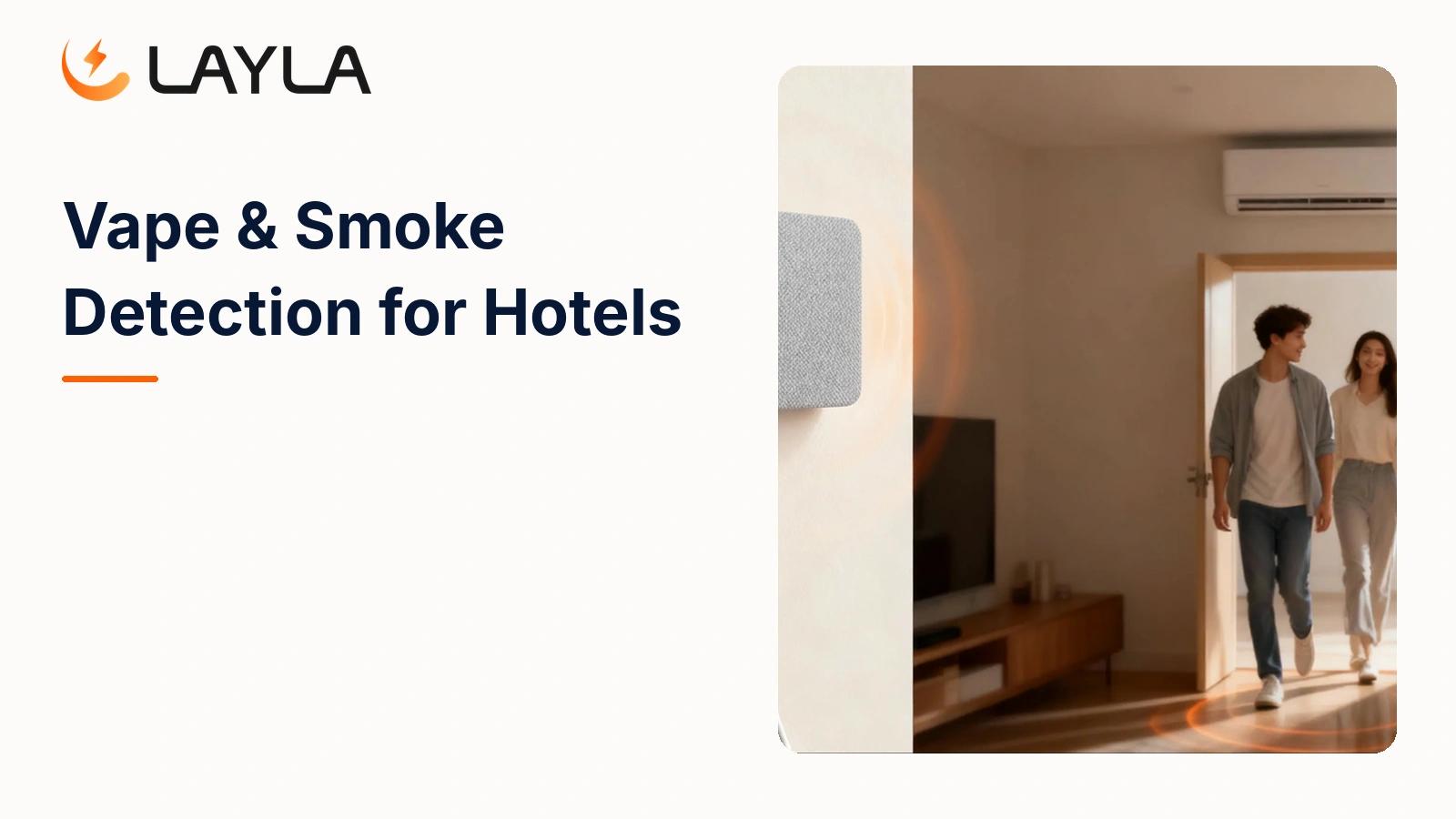
A smoked-in room is one of the most expensive twenty minutes a guest can hand you. The room drops off inventory for a deep clean, sometimes overnight, ozone machine and all, while the front desk deals with the next arrival who booked non-smoking and walked into a room that reeks. Do that across a property in a busy month and the real loss isn't the cleaning fee you might recover. It's the nights you couldn't sell and the reviews that mention the smell. Every big chain charges a smoking penalty for exactly this reason. What most properties still lack is any reliable way to know a room got smoked in before housekeeping walks in the next morning.
Vaping has made the gap wider. It leaves almost nothing behind, clears in a minute, and the guest who'd never light a cigarette indoors will happily vape by the window because they assume nobody can tell. Catching it, and catching it in time to do something, has turned into a line item in protecting room revenue.
Why the kit you already have won't cover it
The hardwired smoke alarm in the ceiling is a fire-safety device, and it needs to stay one. It's tuned for combustion and wired into a life-safety system, so it either ignores a vape completely or, if it does trip, empties a floor and rolls a fire response over what turned out to be someone vaping in the bathroom. Neither of those is enforcement. What you need is a separate, quieter layer that treats smoking as a policy signal, logs it, and tells the right person, without ever touching the fire system.
Cameras are out, and they should be. Guest rooms are the one place where surveillance is both illegal in a lot of jurisdictions and instantly poisonous to a hotel's reputation. Whatever a property uses to catch smoking has to work with no camera and no microphone. That's not a limitation to design around. It's the requirement. And the useful part is that smoking gets detected through the air anyway, never on video.
What guest-room detection actually has to do
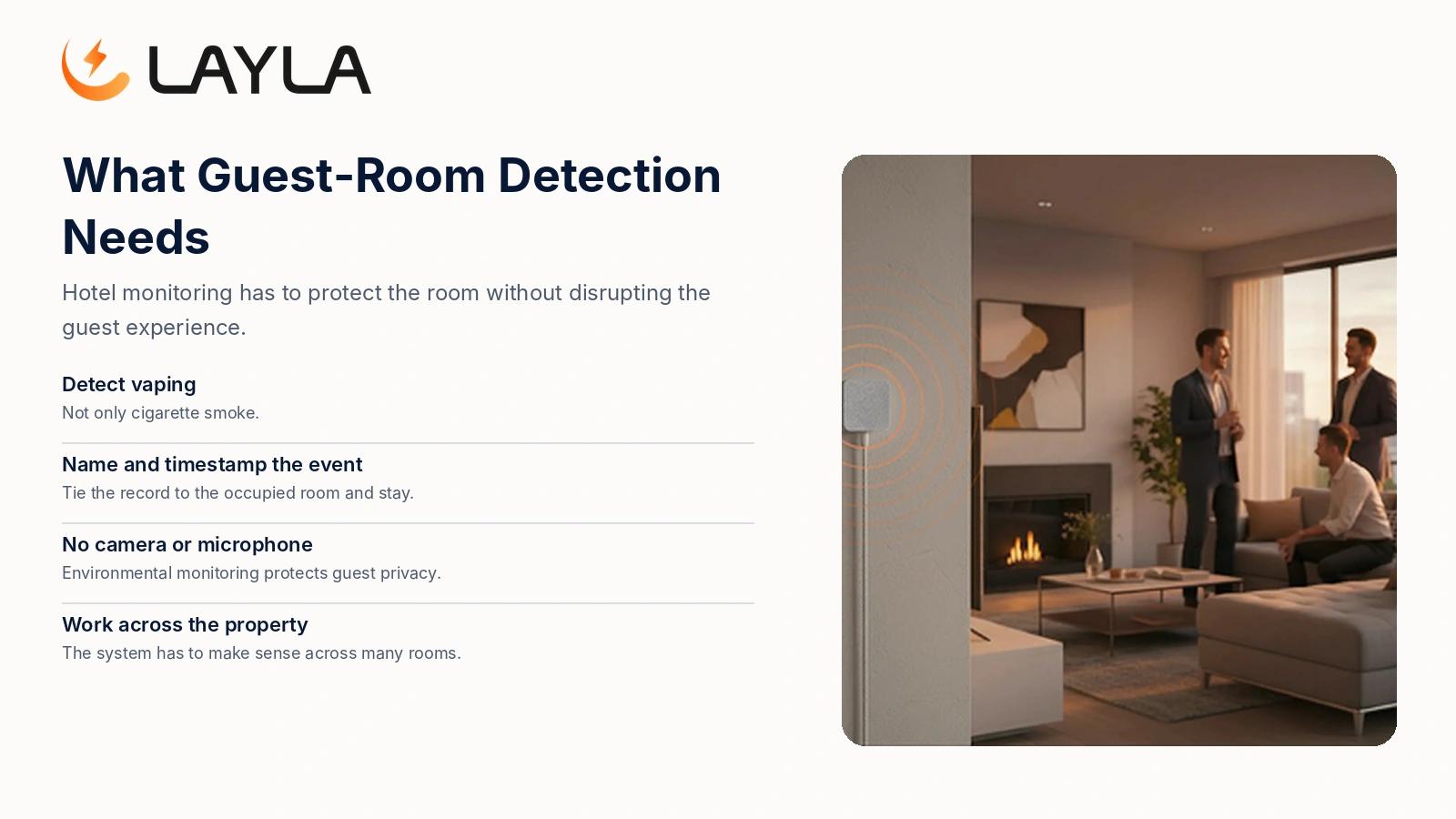
Judge any option against how a hotel really runs. Start with vaping, because it's where guests push hardest and where consumer smoke detection is weakest. The device also needs to name what it caught. A cannabis event in a non-smoking property is a different conversation from a vape, sometimes a legal one, and your staff and your penalty both need that detail. Timestamps matter just as much, since tying an event to whoever occupied the room is what makes a cleaning fee defensible instead of contestable. On top of that it has to stay silent and camera-free, protecting the guest experience rather than wrecking it, and you need to run it across dozens or hundreds of rooms from one place. Anything that only makes sense one room at a time never scales to a property.
Underneath all of that sits the cost question. Plenty of detection products are sold per room, per month, forever, and across a full property that recurring number turns into a serious budget line, one that keeps charging whether or not a single guest ever vapes. A device you buy once per room changes the arithmetic completely, especially at the volume a hotel deploys.
Where Layla fits a property
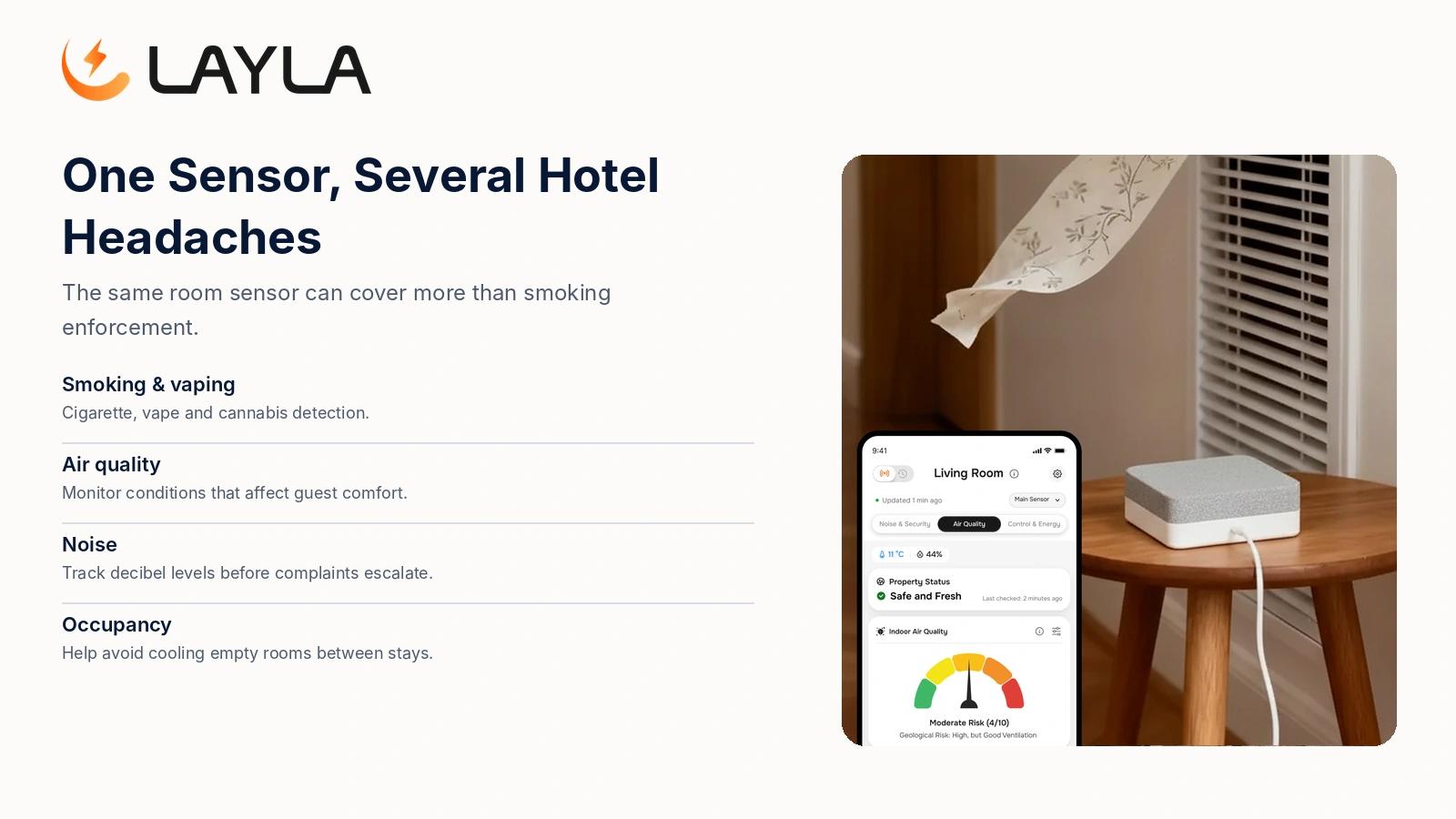
Layla was built as an all-in-one monitoring sensor, and that range is what makes it work in hospitality rather than just short-term rentals. On the smoking side it separates cigarette, vape and cannabis, flags which of the three it picked up, and rates the strength of the event live as it builds and clears. What reaches your team is "vape, medium, room 214, 11:40pm" rather than a vague alarm. Thresholds are yours to set, so a steamy shower or a scented amenity doesn't generate noise. There's no camera and no microphone anywhere in the unit, which is the only acceptable answer for a guest room, and it reads air quality, noise as a decibel level, and occupancy from the same sensor.
That breadth counts for more in a hotel than almost anywhere. The same unit that flags a vape also keeps an eye on indoor air quality for guest comfort, catches a party forming as a rising decibel level before it becomes a front-desk call, and reads occupancy so an empty room stops running the AC flat out between stays. One sensor on the ceiling, several headaches handled. And because Layla is a one-time purchase, currently $99 per unit and discounted from $189, kitting out a whole property doesn't spin up a recurring bill that grows with your room count. For an operator running the numbers on a floor or a full property, real vape detection with defensible records, no cameras and no subscription, and genuine bulk pricing is what moves this from a single-room gadget to a property-wide standard.
Rolling it out across rooms
Start with the rooms that cost you most when they're smoked in, the suites and the high-turnover floors, then widen from there. Place the sensor central to the room so it reads the sleeping and living space instead of a corner. Set thresholds once and keep them consistent, so every room reports on the same scale. Update your booking terms and in-room notice to disclose that rooms are monitored for smoking and vaping by an air-quality sensor with no cameras or mics, which most jurisdictions expect and which quietly discourages the behaviour before it starts. Then route the alerts to whoever acts on them, front desk overnight, housekeeping at turnover, so a detection becomes a response and not a log nobody reads. A property-scale rollout is worth a direct conversation about volume, and it's the kind of deployment Layla's team is set up to handle.
Frequently asked questions
Can hotels legally detect smoking in guest rooms?
Yes, using air-quality and smoke monitoring that carries no camera or microphone and is disclosed to guests. Environmental sensors read the air rather than record the room, which keeps them within the rules where interior cameras are not, and disclosure is both good practice and a deterrent. Cameras and mics in guest rooms are prohibited and should never be used.
Will this set off the fire alarm?
No. A monitoring sensor like Layla sits entirely separate from the building's fire-safety system. It logs smoking as an air-quality event and alerts your staff privately, without triggering an evacuation or a fire response. Your certified fire alarms stay in place and keep doing their job.
Does it detect vaping, or only cigarettes?
It detects vaping specifically, along with cigarette and cannabis smoke, and names which one. That matters for hotels because vape carries far less particulate than cigarette smoke, and it's exactly where basic detection tends to fall down.
How does this help with cleaning fees?
Every detection is timestamped and typed, so an event can be tied to whoever occupied the room in that window. A record reading "cannabis, high, 1:15am, room 214" turns a contested penalty into a defensible one, backed by your disclosed non-smoking policy.
Does it make sense across a whole property?
That's where a one-time device pulls ahead. Because Layla is bought once per room rather than billed monthly, the cost across dozens or hundreds of rooms doesn't compound into a permanent subscription, and the same sensor adds air-quality, noise and occupancy monitoring on top of smoke.
Related reading
- Best Cigarette, Vape & Cannabis Smoke Detectors for Rentals (2026)
- How to Prove a Guest Smoked in Your Rental
Protect every room from the smoke you can't see coming. Talk to Layla about a property rollout: cigarette, vape and cannabis detection with air quality, noise and occupancy from one camera-free sensor, bought once.

Best for: health-conscious homes
Smoke & Air Quality
Air quality, mold and smoke monitoring for healthy homes and smoke-free rentals.
Included forever — no subscription
- Mold-risk early warning
- Smoke & cigarette detection
- Air quality score (IAQ) with alerts
- CO₂ & bVOC monitoring
- AI air insights & recommendations
- Allergy-comfort monitoring
No monthly fees. Ever.
30-day money back guarantee