BLOG
How to Prove a Guest Smoked in Your Rental
 By Nangyal Khan·
8 min read
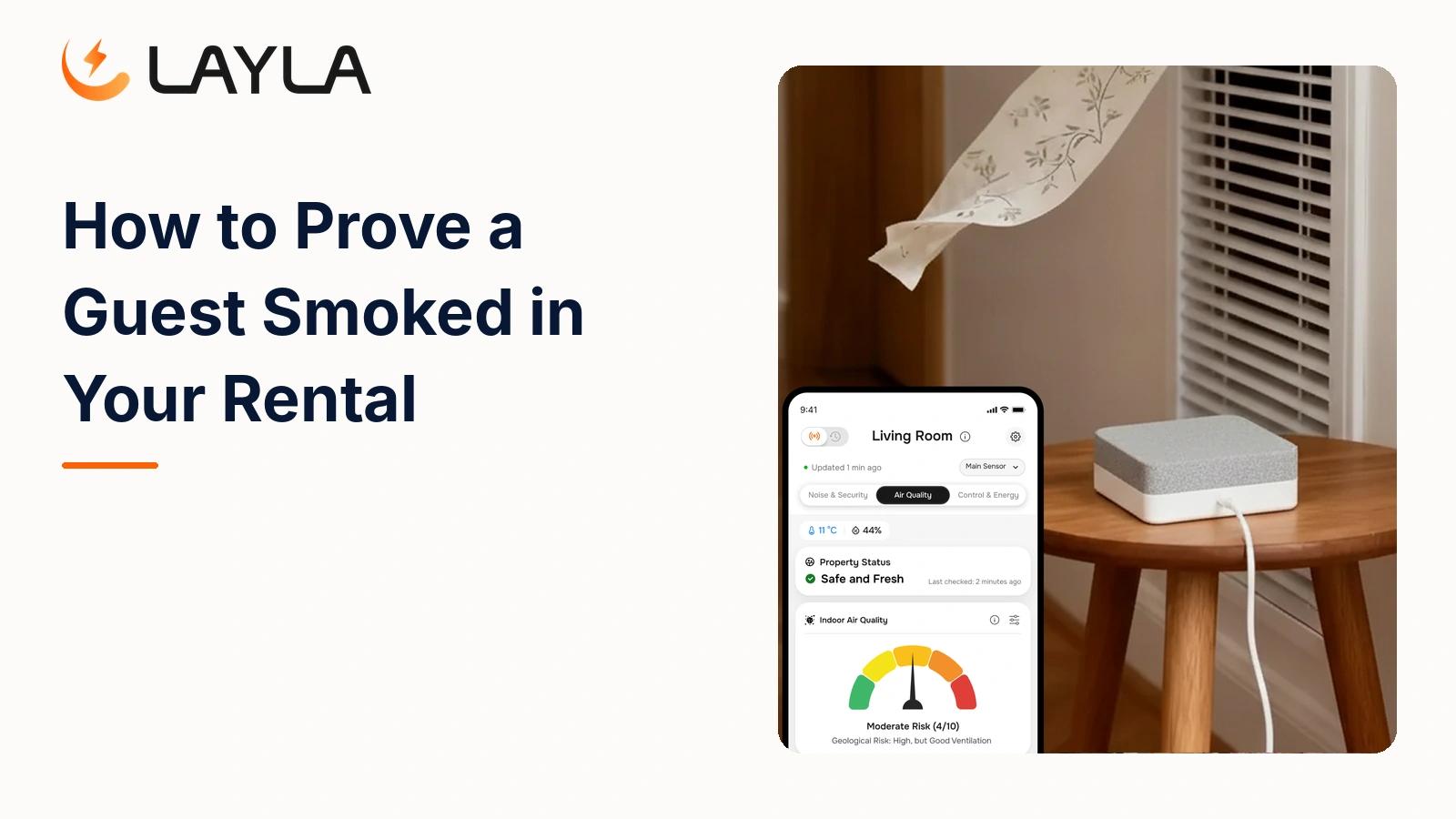
Every host knows how this goes. The cleaner opens the door, the smell hits, and you're already doing the maths on how many nights the place is off the calendar while it airs out. So you file the claim. You attach a photo of a room that looks spotless, because smoke doesn't photograph. And the guest fires back with two words: "wasn't me." Now it's your word against theirs, the platform sees nothing solid, and the smoking fee you were owed quietly evaporates.
The problem was never the smoking. It was that you couldn't prove it. Proof is a specific thing, and most hosts walk into a dispute without it. So let's go through what actually counts as evidence, what platforms and deposit rules will and won't accept, and how to have that proof ready before you need it instead of scrambling after the guest is long gone.
Why "it smells like smoke" almost never wins
A dispute gets decided on evidence, and a smell isn't evidence. You can't attach it to a claim, you can't timestamp it, and you can't tie it to one specific guest, because by the time anyone notices the smell the guest has checked out and any number of people had access to the place. Airbnb's resolution centre and every security-deposit process run the same way. The burden sits on you, the one making the claim, and anything vague or circumstantial tends to get thrown out. A photo of a clean-looking room, a cleaner's note reading "smoky," even a lingering odour the next guest grumbles about, all of it reads as unverifiable.
The three things that flip a claim into a win barely change. When did it happen, exactly, and does that fall inside this guest's stay? What was it, cigarette, vape or cannabis, and how strong? And was the record made at the moment it happened, not reconstructed afterwards from memory? Miss any one of those and you're back to your word against theirs.
What actually counts as evidence
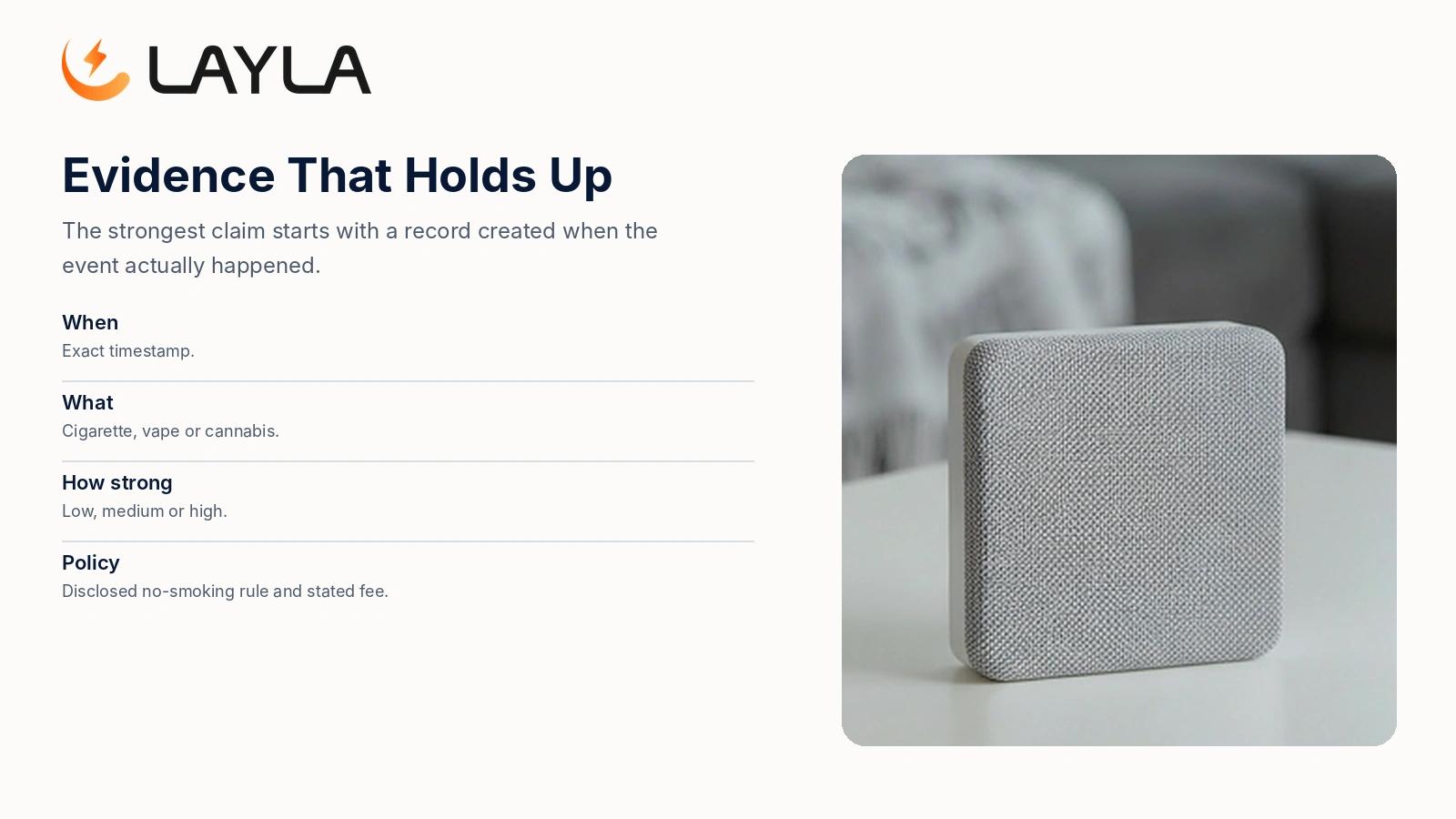
The strongest thing you can bring is a timestamped detection log, and it's the one thing most hosts don't have. A record showing smoke or vape was picked up at a specific date and time, inside the window this guest occupied the property, ties the event straight to them. It quietly kills the "wasn't me" defence, because the timeline argues the case for you.
Naming the type and intensity matters too. "Smoke detected" is decent. "Cannabis, high, 1:15am" is a different league. The substance matters because cannabis in a strict no-smoking unit can be a more serious breach, sometimes even a legal one, than a vape. And grading the intensity shows this wasn't a trace reading or a candle setting the thing off. The more specific the record, the harder it is to shrug away.
Physical stuff helps round it out. Ash, butts, a burn mark on the counter or the duvet, a smell the cleaner logs with photos of anything they can see. On its own it's weak, because you can't put a time on it, but paired with a timestamped log it fills in the picture.
And then there's your own paperwork. A clear no-smoking clause, a stated smoking fee, and a disclosure that the home is monitored, all of it visible before the guest booked. This is what makes the fee enforceable rather than a surprise charge they can contest as unfair. If the rule and the fee weren't there up front, even good evidence can draw pushback.
Notice what's missing from all of that. A camera. You can't put one inside a rental, the platforms ban it, and it wouldn't capture smoking anyway. The evidence that wins is environmental. It's a record of what happened in the air, not footage of who did it.
The evidence gap most hosts never close
Here's the uncomfortable bit. Most hosts have the house rules and the smoking fee written down and nothing else. They've got the policy to charge and none of the proof to back it, so the policy only ever works on honest guests who own up. Everyone else calls the bluff.
Closing that gap means capturing the detection the moment it happens, automatically, because you're never going to be standing in the unit when it does. That's the whole job of an air-quality sensor built for this. It reads the air continuously, and when it recognises the signature of smoking or vaping, it logs the event with a timestamp and pings you in real time. The record gets made in the moment, not pieced together from a smell three days later, and that's exactly the quality a dispute demands.
For that record to carry weight, the sensor has to name what it caught. This is where Layla picks up cigarette, vape and cannabis and tells you which of the three it was, then rates the event from low to high and keeps that reading updating as the smoke builds and clears. What lands in your log is "vape, medium, 11:40pm" rather than a bare "smoke" flag. You set the threshold yourself, so a candle or a steamy bathroom doesn't create a false record. There's no camera and no microphone, which keeps it disclosable and platform-safe, and it reads air quality, noise and occupancy from the same unit. It's a one-time $99 at the moment, discounted from $189, with nothing recurring, and you install it on Wi-Fi in minutes. When a guest says "wasn't me," you're not guessing anymore. You're forwarding a timestamped, typed record from the middle of their stay.
How to actually win the dispute
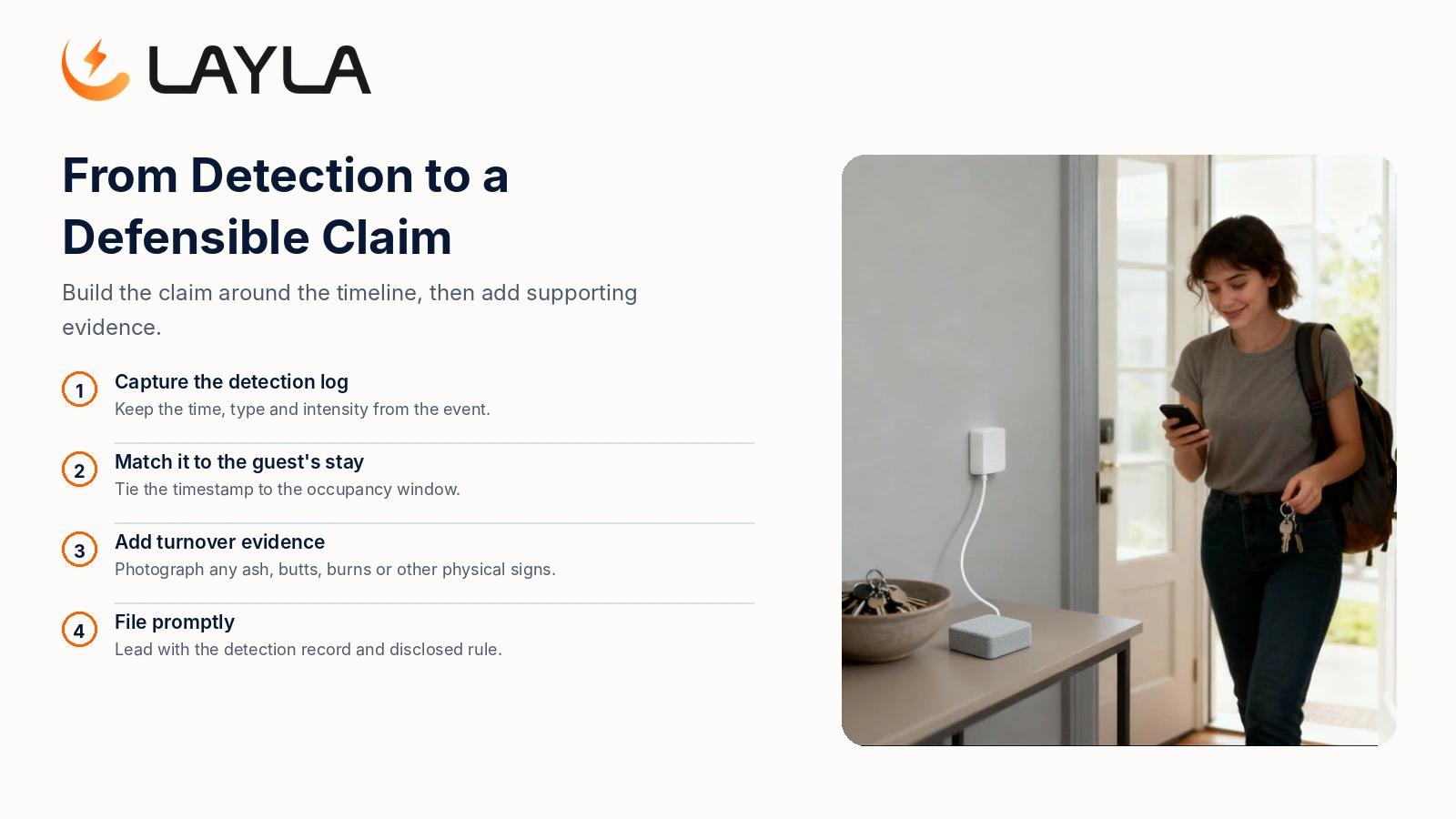
Get the disclosure and the fee sorted before anyone books. State the no-smoking rule, name the fee, and note that the home has an air-quality sensor watching for smoking and vaping, with no cameras or mics. That one line puts off most would-be offenders and makes the fee stick for the rest.
When an alert fires, don't sit on it. Note the time, the type and the intensity while it's fresh, and if the cleaner turns up anything physical at turnover, photograph it and match it to the log. Then file through the platform's resolution process promptly, inside its deadline, leading with the detection record and the disclosed rule, with the physical bits as backup. A claim that opens with "here's a timestamped cannabis detection at 1:15am during this guest's stay, against a disclosed no-smoking policy and a stated fee" is a completely different conversation from "the room smelled off." One gets written off. The other gets paid.
Frequently asked questions
Can I charge a guest for smoking without proof?
You can file the charge, but without evidence it rarely holds. Airbnb's resolution centre and security-deposit processes put the burden of proof on the host, and a smell or a clean-looking photo won't meet it. A timestamped detection record placing the event inside the guest's stay is what makes a smoking fee enforceable.
Does Airbnb accept a smoke detector's log as evidence?
A timestamped record from an air-quality or smoke sensor, showing the type and time of the event within the guest's stay, is far stronger than a smell or a photo, and it gives Airbnb something concrete to act on. Pair it with a disclosed no-smoking rule and a stated fee for the best shot. The platform always makes the final call, so lead with your most specific evidence.
How do I prove it was cannabis and not a cigarette?
Use a sensor that names the substance rather than one that only reports "smoke." A device that separates cigarette, vape and cannabis and grades intensity gives you a record specific enough to back the exact breach you're claiming.
Can I use a camera to prove smoking?
No. Airbnb, Vrbo and Booking.com ban cameras and microphones in interior spaces, and a camera wouldn't detect smoking anyway. The evidence that works is environmental, a timestamped air-quality detection, not footage of the guest.
What if the guest denies it?
That's exactly what a timestamped, typed detection log is for. "Wasn't me" falls apart when the record shows a high-intensity cannabis event at a specific time during that guest's stay, against a policy they agreed to when they booked.
Related reading
- How to Detect Vaping in a Rental Without Cameras
- Best Cigarette, Vape & Cannabis Smoke Detectors for Rentals (2026)
Stop writing off smoking fees you're actually owed. See how Layla gives you the record: timestamped cigarette, vape and cannabis detection, typed and graded, from one sensor, bought once.

Best for: health-conscious homes
Smoke & Air Quality
Air quality, mold and smoke monitoring for healthy homes and smoke-free rentals.
Included forever — no subscription
- Mold-risk early warning
- Smoke & cigarette detection
- Air quality score (IAQ) with alerts
- CO₂ & bVOC monitoring
- AI air insights & recommendations
- Allergy-comfort monitoring
No monthly fees. Ever.
30-day money back guarantee