BLOG
The Real Cost of a Vape Detector: Subscription vs One-Time
 By Nangyal Khan··Updated
 7 min read
The sticker price on a smoke or vape detector barely tells you anything. Two devices can look almost identical on a spec sheet and end up hundreds of dollars apart three years down the line, because one was bought once and the other charges you every month just to keep working. For a single rental that's mildly annoying. Across a portfolio it becomes a budget line that quietly outgrows the problem it was meant to fix.
So before you compare detection, it pays to look at the number the marketing pages are quietest about. Not the up-front price. The total you'll actually spend to keep the sensor running.
Two business models hiding behind two prices
The devices in this market fall into two camps, and that split matters more than any single feature.
One camp sells you the hardware, then charges a recurring fee to keep it alive, monthly or yearly. The device is often cheap or even "included" up front, precisely because the real money is in the subscription, and the sensor goes dark the day you stop paying. You're not buying a detector so much as renting access to one.
The other camp sells you the device once. You own it, it keeps running, and there's no monthly line on your statement. The up-front number is higher than a subsidised subscription device, and that's the trade. Pay a bit more once, or pay less every month for as long as you own it.
Which one is cheaper comes down to how long you keep it and how many you run. Over a single season on one unit, a subscription can look competitive. Over the multi-year, multi-unit reality most hosts actually live in, buying once pulls ahead and never looks back.
What each option really costs
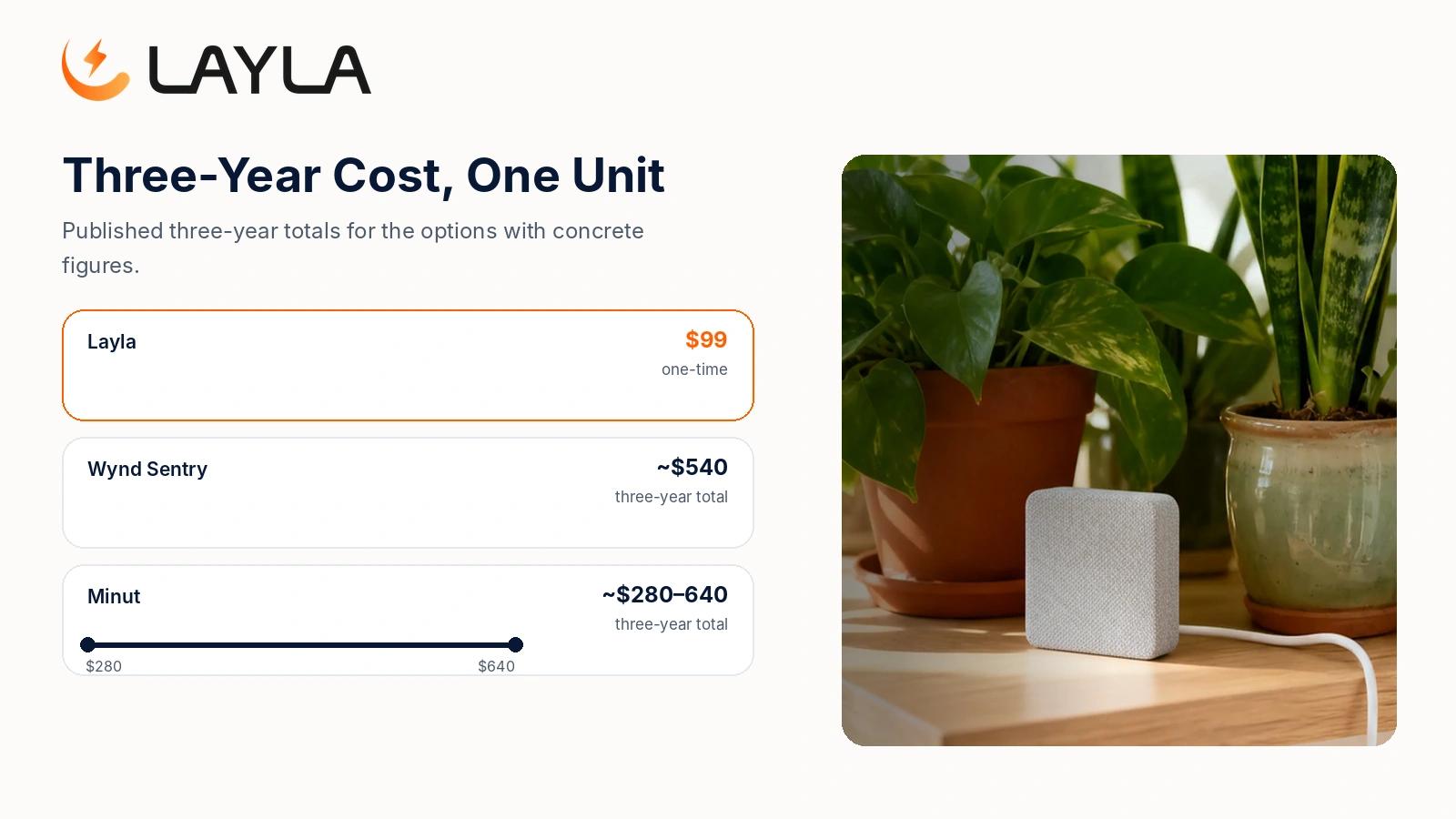
Here's how the main contenders price, based on their published models. Layla is a one-time $99 right now, discounted from $189, with no subscription, and it catches cigarette, vape and cannabis while also covering air quality, noise and occupancy. Wynd Sentry includes the device, but only with a subscription of roughly $180 a year and a one-year minimum after the trial, and it stops working if you stop paying. Minut runs about $100 for the sensor plus $5 to $15 per property each month depending on the plan. FreshAir Sensor and the HALO Smart Sensor are institutional systems sold on subscription or enterprise quote, built for buildings rather than individual hosts.
Line it up over three years for a single unit and the gap is hard to miss.
| Device | Up front | Ongoing | 3-year total, 1 unit |
|---|---|---|---|
| Layla | $99 (from $189) | none | $99 |
| Wynd Sentry | included | ~$180/yr | ~$540 |
| Minut | ~$100 | ~$5–15/mo | ~$280–640 |
| FreshAir / HALO | quote | subscription | enterprise (typically well above) |
Competitor pricing reflects each company's published model at the time of writing and can change. Confirm current terms before you buy.
The one-time device costs $99 across those three years. The subscription options land at three to six times that for the same stretch, and the meter keeps ticking in year four, year five, and every year after. None of the extra money bought better detection. You just kept paying to keep the light on.
Now multiply it by a portfolio
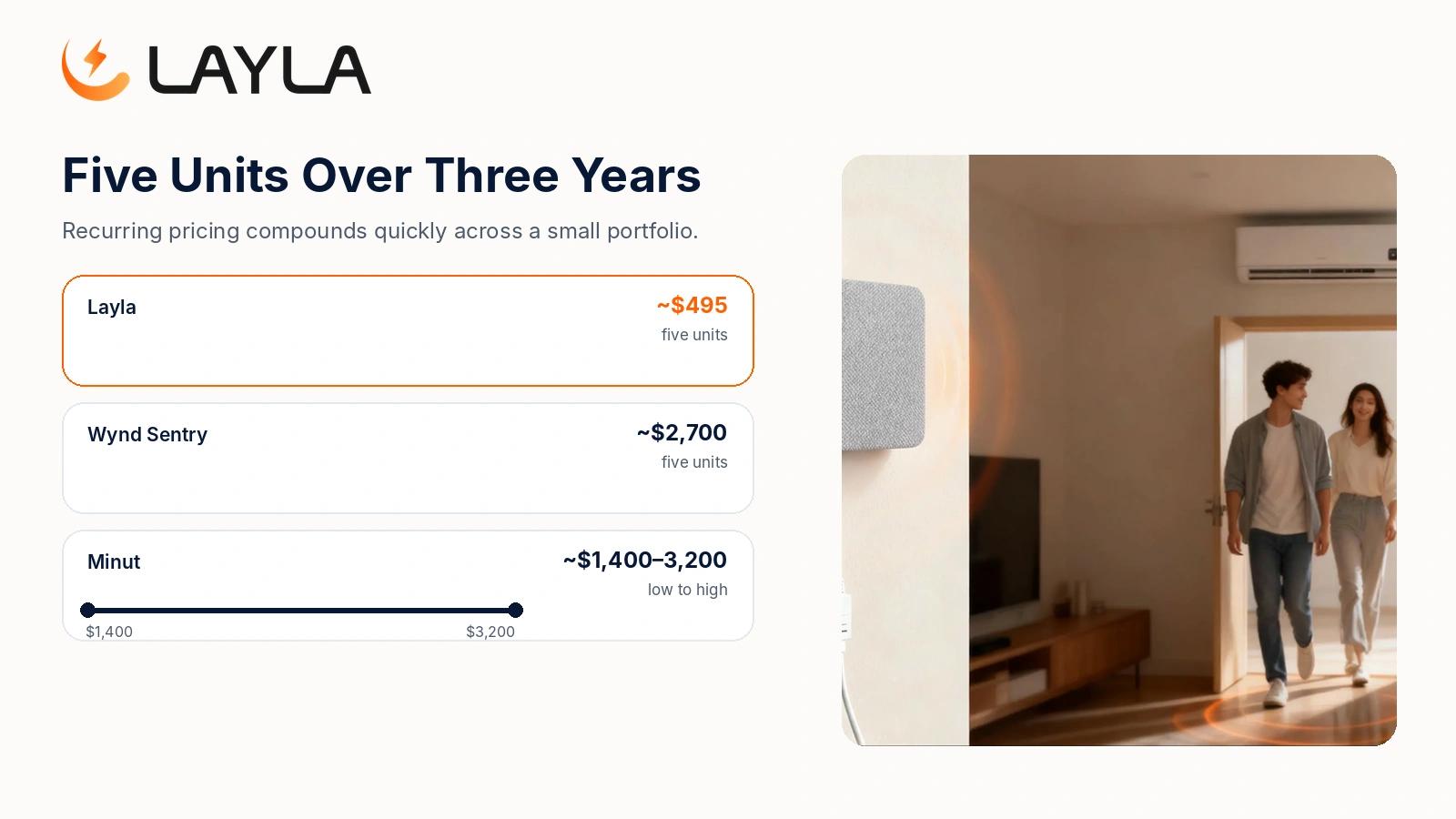
The single-unit table already leans toward buying once. Scale it to the way most of this audience actually works and it stops being close at all. Take five units held for three years. Layla is five one-time purchases, around $495, and then nothing. Wynd Sentry at roughly $180 a year per unit comes to about $2,700 over the same window. Minut lands somewhere between $1,400 and $3,200 depending on the plan. Same three years, same five units, and the recurring models cost anywhere from a thousand to nearly three thousand dollars more, with the bill still arriving long after Layla's has gone quiet.
The subscription meter also doesn't care whether a unit is earning. A short-term rental sitting empty between bookings, a student unit dark over summer, a hotel room out of service, all of them keep paying their monthly fee. A device you own costs the same whether the unit is full or empty. Nothing.
When a subscription still makes sense
To be fair about it, recurring pricing isn't a con, and there are cases where it earns its place. If the platform integration is the whole point for you, Minut's official Airbnb partnership drops warnings straight into tools some hosts already live in, and that convenience is worth real money to them. If you want a smoke specialist with heavily formatted dispute reports and don't mind paying monthly for the managed side, Wynd Sentry delivers that. And at true institutional scale, FreshAir's molecular precision and HALO's enterprise depth are simply the right tools for casinos, schools and large venues that buy that way. If one of those specific needs is your deciding factor, the subscription can be worth it.
For everyone else, and that's most hosts, landlords and small-to-mid operators, the honest read is that you'd be paying a recurring fee for detection you could just own. The reason to buy once isn't only the money, though the money settles it over any real timeframe. It's that ownership takes a permanent liability off the books and a permanent dependency off your vendor's billing system. Layla sits there on purpose. It does real vape detection, not just cigarette, and names the type while grading the intensity. There's no camera or mic, so it's safe to disclose on any platform, and the same unit also covers air quality, noise and occupancy. You pay for it once, right now $99. Bought once, across a portfolio, over years, it isn't a close call.
Frequently asked questions
What's the cheapest vape detector for a rental over time?
Over any multi-year period, a one-time device wins, because subscription fees pile up. Layla is $99 once (down from $189) with no recurring cost, while subscription options like Wynd Sentry (~$180/yr) and Minut (~$100 plus $5–15/mo) cost several times more across three years and keep charging after that.
Why are some vape detectors so cheap up front?
Because the money is in the subscription. A device that's cheap or "included" is usually subsidised by a monthly or annual fee you'll pay for as long as you use it, and the sensor typically stops working if you cancel. The low sticker price hides the recurring one.
Does a one-time detector work as well as a subscription one?
It can work better. Layla detects cigarette, vape and cannabis, names the type and grades intensity, which is more than several subscription devices manage, while adding air quality, noise and occupancy, with no ongoing fee. Subscriptions mostly buy managed services or platform integrations, not necessarily better detection.
When is a subscription detector worth it?
When one specific feature is your deciding factor. Minut's official Airbnb integration, Wynd's formatted dispute reporting, or the institutional systems (FreshAir, HALO) built for schools, casinos and large hotels. For most individual hosts and small portfolios, a one-time device is the better economics.
How much do I save across several units?
A lot, and it grows every year. Across five units over three years, a one-time device runs around $500 total, while subscription models run from roughly $1,400 to $2,700 or more over the same span, and keep charging afterwards.
Related reading
- Best Cigarette, Vape & Cannabis Smoke Detectors for Rentals (2026)
- Layla vs Wynd Sentry: Which Catches Smoking in Your Rental?
- Minut Smoke Detection vs Layla: What Each One Catches
Pay once, not forever. See what Layla covers for a one-time $99: cigarette, vape and cannabis detection with air quality, noise and occupancy from a single sensor, no subscription.

Best for: health-conscious homes
Smoke & Air Quality
Air quality, mold and smoke monitoring for healthy homes and smoke-free rentals.
Included forever — no subscription
- Mold-risk early warning
- Smoke & cigarette detection
- Air quality score (IAQ) with alerts
- CO₂ & bVOC monitoring
- AI air insights & recommendations
- Allergy-comfort monitoring
No monthly fees. Ever.
30-day money back guarantee