BLOG
Texas Short-Term Rental Laws 2026: State Rules, Austin, Dallas, Houston
 By Nangyal Khan··Updated
11 min read

Last updated: October 28, 2026. Sources last checked: October 28, 2026. This guide is informational, not legal advice.
Short-term rentals are legal in Texas, and the one rule that applies everywhere is tax: you collect the 6% state hotel occupancy tax on stays of less than 30 consecutive days, plus whatever your city and county add. Beyond that, Texas short-term rental laws are city by city. Austin requires a two-year operating license, limits how many units one person can run per site, and since July 1, 2026 asks platforms to pull unlicensed listings. Dallas adopted zoning and registration ordinances in 2023, but the city says a temporary injunction filed that December prohibits enforcing them. In Houston, guests pay 17% in combined hotel taxes.
Are short-term rentals legal in Texas?
Yes. The Texas Comptroller treats a rented house the way it treats a hotel room: "Persons leasing their houses must collect hotel occupancy tax from their customers in the same way a hotel or motel collects the tax from its guests." Whether you need a permit, how many units you can run and what fines apply all depend on the city the property sits in.
A short-term rental in Texas tax terms is the rental of all or part of a residential property to someone who isn't a permanent resident, for 29 days or less, per the Comptroller's hotel tax FAQ, citing Tax Code Section 156.001(b). Austin and Dallas draw the same line in their own definitions — fewer than 30 consecutive days.
The state layer: hotel occupancy tax
The Comptroller's hotel tax page and FAQ set out what applies statewide:
- Rate: 6% of the cost of the room, on stays of less than 30 consecutive days, where the room costs $15 or more a day.
- Local tax on top: cities, some counties and special purpose districts can each add their own hotel tax, generally up to 7%, plus up to 2% for sports and community venue projects (up to 3% in Dallas County). Local taxes apply from $2 a day.
- Who collects: a platform that has an agreement with you to collect state tax must do so. If it doesn't, or you book guests directly, you collect and remit the state tax yourself. For local tax, the Comptroller sends you to your city and county.
- When: monthly returns are due on the 20th of the following month, or quarterly if you qualify. Filing and paying on time earns a 1% discount.
- Late: a $50 penalty for each late report, 5% if tax is paid 1 to 30 days late and 10% after that, with interest from 61 days.
- Long stays: guests who stay 30 or more days and say so in writing beforehand are exempt from the day they notify you.
Texas short-term rental laws by city
| Austin | Dallas | Houston | |
|---|---|---|---|
| Permit | Operating license, valid 2 years | Registration ordinance adopted 2023, enforcement enjoined since Dec 6, 2023 | See the city's own STR page |
| Unit limits | Up to 2 STR units per single-family site; others 1,000 ft apart | Zoning ordinance adopted 2023, enforcement enjoined | Not covered here |
| City hotel tax | Platforms collect since April 1, 2025; owners file quarterly reports | 9%, paid by the owner; no platform agreement | 7% city, plus 2% Harris County and 2% sports authority |
| Plus state tax | 6% | 6% | 6% |
| 2026 change | Platform rules and removal requests from July 1, 2026 | 15% penalty on hotel tax unpaid three months after its due date, from Feb 1, 2026 | Not confirmed |
Noise is where Austin and Dallas overlap. Austin writes decibel limits for sound equipment into its code, and Dallas still enforces its disturbing-noise rules while the STR ordinances are on hold. A camera-free sensor such as All-in-One, $299 one time alerts you when the noise level inside climbs, as the monitoring section at the end explains.
Austin
Austin regulates short-term rentals, meaning residences rented for less than 30 consecutive days, through a city ordinance, with licensing by Development Services Code Compliance (City of Austin STR page). The rules changed twice in 2025.
In February 2025, the City Council made STRs an accessory use to all residential uses in every zoning district, as long as the operator holds a valid license. Then in October 2025 these changes took effect:
- Licenses last two years instead of one.
- A certificate of occupancy and proof of insurance are no longer required.
- Tenants may operate an STR with the landlord's permission.
- On a single-family site, one person may run up to two STR units, and more elsewhere only if they're at least 1,000 feet apart.
- On mixed-use sites with four or more homes and a commercial use, the limit is the greater of one unit or 25% of the units. On multifamily sites, the greater of one unit or 10%.
- Neighbors within 100 feet are notified at every renewal as well as for the first license.
The city's page sets no annual night cap; the limits above are about how many units one operator runs.
Licensing and fees. A new operating license costs $736.60, which is the $642.00 license fee plus a $94.60 neighbor notification fee, and fees aren't refundable. In the full-purpose jurisdiction you also need an Austin Finance Online account for hotel tax. Properties in Austin's extraterritorial jurisdiction need no city license and pay no city hotel tax. Those in the limited purpose jurisdiction need a license but don't pay the city hotel tax.
Local contact. If you don't live in the Austin metro area, you must name a local contact in Travis, Williamson, Hays, Bastrop or Caldwell County who can respond within two hours of being told about an emergency, at any hour.
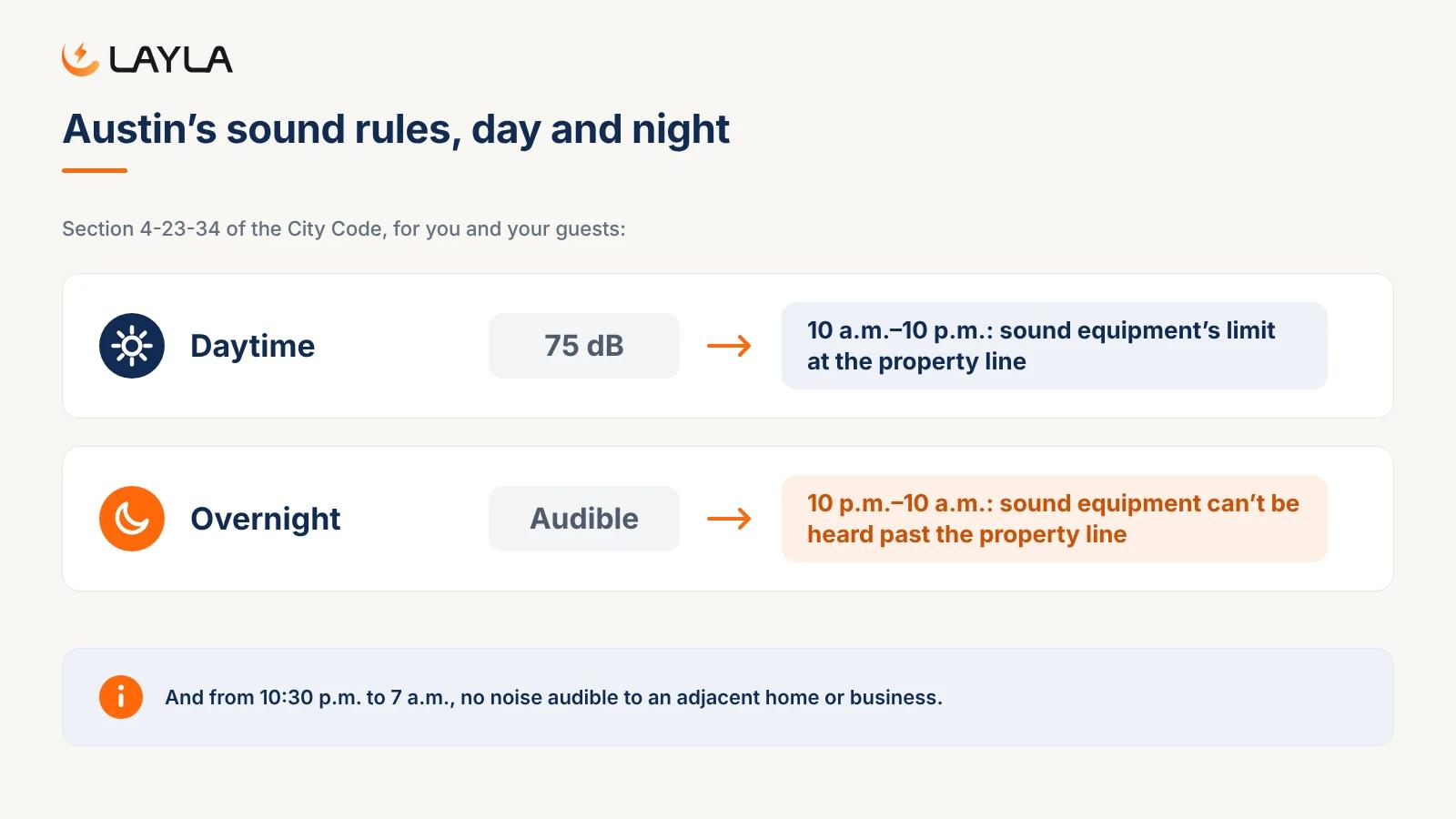
Noise rules. Under section 4-23-34 of the City Code, neither you nor your guests may:
- use sound equipment louder than 75 decibels at the property line between 10 a.m. and 10 p.m.
- use sound equipment audible beyond the property line between 10 p.m. and 10 a.m.
- make noise audible to an adjacent home or business between 10:30 p.m. and 7 a.m.
- advertise the home as a short-term rental if it isn't licensed
You also leave guests an information packet with the local contact's details, the noise limits, parking rules and the trash schedule.
Tax. Since April 1, 2025, booking platforms must collect Austin's hotel tax for you. You still file a quarterly report showing what each platform collected, a zero report if you had no stays, and you remit tax yourself on any direct bookings.
Dallas
Dallas Code Compliance defines a short-term rental as a unit rented for fewer than 30 consecutive days or one month, whichever is less. On June 14, 2023, the City Council approved two ordinances: zoning amendments creating a "short-term rental lodging" use in Chapters 51 and 51A, and a separate registration ordinance run by Code Compliance (Dallas Planning STR page).
Neither is being enforced. The same Code Compliance page says: "On December 6, 2023, a temporary injunction was filed prohibiting the enforcement of the two short-term rental ordinances." In the meantime, the city keeps enforcing its existing rules on minimum property standards, disturbing noises and private nuisances.
Hotel tax isn't paused. The Controller's Office requires every hotel, which includes short-term rentals, to collect 9% of net room receipts. The city has no collection agreement with any platform, so you register the property and pay the tax yourself. Returns are due by the 15th of the following month, with a 1% discount for paying on time. From February 1, 2026, tax unpaid three months after its due date carries a 15% penalty, and 10% annual interest runs from the first day late. The city says penalties and interest cannot be waived.
Houston
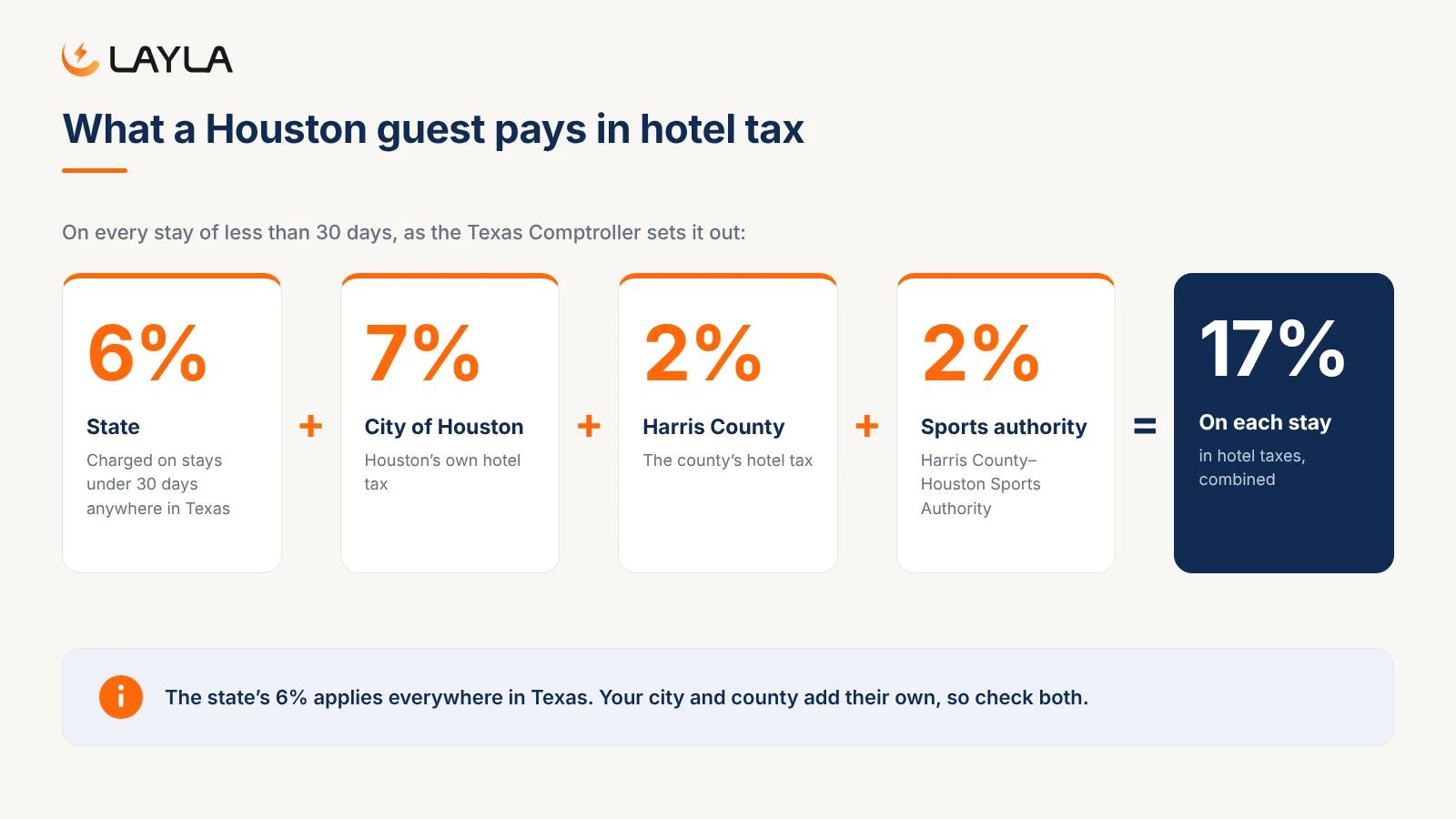
Houston's tax stack is the one the Comptroller uses as its example: 6% state tax, 7% Houston tax, 2% Harris County tax and 2% Harris County–Houston Sports Authority tax. That's 17% on each stay.
For registration and operating rules, check the City of Houston's website before you list, and check it again before you renew.
What changed for 2026
Only changes dated on a government page are listed.
- Austin, July 1, 2026: platform regulations took effect. Platforms must have a license display field and remove unlicensed listings when the city asks, and the city said it would begin requesting removals of unlicensed properties that day (City of Austin).
- Dallas, February 1, 2026: a 15% penalty on hotel tax left unpaid three months past its due date (Controller's Office).
- State: the Comptroller's hotel tax pages show no 2026-dated change to the 6% rate.
What this means for monitoring your listing
Austin's code puts a decibel number on sound equipment: 75 dB at the property line in the daytime, and nothing audible past it between 10 p.m. and 10 a.m. Dallas still enforces disturbing-noise rules while its STR ordinances sit under injunction. If you're not local, Austin also expects your contact to respond within two hours.
Inside the home, the platform sets the limits. Airbnb's policy, in force since April 30, 2024, says: "We do not allow hosts to have security cameras or recording devices that monitor indoor spaces in homes… even if these devices are turned off." On noise, it says "Noise decibel monitors are devices that assess sound levels and their duration but do not record audio," allowed indoors "as long as the host discloses their presence and they are not located in bedrooms, bathrooms, or sleeping areas." More in our guide on whether monitoring sensors are allowed in Airbnb.
Layla gives you a decibel reading, never a recording, and counts people with radar presence sensing rather than a camera. Set a strict threshold for the overnight hours and a looser one for the day, and your phone gets an alert when the level inside crosses it. The party detector looks at how many people are inside, how loud it is and what time it is, so a late-night crowd shows up as an alert.
All-in-One puts noise, occupancy, smoke detection and AC control on one sensor for $299 one time, with no subscription. Hot Texas summers make the Eco Mode part useful too — it turns the AC down or off when the place is empty between stays. Compare it with other devices in our best noise monitor for Airbnb guide, and use our quiet hours guide to set your listing's quiet hours to match the city's. Hosting in other states too? See our California short-term rental laws guide.
FAQ
What are the Texas short term rental laws in 2026?
Statewide, you collect 6% hotel occupancy tax on stays under 30 consecutive days, plus local hotel taxes. Everything else is local. Austin requires a two-year operating license, limits units per site and enforces platform rules since July 1, 2026. Dallas's 2023 STR ordinances are under injunction, but its 9% hotel tax applies.
Are short term rentals legal in Texas?
Yes. The state Comptroller treats a rented house like a hotel room for tax: you collect the 6% state hotel occupancy tax unless a platform does it for you under an agreement. Permits, unit limits and noise rules are set by each city, so check your city's short-term rental page before listing.
Do you need a license for a short term rental in Austin?
Yes. Every STR owner or operator in the City of Austin needs a city operating license, valid for two years. A new license costs $736.60, including the neighbor notification fee. Properties in the extraterritorial jurisdiction need no license. Since July 1, 2026, the city can ask platforms to remove unlicensed listings.
Is the Dallas short term rental ordinance in effect?
Not for now. Dallas adopted a zoning ordinance and a registration ordinance for short-term rentals on June 14, 2023, but a temporary injunction filed on December 6, 2023 prohibits enforcing them. The city still enforces property standards, noise and nuisance rules, and owners must register for and pay the 9% city hotel tax.
What is the hotel occupancy tax on a short term rental in Texas?
The state rate is 6%, and cities, counties and special districts can add local hotel taxes, generally up to 7% plus venue taxes. In Houston, the total is 17%: 6% state, 7% city, 2% Harris County and 2% sports authority. Dallas charges 9% city tax on top of the state 6%.

Best for: full property coverage
All-in-One
Noise monitoring, smoke detection and smart AC control for complete coverage.
Everything included
Everything in Noise & Security Pro
AI party detector, noise alerts, intruder & break-in, occupancy, 180-day history, indoor + outdoor climate
Everything in Smoke & Air Quality
Air quality index (IAQ), CO2, bVOC, mold & smoke — full indoor + outdoor climate
Everything in AC Control & Energy
Smart AC (150+ brands), Eco Mode, schedules, filter health
Plus exclusive
- Advanced reports & insights
- Priority support
- Priority support
No monthly fees. Ever.
One sensor. Full coverage
One sensor. Full coverage.* Layla 3.0 monitors noise, air quality, motion, occupancy, temperature, humidity, pressure, VOCs, CO2, and controls your AC - from a single device on your shelf.
No subscription means no surprise costs.
Pay once. Every feature unlocked. Forever. No monthly fees eating into your rental margins or household budget.
The smartest buy is the one you make once.
Other solutions charge per-feature monthly subscriptions that exceed the device cost within a year. Layla's all-in-one pays for itself compared to any subscription alternative.
30-day money back guarantee