BLOG
What happens when a noise monitor detects a party: one night at a rental, alert by alert
 By Nangyal Khan·
7 min read
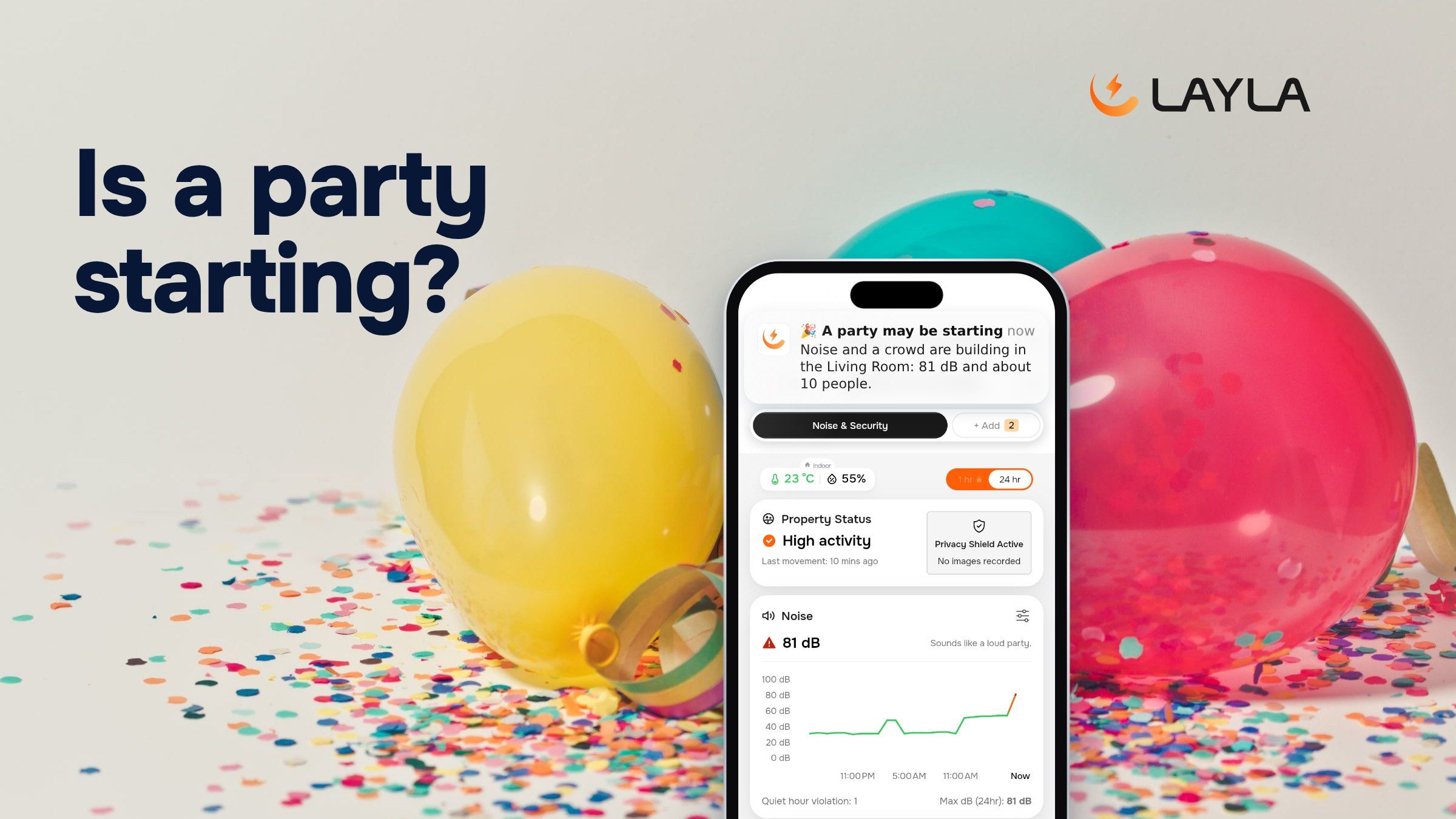
When noise and a crowd build at the same time, Layla sends a party alert to your phone. It says how loud it is and about how many people are inside. A loud alert alone is not a party alert: the party alert comes only when noise and people rise together. Layla never steps in. It tells you, and you decide what to do while there is still time. It measures noise in decibels, records no audio and uses no camera.
See Noise & Security Pro, the plan with the party alert
Here is one Saturday night at a home we will call Beach House. It allows 6 guests. You will see each alert as it arrives, what it means and what the host does next.
What do you set before guests arrive?
A few settings decide when your alerts come. Set them once and they hold for every stay.
- Your guest limit. Tell Layla how many guests the home allows. Layla tells you how many people are inside, and sends a crowd alert when there are more than that. Beach House is set to 6.
- When a loud alert comes. Choose Strict (70 dB for 1 minute), Balanced (70 dB for 5 minutes) or Relaxed (85 dB for 10 minutes). Beach House uses Balanced, so a short burst of laughter sends nothing, but noise that keeps going does.
- Quiet hours. Set a night limit for quiet hours, from 65 to 75 dB. Beach House has quiet hours from 22:00 to 07:00 at 65 dB.
Then tell your guests. Airbnb allows noise decibel monitors when guests are told about them, so say so in your listing and your house rules. A plain line works: "This home has a noise monitor that measures noise levels in decibels and counts how many people are inside. It records no audio and has no camera."
What does the first alert look like?
Quiet hours at Beach House started at 22:00, so the night limit of 65 dB applies. At 23:10 the living room reaches 68 dB, which is already over it, and the host gets a phone notification: "Too loud for quiet hours. 68 dB in the Living Room at 23:10. Your night limit is 65 dB." It gives the reading, the room, the time and the limit it passed, so the host knows how far over it is without opening the app.
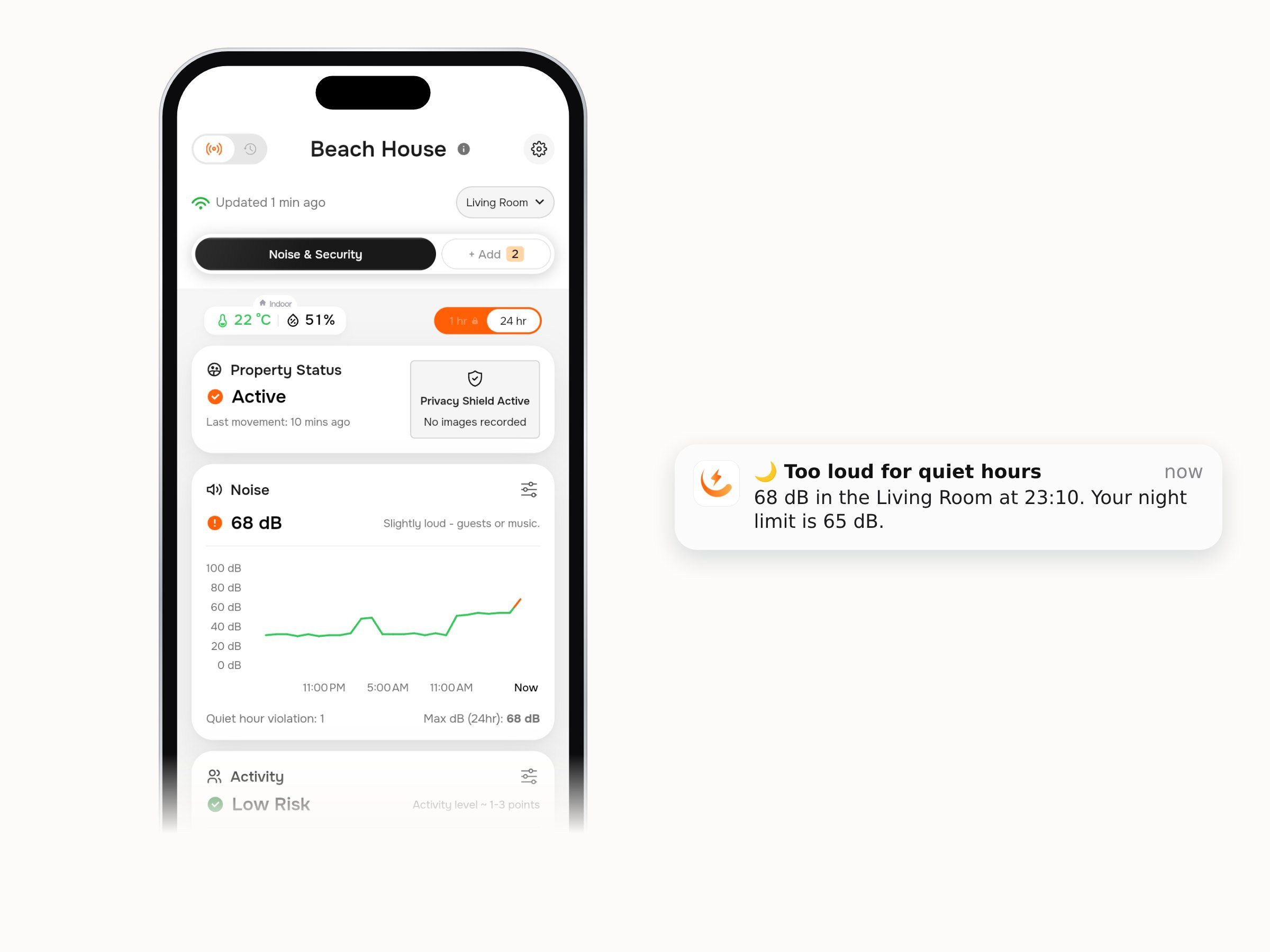
Layla's first alert at 23:10: how loud, where, when and the night limit
This is the moment for a friendly message, not a warning. The host sends:
"Hi! Hope you're having a great time. Just a heads-up that it's quiet hours now and noise carries to the neighbors here, so could you keep it down a little? Thanks so much!"
A calm message like this often settles it on the spot. At Beach House it did not. At 23:25 a crowd alert comes in: 8 people are inside, against a limit of 6. The noise is now only part of it, because more people have arrived than the booking allows.
When does Layla say it is a party?
Ten minutes later, at 23:35, noise and the crowd are both still climbing. That is what the AI Party Detector looks for, and the party alert arrives: "A party may be starting. Noise and a crowd are building in the Living Room: 81 dB and about 10 people."
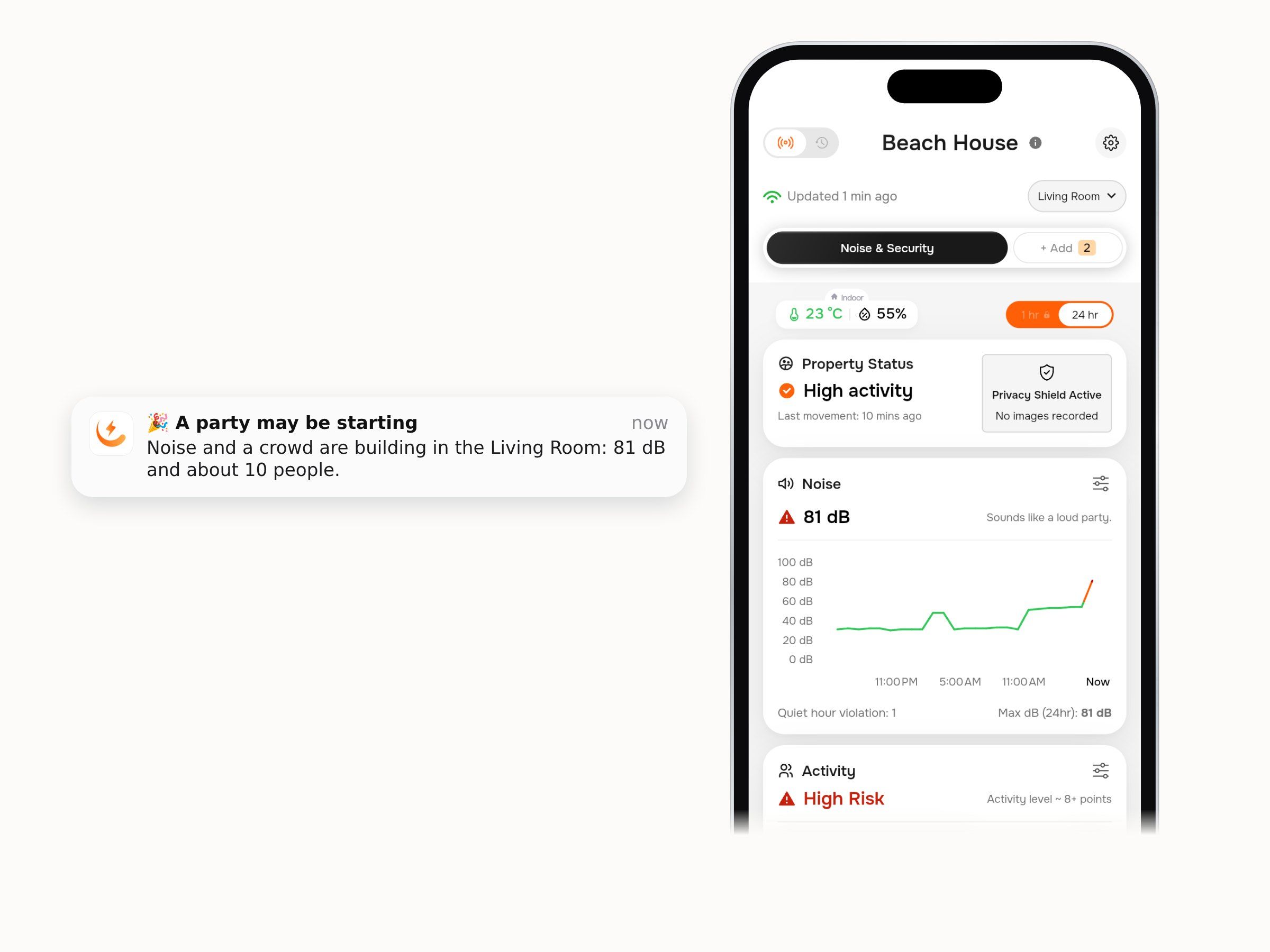
Layla's party alert at 23:35, and the screen it opens
The alert carries both numbers at once, so the host does not have to piece the night together. In the app, Beach House shows the Living Room live: 81 dB, "Sounds like a loud party", and activity high. The host set the limit at 6.
What the host does next:
- Call or message the guest who booked. Keep it short and factual: the house allows 6 guests, and there are about 10 people inside. Ask the extra guests to leave and the noise to come down now.
- Point to the house rules. The guest agreed to the guest limit and the quiet hours when they booked. Quote the rule rather than arguing about it.
- Know your next step if it goes on. If the noise and the crowd hold after your call, follow your booking platform's process for a guest breaking the house rules, and keep your neighbors in the loop.
At Beach House the call worked, but a party takes time to wind down. The noise came down slowly and was back under the night limit by about 01:20.
What does the morning after show?
By about 07:15 the morning Summary is ready. With Party & guest watch and Quiet pinned, Beach House opens on last night. The Guest Watch card says Party, "Full house and loud", and the Quiet card says Low. Tap Guest Watch and Party & guest watch opens with the detail: about 10 people inside, and noise over the limit from the 23:00 hour. The host does not have to dig through charts to remember what happened.
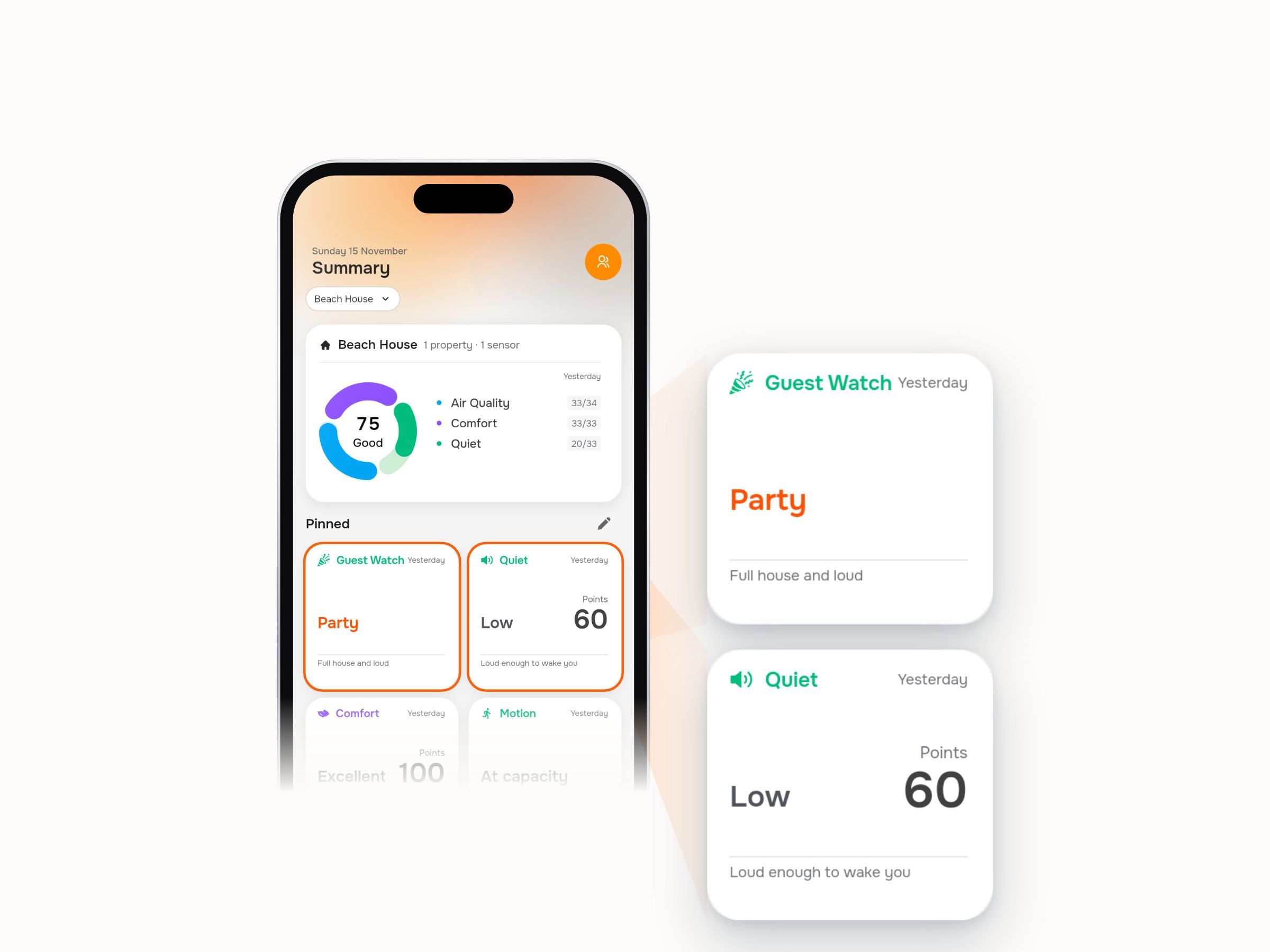
The next morning, Layla's Summary shows last night as a party and the quiet score it cost
If a neighbor complains, or the host wants to talk to the guest about the extra people, there is an incident report too. It is a PDF for the whole home over the dates you choose, with charts of noise and of people over time, sent by email. On Noise & Security Pro you can ask for one for any dates in the last six months.
With the facts in hand, the conversation stays calm: "We saw about 10 people at the house on Saturday night, against a limit of 6. Please keep to the guest limit next time." No guessing, and nothing to argue about.
Which plan gives you this night?
Not every alert in this story comes with every plan. Noise Basic, at $149, gives you the noise alerts, the quiet-hours alert and the crowd alert. The party alert and the morning Party & guest watch come with Noise & Security Pro, at $179.
| What you get | Noise Basic | Noise & Security Pro |
|---|---|---|
| Noise and quiet-hours alerts | Yes | Yes |
| Crowd alerts | Yes | Yes |
| Party alert | No | Yes |
| Party & guest watch | No | Yes |
| Readings | Every 5 minutes | Real time |
| Charts | 7 days | 30 days |
| Incident reports | 7 days | Six months |
Pro also adds radar security for when the home should be empty.
Pro costs $30 more than Basic, and you pay it once. Neither plan has a subscription: what you buy is yours. If parties are the worry, the party alert is what turns "it got loud" into "a party is starting", while there is still time to act. You can compare every plan on the pricing page.
What else happens on a party night?
Guests at a party may smoke or vape inside, which you often find out about only from the smell or the next guest's review. Smoke & Air Quality, at $99, detects cigarette, vape and cannabis smoke. Its alert says smoke was detected, with the time and the room.
If you want both problems covered, All-in-One, at $299, is one sensor with everything in Noise & Security Pro and Smoke & Air Quality: the noise, the people count, the party alert and the smoke alerts, in one setup.
Keep reading
A party you only hear about from a neighbor or a one-star review is the one you could not stop. With the party alert, you hear about it at 23:35, not the next day.
Get Noise & Security Pro for the party alert and the morning after
- Best noise monitor for Airbnb: how Layla's alerts compare with the other noise monitors hosts buy, side by side.
- How to catch extra guests at your short-term rental: when the problem is more guests than you allowed rather than noise, here is how to catch it.
- How to detect vaping in a rental without cameras: the other thing that happens at parties, and how to know a guest vaped without a camera.

Best for: serious hosts
Noise Pro
Compliant with Airbnb's rules and local noise laws worldwide. Advanced protection for serious hosts.
Included forever – no subscription
- AI party detector
- Instant noise alerts with timestamps
- Live data feed, no 5-minute delay
- 180-day data history
- Radar intruder & vacant-home alerts
- Property status dashboard
- Outdoor temperature & humidity
- Automatic AI accuracy updates
- Daily & weekly summary reports by email
No monthly fees. Ever.
Your indoor air is 2-5x more polluted than outdoor air.
The EPA confirms it, but most people have no idea. You spend 90% of your time indoors breathing air you've never measured.
CO2 builds up silently.
A bedroom with two people can hit 2,500 ppm overnight. Harvard research shows decision-making drops 50% at 1,400 ppm. That brain fog and morning fatigue? It might not be bad sleep - it's bad air.
VOCs are off-gassing in every room.
New furniture, carpets, paint, cleaning products indoor VOC levels run up to 10x higher than outdoors. Some, like formaldehyde and benzene, are classified carcinogens. You can't smell most of them.
Mold starts in 24 hours.
When humidity exceeds 60%, mold begins colonizing within a day. 47% of U.S. homes show visible mold. Average remediation cost: $2,368 severe cases hit $30,000. A sensor that warns you before mold starts is orders of magnitude cheaper than cleanup.
Standard smoke detectors only catch fires.
They don't detect cigarette, vape, or marijuana smoke at low levels. For landlords and hosts, unauthorized smoking causes damage that goes unnoticed for weeks.
Post-COVID, people want data.
66% of Americans are more cautious about indoor air since the pandemic. 61% say they'd trust a space more if it monitored air quality. The awareness shift is permanent.
30-day money back guarantee