BLOG
Layla vs Aqara FP2: Presence Sensor or Property Monitor?
 By Nangyal Khan··Updated
 8 min read
Both devices tell when someone is in a room using radar, with no camera and no microphone. That shared starting point is where most Layla vs Aqara FP2 comparisons begin, and it is roughly where they end, because the two products are built for different jobs. The Aqara FP2 is a smart-home component. It senses presence in a zone and fires an automation: lights on, fan off, scene triggered. Layla is a property monitor. It reads presence as one signal among many and turns it into something a host or owner can act on. So the question comes down to this. Do you want a sensor that makes your home react, or a sensor that tells you what is happening inside a property?
What does the Aqara FP2 do?
The FP2 is a millimetre-wave radar presence sensor, and it is good at the thing it was designed to do. It maps a room into zones, up to 30 of them across a space of roughly 40 square metres, and it tracks several people at once, rated for up to five targets though it performs best with three or fewer. Because it reads micro-movement rather than heat or motion blur, it registers a person sitting still at a desk — exactly where cheaper PIR motion sensors fail. Ceiling-mounted, it adds a fall-detection mode aimed at elder-care and bathroom setups. No camera is involved, so none of this carries the privacy baggage of a lens.
It connects over 2.4GHz Wi-Fi with wired USB-C power, and it plugs into the major ecosystems: Apple HomeKit, Amazon Alexa, Google Home and Home Assistant. You do not need an Aqara hub for basic presence detection, and the core functionality carries no subscription. The hardware is cheap too — roughly $55 on sale and about $83 at list — which for a precise multi-zone radar sensor is a genuinely strong price. If your goal is to make a room respond to people automatically, the FP2 is a sharp, affordable tool, and its depth of HomeKit and smart-home integration is a real advantage that budget sensors cannot match.
The limits are not flaws so much as scope. The FP2 is a single-purpose automation component that knows presence and nothing else. It does not measure noise, read air, detect smoke or flag mould, and it has no concept of a "party" or a guest threshold. To be useful at all it assumes you already run a smart-home ecosystem for it to talk to. On its own, a sensor that only reports true or false to an automation engine is not a monitoring product. It tells your house to do something; it does not tell you what is going on.
What does Layla do that the FP2 doesn't?
Layla starts from the same radar foundation and keeps going. It counts people in a room with no camera, no microphone and no Bluetooth tracking, and that reading drives a Presence & motion score rather than a bare on/off trigger. From there the single device picks up the signals a property actually generates. It measures noise in decibels against quiet-hours rules, with no audio ever recorded. It measures CO₂ directly, tracks VOCs, and reports an indoor air quality index. It identifies smoke and tells cigarette apart from vape apart from cannabis, with intensity grading. It watches temperature, humidity and mould risk, and it controls an AC natively through an Eco Mode that trims roughly a quarter off cooling energy.
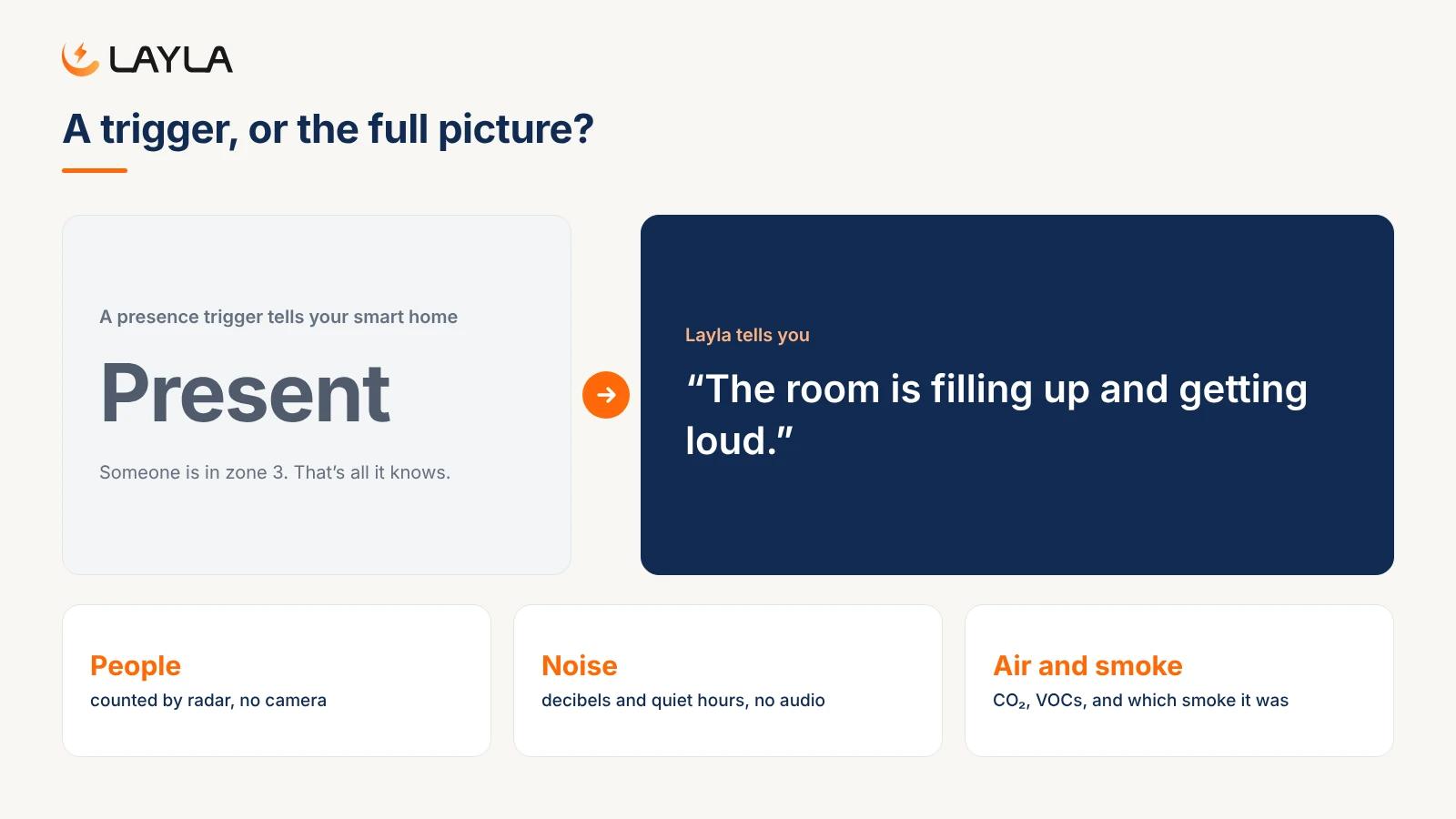
The feature that pulls presence into the monitoring world is Party & guest watch. It combines radar presence with noise, so instead of "someone is in zone 3," you get "the room is filling up and getting loud." That is the gap between an automation trigger and an insight. One flips a switch; the other tells a host that a two-person booking may be turning into twenty. Party & guest watch runs on the Pro sensor, and every reading rolls up into a Home Score and a multi-home dashboard, so an owner with several properties sees the whole portfolio in one view. The FP2 has no equivalent, because that was never its job.
Automation component vs property monitor: which fits you?
The honest way to frame this is by what you are trying to accomplish. If you live in your home and you want lights, fans and HVAC to respond intelligently to where people are, the FP2 slots neatly into an existing HomeKit or Home Assistant setup and does it well for very little money. That is a smart-home automation job, and the FP2 is built for it.
If you own or manage a property and you want to know what is happening inside it, especially when you are not there, that is a different job. A host does not primarily want the lights to react to a guest. A host wants to know the booking is quiet, the air is fine, nobody lit a cigarette, and the two-guest reservation has not quietly become a party. That calls for presence read in context alongside noise, air and smoke, with alerts and a dashboard, not a trigger wired into an automation. It is the job Layla's noise and security monitoring was designed around. Presence is not the dividing line, because both devices sense it. The dividing line is what each product does with presence once it has it.
At a glance
| Aqara FP2 | Layla | |
|---|---|---|
| Built for | Smart-home automation | Property & home monitoring |
| Presence sensing | mmWave radar, up to 30 zones, drives automations | Radar presence, counts people, drives Presence & motion score |
| Noise & party | Not measured | Decibels, quiet-hours, Party & guest watch (radar × noise) |
| Air & smoke | Not measured | CO₂, VOCs, IAQ index, smoke type-ID, mould risk |
| Ecosystem / hub needed | Needs a smart-home ecosystem to be useful | Works on its own, no ecosystem required |
| Subscription | None (core features) | None, one-time purchase |
| Price | ~$55–$83 | From $179 (Pro); $299 All-in-One |
Which one should you buy?
Buy the Aqara FP2 if you are a smart-home builder. You already run HomeKit, Alexa, Google or Home Assistant, you want precise zone-level presence to drive lights and climate, and you value the low price and the deep integration. For automating a room you live in, it is an excellent and affordable choice, and nothing here is meant to take that away from it.
Buy Layla if you want to understand a space rather than automate one. That is the host or landlord watching a rental from a distance, but it is also the homeowner who cares less about triggering lights and more about whether the air is healthy, the bedroom is quiet at night, and nobody has been smoking indoors. Layla reads presence as part of a fuller picture, noise, air, smoke and mould, surfaces it as plain-language scores and alerts, and shows every home in one dashboard. One sensor covers what would otherwise take several, plus the smart-home platform to tie them together, with no ecosystem to assemble and no subscription. That is the buyer Layla is built for, and the FP2 was never trying to serve it.
Get Layla — from $179, no subscription
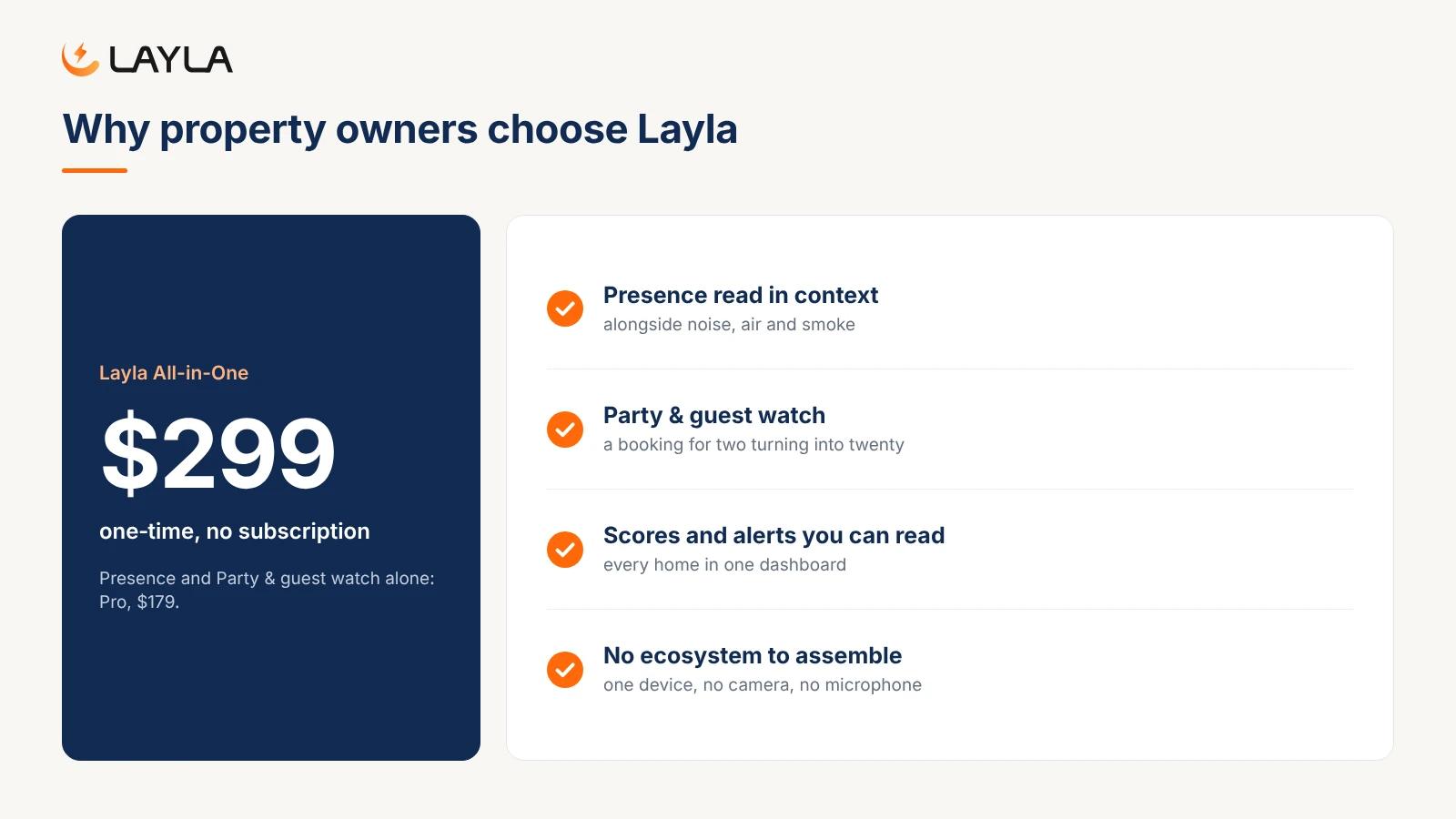
Layla's presence and Party & guest watch run on the Pro sensor at $179, a one-time price with no subscription. If you want the complete stack, with noise, air quality, smoke type-ID, mould risk and AC control alongside presence, the All-in-One is $299. One device, no camera, no microphone, no ecosystem required.
See Layla pricing and own it once →
Frequently asked questions
Does Layla do presence detection like the Aqara FP2?
Yes. Layla uses radar to sense presence and count people in a room, with no camera, microphone or Bluetooth. The difference is what happens next: Layla turns that reading into a Presence & motion score and feeds it into Party & guest watch, while the FP2 fires a smart-home automation. Same radar starting point, very different outcome.
Can Layla replace the FP2 in my smart home?
Layla replaces the FP2 if your goal is monitoring a property rather than automating a room. Layla covers presence plus noise, air, smoke and mould in one device. If you only want to trigger lights and HVAC inside a HomeKit or Home Assistant setup, the FP2 is a cheaper, more specialised tool for that single automation job.
Does Layla need a hub or smart-home ecosystem?
No. Layla works on its own and reports through its own app and dashboard. There is no Aqara-style hub to add and no HomeKit, Home Assistant or Matter ecosystem required to make it useful — which is the opposite of the FP2, a component that needs a smart-home platform around it.
What can Layla detect that a presence sensor can't?
Layla measures noise with quiet-hours, air quality with direct CO₂ measurement, VOCs and an IAQ index, and smoke identified as cigarette, vape or cannabis with intensity. It also tracks temperature, humidity and mould risk, and controls AC with an Eco Mode. A single-purpose presence sensor like the FP2 measures presence only.
Is there a subscription with Layla?
No. Layla is a one-time purchase with no subscription. The Pro sensor is $179 and includes presence and Party & guest watch; the All-in-One is $299 for the full monitoring stack. You own the hardware outright and keep every core feature with no recurring fee.
Keep reading

Best for: serious hosts
Noise Pro
Compliant with Airbnb's rules and local noise laws worldwide. Advanced protection for serious hosts.
Included forever – no subscription
- AI party detector
- Instant noise alerts with timestamps
- Live data feed, no 5-minute delay
- 180-day data history
- Radar intruder & vacant-home alerts
- Property status dashboard
- Outdoor temperature & humidity
- Automatic AI accuracy updates
- Daily & weekly summary reports by email
No monthly fees. Ever.
Your indoor air is 2-5x more polluted than outdoor air.
The EPA confirms it, but most people have no idea. You spend 90% of your time indoors breathing air you've never measured.
CO2 builds up silently.
A bedroom with two people can hit 2,500 ppm overnight. Harvard research shows decision-making drops 50% at 1,400 ppm. That brain fog and morning fatigue? It might not be bad sleep - it's bad air.
VOCs are off-gassing in every room.
New furniture, carpets, paint, cleaning products indoor VOC levels run up to 10x higher than outdoors. Some, like formaldehyde and benzene, are classified carcinogens. You can't smell most of them.
Mold starts in 24 hours.
When humidity exceeds 60%, mold begins colonizing within a day. 47% of U.S. homes show visible mold. Average remediation cost: $2,368 severe cases hit $30,000. A sensor that warns you before mold starts is orders of magnitude cheaper than cleanup.
Standard smoke detectors only catch fires.
They don't detect cigarette, vape, or marijuana smoke at low levels. For landlords and hosts, unauthorized smoking causes damage that goes unnoticed for weeks.
Post-COVID, people want data.
66% of Americans are more cautious about indoor air since the pandemic. 61% say they'd trust a space more if it monitored air quality. The awareness shift is permanent.
30-day money back guarantee