BLOG
The best occupancy sensors without cameras
 By Nangyal Khan··Updated
 10 min read
A good occupancy sensor without a camera tells you a room is in use without ever pointing a lens at the people inside it. Radar and thermal sensing read a space instead of recording it, which is what you want when the people being sensed are your family, your guests or your tenants. Every pick below works that way.
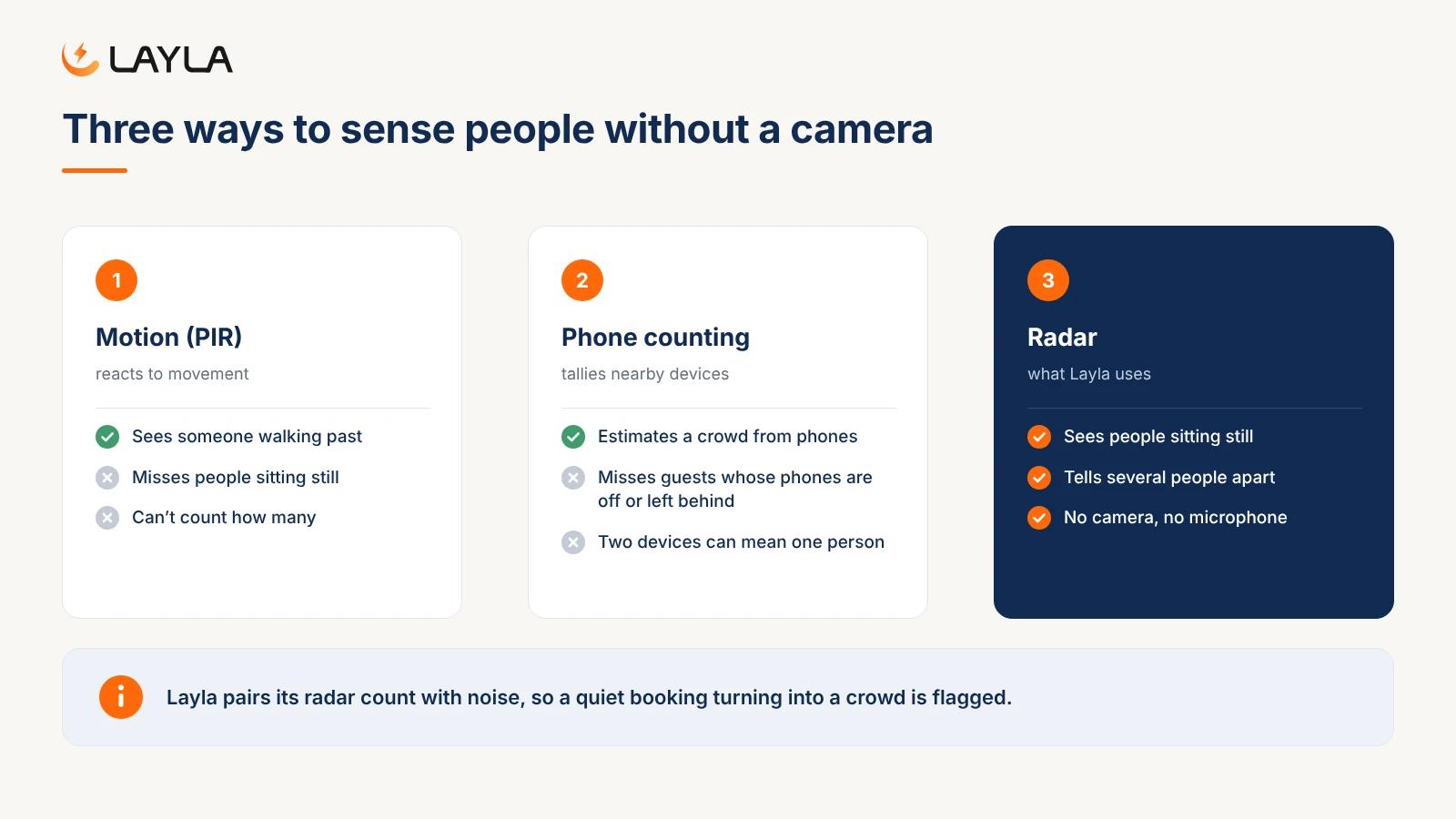
The thing that separates the good ones from the frustrating ones is the sensing method. Passive infrared, the PIR inside most cheap motion sensors, only fires on movement. Sit still and it goes blind. Millimetre-wave radar (mmWave) detects the small rise and fall of a stationary chest and holds the reading, so a person reading on the couch still counts as present. For real occupancy, that single difference decides whether you can trust the sensor at all. None of the products here use a camera or a microphone. Here is how the strongest camera-free options compare, and who each one actually suits.
How to choose an occupancy sensor without a camera
Start with what "occupancy" means for you. A smart-home user wants a room to know someone is there so the lights behave. A short-term-rental host wants to know how many people are inside, and whether a quiet booking has quietly become a gathering. An office wants aggregate headcounts for space planning. Three different jobs — and the right sensor follows the job, not the spec sheet.
Sensing technology is the next filter. PIR is cheap and everywhere, but it misses still people and can't count. mmWave radar sees stillness and can tell several people apart in a room, which is why it now dominates serious presence sensing. Wi-Fi device counting estimates crowd size by tallying nearby phones. Thermal arrays read body heat for anonymous counts. After that, weigh the running cost — some systems carry an annual subscription, others are a one-time buy — and whether the device does a single job or folds occupancy into a broader read on the property.
1. Layla — best for hosts and property owners who want presence read as monitoring
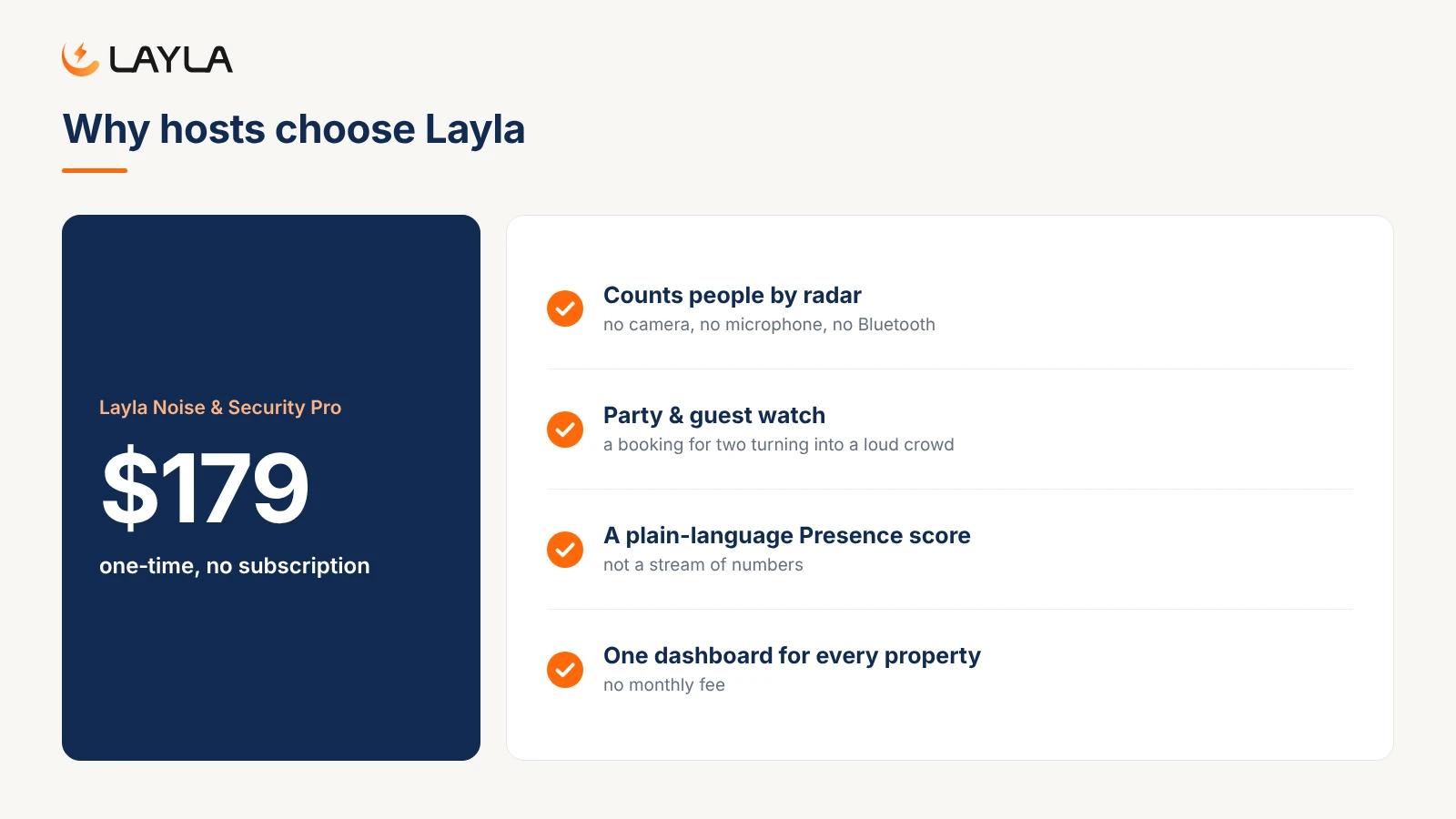
For a short-term rental or a managed property, raw presence detection isn't the goal. The goal is knowing when presence means a problem. Layla is built around that distinction. Its radar counts people in a space with no camera, no microphone and no Bluetooth, then surfaces the result as a plain-language Presence & motion score rather than a stream of numbers you have to decode.
The signature feature is Party & guest watch, which reads radar presence against noise together. A booking for two that swells into a loud crowd throws a clear signal instead of leaving you to guess. That pairing is what separates a monitoring tool from a motion sensor, and it runs on the Pro sensor.
What makes Layla a strong single-device choice is everything the same unit reads alongside presence. One sensor tracks noise in decibels with quiet-hours logic and no audio recording, air quality through CO₂ and VOCs, smoke with cigarette-versus-vape-versus-cannabis differentiation, plus temperature, humidity and mold risk — all rolled into a Home Score and a multi-home dashboard. For an owner watching several units, that consolidation is the whole point. Layla's presence tier is the Noise and Security Pro sensor at $179, one-time, with no subscription, free shipping, a one-year warranty and 30-day returns.
2. Aqara FP2 — best for smart-home automation
The Aqara FP2 is the enthusiast's presence sensor, and deservedly popular. It's a 60 GHz mmWave radar covering roughly 40 square metres, tracks up to five people, and its standout trick is up to 30 configurable zones. A single unit can tell the sofa from the doorway from the desk and fire a different automation for each. It works with HomeKit, Alexa, Google Home and Home Assistant, needs no Aqara hub for basic presence, and carries no subscription. At around $83 list, it packs a lot of capability for the money.
Two caveats keep it in the automation lane rather than the monitoring one. It needs wired USB-C power, which limits where it goes. And over HomeKit it reports presence as a simple true or false rather than a live person count. For turning lights on while you sit still, it's excellent. For counting a crowd in a rental, it isn't the tool. We go deeper on that split in Layla vs Aqara FP2.
3. Aqara FP300 — best for battery-powered placement anywhere
Launched in late 2025, the FP300 answers the FP2's biggest limitation: the cord. It runs on two CR2450 batteries for roughly two to three years depending on protocol, which frees you to mount presence sensing where no USB outlet reaches. Aqara markets it as a 4-in-1 unit — mmWave radar paired with PIR for occupancy, plus light, temperature and humidity — and it speaks Matter over Thread as well as Zigbee, so it drops into most modern smart-home setups cleanly. At an MSRP of $49.99 it's the most affordable serious mmWave option here.
The trade-off for battery life is responsiveness and zone granularity that don't match the always-powered FP2. It's the right pick when flexible placement and a low price matter more than squeezing out the last bit of precision.
4. Party Squasher — best for simple phone-count party alerts
Party Squasher takes a different route to occupancy. Rather than radar, it passively counts the mobile devices in and around a property, whether or not they're on the Wi-Fi, and turns that into a live estimate of how many people are present. For a host whose single worry is an unauthorised party, that's a focused, purpose-built answer, and device-counting can pick up a crowd spilling across a whole home rather than one room.
The cost model is what to weigh. The Standard runs about $249 in year one and renews near $199 a year; the Pro is roughly $309 up front with renewal around $252. Either way it's an ongoing subscription, not a one-time buy. It also counts phones, not bodies, so a guest with no device or three devices can skew the tally. As a single-purpose party alarm, it does its one job well.
5. PIR motion sensors — best for low-cost, movement-only triggers
Most sensors still sold as "occupancy" sensors use the oldest technology on this list, and it's the one to treat with care. Passive infrared sensors are inexpensive, battery-friendly and sold by nearly every smart-home brand, and for triggering a hallway light when someone walks past they're perfectly good. That's their genuine strength — cheap, simple, reliable movement detection.
The problem for real occupancy is that PIR only reacts to motion. A guest reading on the couch or asleep in bed stops registering within seconds, and the room reports empty when it plainly isn't. PIR also can't count people. If your use case is anything past "did something just move here," radar is the upgrade worth paying for.
6. Butlr — best for commercial office people-counting
Butlr sits apart from the rest because it's built for buildings, not homes. Its low-resolution thermal arrays read body-heat signatures to count people and measure dwell time anonymously, capturing no imagery and no personally identifiable information. With AI on top it reaches high accuracy for aggregate headcounts, and it plugs into facilities and workplace-analytics platforms through a long list of connectors. For offices, campuses and stores planning space utilisation, it's a strong, privacy-respecting fit.
It is firmly B2B, though. Pricing is quoted per deployment rather than sold off a shelf, and the platform is aimed at space analytics, not at a host watching a single rental. Listed here for completeness, not as a short-term-rental option.
At a glance
| Sensor | Best for | Sensing tech | Also monitors | Subscription | Price |
|---|---|---|---|---|---|
| Layla | Host/property monitoring | mmWave radar | Noise, air quality, smoke, mold, temp | No | $179 (Pro), one-time |
| Aqara FP2 | Smart-home automation | 60 GHz mmWave, 30 zones | Light (model-dependent) | No | ~$83 |
| Aqara FP300 | Battery-powered placement | mmWave + PIR | Light, temp, humidity | No | ~$50 |
| Party Squasher | Phone-count party alerts | Wi-Fi device counting | Occupancy count only | Yes (annual) | ~$249–$309 + renewal |
| PIR sensors | Low-cost motion triggers | Passive infrared | Movement only | No | ~$15–$40 |
| Butlr | Office people-counting (B2B) | Thermal array | Dwell time, traffic flow | Yes (enterprise) | Quote-based |
Which occupancy sensor should you choose?
Match the tool to the job. Want a room to react to you and happy to run a cable? The Aqara FP2 and its 30 zones are hard to beat for the price. Want that radar freedom without a cord? The battery-powered FP300 is the value pick. If your single fear is an unauthorised party and an annual fee doesn't bother you, Party Squasher's phone-count approach is purpose-built for exactly that. For an office measuring how space gets used, Butlr is the privacy-first commercial answer. And PIR is fine when all you need is a motion-triggered light.
For a short-term rental or a property you manage, though, presence is only useful when it tells you something is wrong. Layla reads presence as monitoring, pairs it with noise through Party & guest watch, and folds air quality, smoke and mold into the same one-time device and dashboard. That's why it leads this list for hosts and owners.
Get Layla — from $179, no subscription
Layla gives you camera-free, microphone-free presence detection, the Party & guest watch signal that catches a booking turning into a gathering, and a single dashboard for every property you run, with no monthly fee. The Pro sensor is $179, one-time, with free shipping, a one-year warranty and 30-day returns.
See Layla pricing and own it once →
Frequently asked questions
Does Layla use a camera or microphone to detect occupancy?
No. Layla detects presence with radar and has no camera and no microphone in the hardware. It counts people and reads noise in decibels without recording any audio or video, then presents it as a plain-language Presence & motion score and the Party & guest watch signal for hosts.
Why is radar better than PIR for occupancy sensing?
PIR only detects motion, so a person who sits or lies still disappears from it within seconds and the room reads as empty. mmWave radar, which Layla and the Aqara sensors use, detects the subtle movement of a still person and holds the reading, and it can tell several people apart in a space. For genuine occupancy rather than motion triggers, radar is the reliable choice.
Can an occupancy sensor tell me if guests are throwing a party?
Layla's Party & guest watch is built for exactly that. It reads radar presence against noise levels together, so a quiet booking that turns into a loud crowd produces a clear signal on the Pro sensor. Party Squasher takes a different route by counting nearby phones, which also flags a crowd but relies on every guest carrying a device.
Do any of these sensors require a subscription?
Layla and both Aqara sensors are one-time purchases with no subscription. Party Squasher carries an annual renewal after the first year, and Butlr is sold as an enterprise deployment. Layla's Pro presence sensor is $179 once, with nothing recurring.
Which sensor is best for a short-term rental?
Layla is the best fit for a short-term rental because it treats presence as monitoring rather than automation and combines it with noise, air quality, smoke and mold in one camera-free device and multi-home dashboard. Smart-home radar like the Aqara FP2 and FP300 is excellent for home automation but reports presence as a simple on-off state rather than the host-focused signals a rental needs.
Keep reading
- Layla vs Aqara FP2 — camera-free radar for home automation versus property monitoring.
- Layla vs Party Squasher — radar-plus-noise monitoring versus phone-count party alerts.
- Best noise monitor for Airbnb — the noise side of the same host toolkit.

Best for: serious hosts
Noise Pro
Compliant with Airbnb's rules and local noise laws worldwide. Advanced protection for serious hosts.
Included forever – no subscription
- AI party detector
- Instant noise alerts with timestamps
- Live data feed, no 5-minute delay
- 180-day data history
- Radar intruder & vacant-home alerts
- Property status dashboard
- Outdoor temperature & humidity
- Automatic AI accuracy updates
- Daily & weekly summary reports by email
No monthly fees. Ever.
Your indoor air is 2-5x more polluted than outdoor air.
The EPA confirms it, but most people have no idea. You spend 90% of your time indoors breathing air you've never measured.
CO2 builds up silently.
A bedroom with two people can hit 2,500 ppm overnight. Harvard research shows decision-making drops 50% at 1,400 ppm. That brain fog and morning fatigue? It might not be bad sleep - it's bad air.
VOCs are off-gassing in every room.
New furniture, carpets, paint, cleaning products indoor VOC levels run up to 10x higher than outdoors. Some, like formaldehyde and benzene, are classified carcinogens. You can't smell most of them.
Mold starts in 24 hours.
When humidity exceeds 60%, mold begins colonizing within a day. 47% of U.S. homes show visible mold. Average remediation cost: $2,368 severe cases hit $30,000. A sensor that warns you before mold starts is orders of magnitude cheaper than cleanup.
Standard smoke detectors only catch fires.
They don't detect cigarette, vape, or marijuana smoke at low levels. For landlords and hosts, unauthorized smoking causes damage that goes unnoticed for weeks.
Post-COVID, people want data.
66% of Americans are more cautious about indoor air since the pandemic. 61% say they'd trust a space more if it monitored air quality. The awareness shift is permanent.
30-day money back guarantee