BLOG
Layla vs Party Squasher: Which Party Detector Actually Works?
 By Nangyal Khan··Updated
 9 min read
A party is the one booking that keeps a short-term rental host up at night. So the Layla vs Party Squasher question is really about trust: when the app says a party is happening, is it right? Party Squasher counts the mobile phones in and around your property and alerts you when that number climbs past a threshold you set. It is a clean, single-purpose idea, and that simplicity is a real strength. But counting phones is a proxy for counting people, and proxies drift. Layla reads the actual bodies in the room with radar and pairs that with noise, so a full house and a problem party look different in your feed. Here is how the two compare.
What Does Party Squasher Do?
Party Squasher is a small sensor that plugs into your router and does one job well. It estimates how many people are at the property by counting nearby mobile-device signals. You set a threshold — say, eight phones — and when the count crosses it, an SMS or email lands. The Standard sensor runs $249 and the Pro $309, and both bundle the first year of the required subscription into that price. After year one you renew: $199 a year for Standard, $252 for Pro. Portfolios buying in volume pay less per unit.
The pitch is privacy and focus. There is no camera and no microphone, which matters to guests and to review scores, and the single-metric design is easy to explain to a cleaner or a co-host. That focus is Party Squasher's genuine win, and it deserves saying plainly. If all you want is a phone counter that one number can trigger, it does exactly that, and nothing else gets in the way.
The trouble is that phones are not people. Someone who arrives with their phone off, on airplane mode, or simply out of battery never shows up in the count. A guest carrying a work phone and a personal phone counts as two. A sensor near a shared wall or a busy street can register the neighbor's devices, or a phone walking past on the sidewalk. Party Squasher is candid about this itself: it works best in detached homes, and in a condo, duplex or apartment the count picks up neighboring units and gets unreliable. None of this is a build-quality flaw. It is baked into the method. You are inferring a crowd from radio signals, and radio signals belong to devices, not to the humans you actually care about.
What Does Layla Do That Party Squasher Doesn't?
Layla is one sensor that turns raw readings into plain-language scores. There is a Home Score, plus Sleep, Air quality, Comfort, Quiet, Mold risk, Smoke and safety, Presence and motion, and Allergies, all on a multi-home dashboard. No camera, no microphone, and that is enforced in hardware rather than promised in a privacy policy.
For party detection, two pieces matter: radar presence and noise. Layla's radar counts the people physically in a room, with no phone, Bluetooth, or app needed on their part, and that feeds the Presence and motion score. On top of it, Layla measures loudness in decibels against your quiet hours while storing no audio at all. No words, no clip, just a number. That combination is what a phone counter structurally cannot offer, because it has no way to hear that the house has gone loud at 1 a.m.
Layla also handles the rest of the monitoring that hosts otherwise juggle across separate gadgets. It measures CO₂, VOCs and an indoor air quality index. It detects smoke and tells cigarette from vape from cannabis with an intensity read. It tracks temperature, humidity and mold risk, and it controls the AC across 150-plus brands with an Eco Mode that trims roughly a quarter off energy use. Party Squasher is a specialist. Layla is the sensor that also happens to be an excellent party detector.
How Each One Actually Catches a Party
Here the methods separate. Party Squasher watches the device count and fires when it passes your threshold. If the real crowd is twenty people, but half left their phones in a coat pile and three brought two devices each, the number you see is not the number in the house. The alert is only as honest as the link between phones and people, and that link is noisy by nature.
Layla reads the situation the way a worried host would. Its signature Party and guest watch combines radar presence with noise to tell a gathering from a disaster. The logic is simple. Overnight, three or more people present for two or more hours with at most one loud hour reads as guests enjoying themselves. Add a second loud hour on top of that crowd and it reads as a party, and you hear about it. You are no longer guessing from a phone tally. You have the body count and the sound profile together — the actual signature of a problem night. A quiet family reunion does not trip it. A cramped, loud, late crowd does.
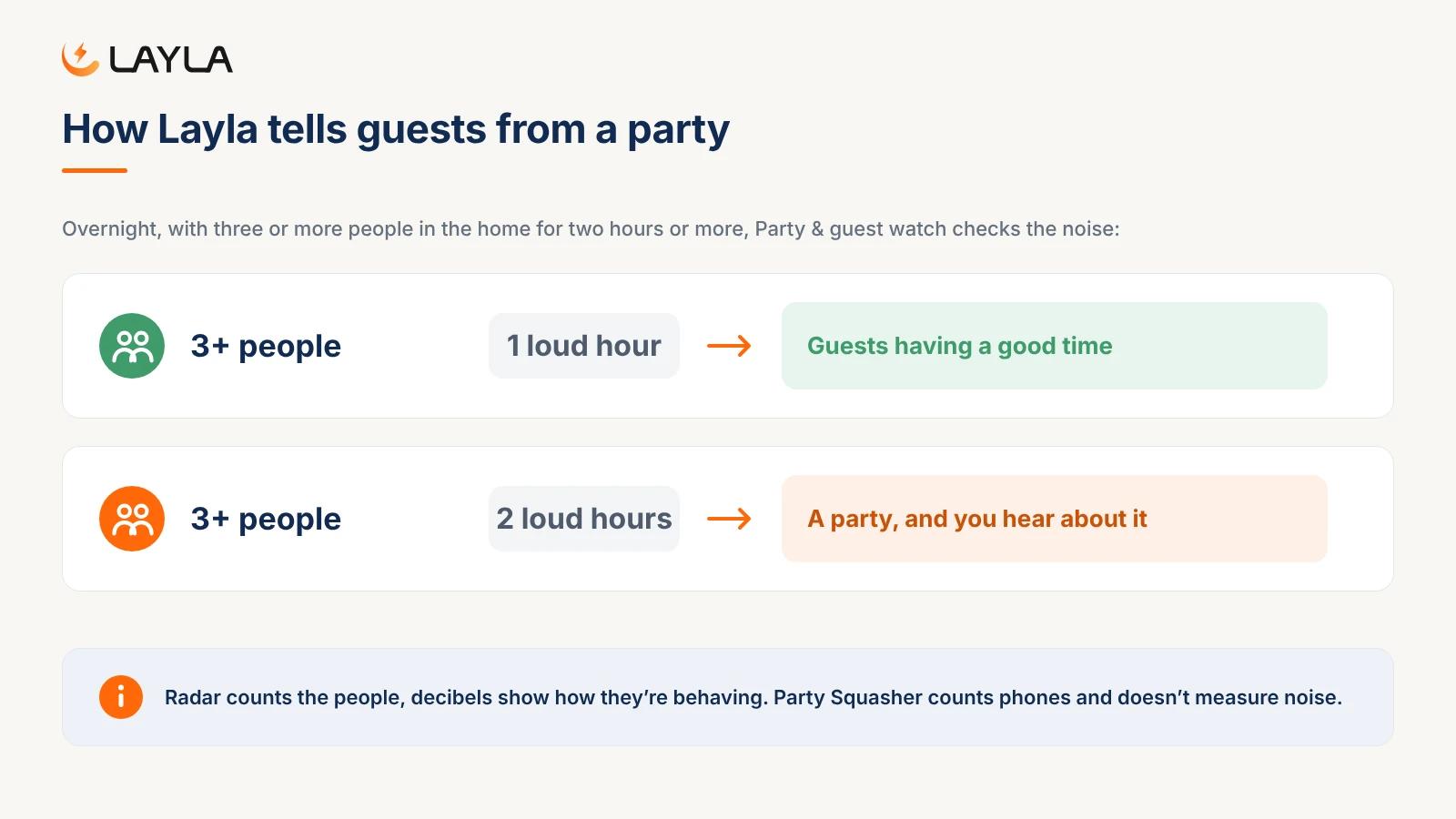
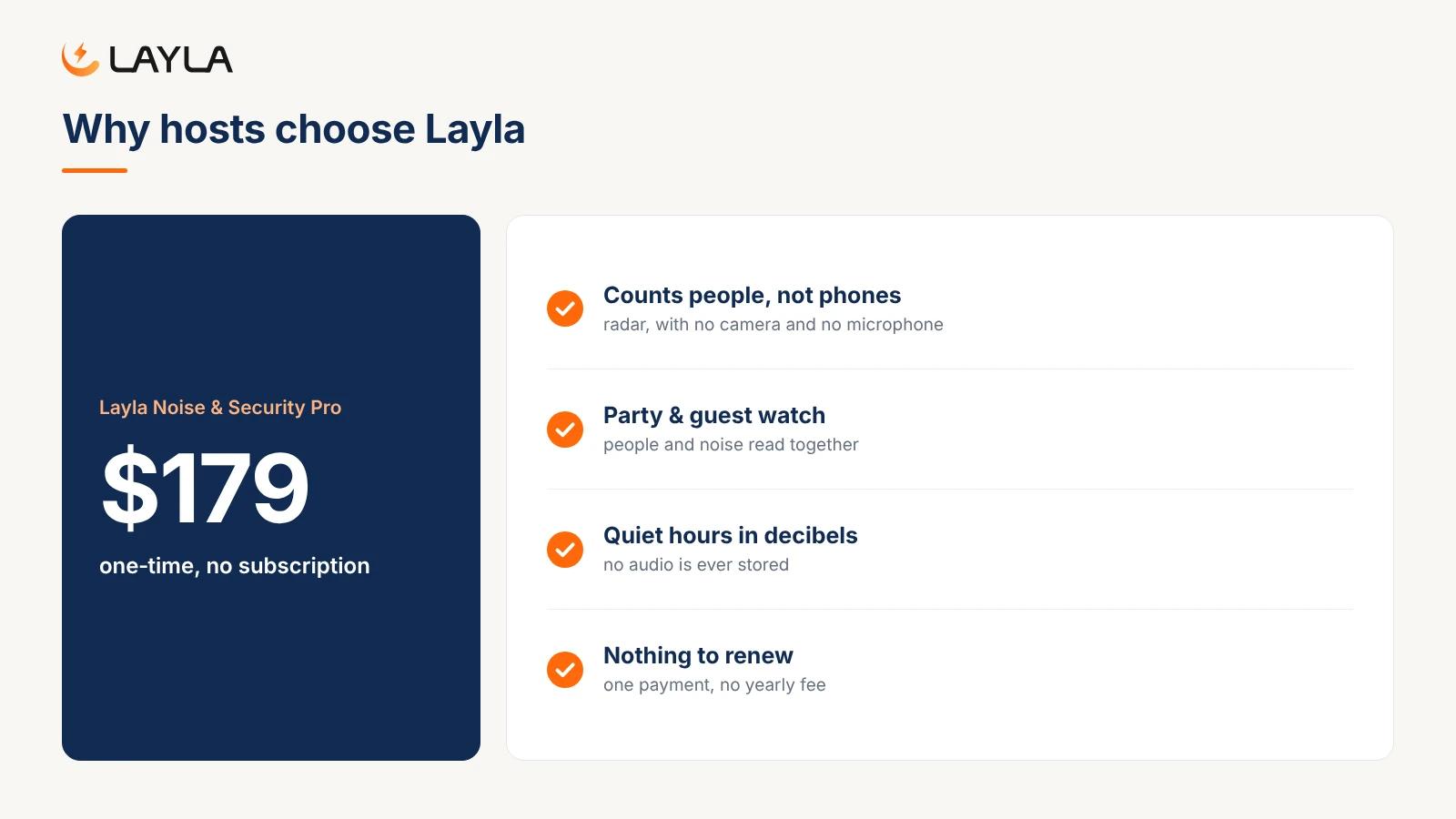
That pairing is why radar times noise beats counting signals. One channel tells you how many people are really there. The other tells you whether they are behaving. Party Squasher gives you the first, approximately, and nothing on the second. Party and guest watch runs on a Layla Noise and Security Pro sensor at $179, a one-time cost with no subscription behind it. If you want to see how it stacks up against the rest of the field, the Party Squasher alternatives roundup lines up the main options side by side.
At a Glance
| Layla (Noise & Security Pro) | Party Squasher | |
|---|---|---|
| Built for | Whole-home monitoring with party and guest watch | Counting phones to flag crowding |
| How it detects people | Radar presence counts actual bodies | Counts nearby mobile-device signals |
| Noise | Decibels and quiet hours, no audio stored | None |
| Air & smoke | CO₂, VOCs, IAQ, smoke with cigarette/vape/cannabis ID | None |
| Install & privacy | One sensor, no camera, no mic (hardware-enforced) | Router-connected, no camera, no mic |
| Subscription | None, one-time purchase | Required, $199–$252/year after year one |
| Price | $179 one-time (Pro) | $249–$309, plus annual renewal |
Which One Should You Buy?
If your only question is "are there more phones here than I allowed," and you want the single simplest answer to it, Party Squasher is a fair pick and easy to live with. Just go in knowing the ongoing subscription is part of the real price, and that a phone count can miss, double, or borrow from next door.
For almost every host, Layla is the stronger choice, because real party risk is a crowd that is also loud, and Layla reads both. You get radar presence that counts people instead of devices, noise that confirms a gathering has turned, and a verdict designed around how parties actually unfold overnight. You also get air quality, smoke identification, mold risk and AC control from the same device, with no camera, no mic and no subscription. One $179 Pro sensor replaces a shelf of single-purpose gadgets, and it does the party job more honestly than a phone counter can.
Get Layla — From $179, No Subscription
Party and guest watch lives on the Noise and Security Pro at $179: a one-time purchase with free shipping, a 30-day return window and a one-year warranty. No monthly fees, no annual renewal, no camera, no microphone. See the full lineup and pick your sensor at layla.eco/pricing.
Frequently Asked Questions
Is Layla a good Party Squasher alternative?
Layla is a strong Party Squasher alternative and, for most hosts, the better tool. It counts real people with radar and pairs that with noise, so it catches the loud, crowded nights that define an actual party instead of inferring a crowd from mobile signals. Layla is also a one-time $179 purchase on the Pro sensor, with no subscription at all.
How does Layla detect a party without a camera or microphone?
Layla detects a party by combining radar presence with noise, and it uses no camera or microphone. Radar counts the bodies present, while a decibel reading measures loudness against your quiet hours and stores no audio, so no words or clips are ever recorded. When a crowd stays late and gets loud, Party and guest watch flags it.
Does Layla need a subscription like Party Squasher?
Layla needs no subscription, which is a core difference. It is a one-time purchase, so the price you pay is the whole price. Party Squasher, by contrast, is sold as an annual service and requires an ongoing cloud subscription that runs $199 to $252 per year after the first year, which is bundled with the hardware.
Can Layla tell a normal full house from a real party?
Layla can tell a normal full house from a real party, and that is the point of pairing radar with noise. A full but quiet home reads as guests enjoying themselves, while a crowd that adds extra loud hours late at night reads as a party and triggers an alert. You judge the night by people and sound together, not a phone count.
What does Layla do besides party detection?
Besides party detection, a single Layla sensor tracks noise, air quality including CO₂, VOCs and an IAQ index, and smoke with cigarette, vape and cannabis identification. It also monitors temperature, humidity and mold risk, and controls the AC across 150-plus brands with an energy-saving Eco Mode. One device covers what hosts usually split across several gadgets.
Keep Reading

Best for: serious hosts
Noise Pro
Compliant with Airbnb's rules and local noise laws worldwide. Advanced protection for serious hosts.
Included forever – no subscription
- AI party detector
- Instant noise alerts with timestamps
- Live data feed, no 5-minute delay
- 180-day data history
- Radar intruder & vacant-home alerts
- Property status dashboard
- Outdoor temperature & humidity
- Automatic AI accuracy updates
- Daily & weekly summary reports by email
No monthly fees. Ever.
Your indoor air is 2-5x more polluted than outdoor air.
The EPA confirms it, but most people have no idea. You spend 90% of your time indoors breathing air you've never measured.
CO2 builds up silently.
A bedroom with two people can hit 2,500 ppm overnight. Harvard research shows decision-making drops 50% at 1,400 ppm. That brain fog and morning fatigue? It might not be bad sleep - it's bad air.
VOCs are off-gassing in every room.
New furniture, carpets, paint, cleaning products indoor VOC levels run up to 10x higher than outdoors. Some, like formaldehyde and benzene, are classified carcinogens. You can't smell most of them.
Mold starts in 24 hours.
When humidity exceeds 60%, mold begins colonizing within a day. 47% of U.S. homes show visible mold. Average remediation cost: $2,368 severe cases hit $30,000. A sensor that warns you before mold starts is orders of magnitude cheaper than cleanup.
Standard smoke detectors only catch fires.
They don't detect cigarette, vape, or marijuana smoke at low levels. For landlords and hosts, unauthorized smoking causes damage that goes unnoticed for weeks.
Post-COVID, people want data.
66% of Americans are more cautious about indoor air since the pandemic. 61% say they'd trust a space more if it monitored air quality. The awareness shift is permanent.
30-day money back guarantee