BLOG
The best property monitoring devices, ranked by the job they do
 By Nangyal Khan·
9 min read
The best property monitoring device for most landlords, property managers and homeowners is a multi-sensor unit that covers noise, occupancy, air quality and smoke in one box with no subscription, then a cheap water-leak sensor for the one job it leaves out. Layla is our pick for the broad job; Minut for dedicated noise and occupancy; Operto for operations at scale; and a standalone leak puck for water. The rest of this guide explains why, job by job.
A property throws off signals all day. Noise climbs on a Saturday night. The guest count quietly doubles, humidity drifts toward mould territory, someone lights a cigarette in a no-smoking unit, and a pipe under the sink starts to weep. No single reading tells the whole story, and that is why the field has fragmented into a device for every job. So the hard part is not finding a monitor. It is working out which jobs actually matter for your property, then covering them with as few boxes on the wall as possible. This guide ranks property monitoring devices by job, picks a winner for each, and shows where one multi-sensor device does most of the work.
What to monitor in a property (and how to choose)
Start with the problems that cost you money or a licence. For a short-term rental that usually means noise and unauthorised parties, where a single complaint can put your permit at risk. A long-let landlord cares more about smoke and vape in non-smoking units, humidity and mould that damage the building, and a quiet tenant turnover with no surprises. A homeowner or home-office worker is often chasing comfort and air quality: stuffy rooms, poor sleep, a bedroom that fills with CO₂ overnight. Energy monitoring and AC control trim the bills for all three. And water-leak detection guards everyone against the slow, expensive damage nobody notices until the ceiling stains.
The real question is how many devices you want to own and manage. Some owners buy one gadget per job and juggle five apps. Others want a single sensor that handles the common jobs, then add a second device only for the one thing it cannot do. Both camps are valid. The ranking below is ordered for the second, broadest device first.
1. Layla — best for covering most jobs in one sensor
Layla tops the list because it folds the everyday monitoring jobs into one unit and reports them as plain-language scores rather than raw numbers you have to interpret. A single Layla sensor tracks noise by decibel with quiet-hours logic, detects presence and motion by radar, measures CO₂, VOCs and overall air quality, and watches temperature, humidity and mould risk. It also catches smoke and tells cigarette, vape and cannabis apart with an intensity reading. There is no camera and no microphone recording audio, which matters for guest trust and for privacy rules.
The signature feature is Party and guest watch. It pairs radar presence with noise to flag the pattern of a gathering getting out of hand, not just one loud moment. On comfort, Layla controls air conditioners across 150 or more brands and runs an Eco Mode that owners report trims cooling costs by roughly a quarter. Everything rolls up into a Home Score and a multi-home dashboard, so a manager with several units sees where attention is needed at a glance.
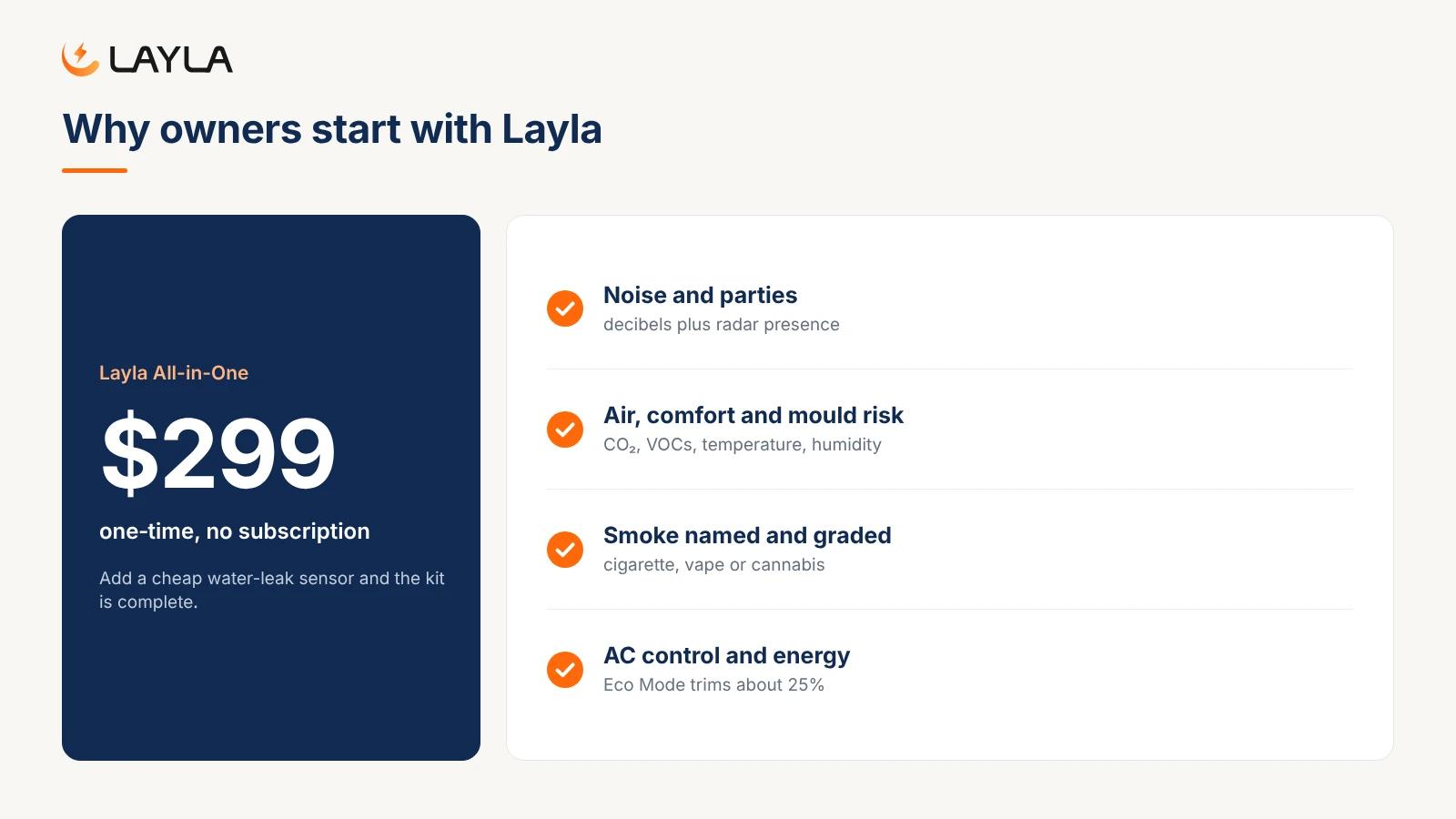
Pricing is one-time, no subscription. The All-in-One sensor is $299. Narrower versions exist if you only need part of the picture — Smoke and Air Quality at $99, or AC Control and Energy at $89. For an owner who wants noise, parties, air and smoke handled by one device bought once, nothing else here is as complete.
2. Minut — best for dedicated noise and occupancy on a subscription
Minut built its name on privacy-first noise and occupancy monitoring for short-term rentals, and it is still a focused, well-regarded pick for that specific job. The M3 sensor runs about $100 for the hardware. It reads sound levels without recording audio, tracks occupancy to help catch unauthorised crowds, and layers in climate and smoking alerts depending on the plan.
The catch is the subscription. Minut requires an ongoing plan, with tiers running roughly $5, $10 and $15 per property per month, billed per property. For a host who wants a dependable party watchdog and accepts a recurring fee, Minut is a safe choice. The trade-off is the math over time: the monthly cost compounds across a portfolio, which is the main reason owners weigh it against a one-time device.
3. Operto — best for operations and device automation at scale
Operto is not a sensor. It is a property automation platform that sits on top of smart locks, thermostats and monitoring hardware, tying them into one dashboard alongside your booking system. Its strength is operations — contactless check-in, access codes that rotate with each reservation, and remote control of connected devices across a portfolio.
Pricing is per unit per month and quote-based for the full Connect suite, with entry tiers starting around $7 a unit depending on which modules you switch on. If your pain point is coordinating many units and automating the guest journey rather than reading an environmental signal, Operto earns its place. It orchestrates hardware rather than replacing it, so it pairs with a monitoring device for the actual sensor data. We go deeper on where the line falls in Layla vs Operto.
4. A dedicated water-leak sensor — best for catching leaks early
Water damage is the quiet budget-killer, and it is the one job best handed to a purpose-built device. A good smart water-leak sensor is cheap, usually $20 to $40 per puck, and you place it right where trouble starts. Under the sink, behind the toilet, beside the water heater, next to the washing machine. The moment it senses moisture it fires an alert. Pair it with an automatic shutoff valve (a separate, pricier add-on) and a burst line can be stopped before it floods the floor below.
Add one or two of these and the setup is complete. They cover the leak job cleanly, and because they cost so little, there is no reason to leave that corner uncovered. Think of a leak sensor as the finishing touch on a monitoring kit — a smart companion to a broad sensor, not a rival to it.
5. Layla smoke type-ID — best for smoke and vape in rentals
Smoke and vape detection deserves its own mention, because a generic smoke alarm only tells you something is burning, never what. Layla distinguishes cigarette, vape and cannabis and grades the intensity, which turns a vague alert into evidence you can actually raise with a guest or a tenant. That specificity pays off in non-smoking units, student housing, and any property where a smoking violation triggers a cleaning fee or a fine.
Because this capability already lives inside the All-in-One sensor, most owners get it without buying anything extra. If smoking violations are your main worry, our cigarette, vape and cannabis detector roundup breaks down how type-identifying monitors stack up against standalone alarms.
At a glance
| Device | Best for (job) | What it monitors | Subscription | Price |
|---|---|---|---|---|
| Layla | Most jobs in one unit | Noise, presence/party, CO₂/VOCs/air, temp/humidity/mould, smoke type-ID, AC control | No | From $299 (All-in-One) |
| Minut | Noise & occupancy | Noise, occupancy, climate, smoking (by plan) | Yes | ~$100 + ~$5–$15/property/mo |
| Operto | Operations & automation | Access, check-in, device orchestration | Yes | Per unit/mo |
| Water-leak sensor | Leak detection | Moisture, optional shutoff | Varies | ~$20–$40 each |
| Layla (smoke) | Smoke & vape in rentals | Cigarette vs vape vs cannabis + intensity | No | Included in All-in-One |
Which property monitoring device should you buy?
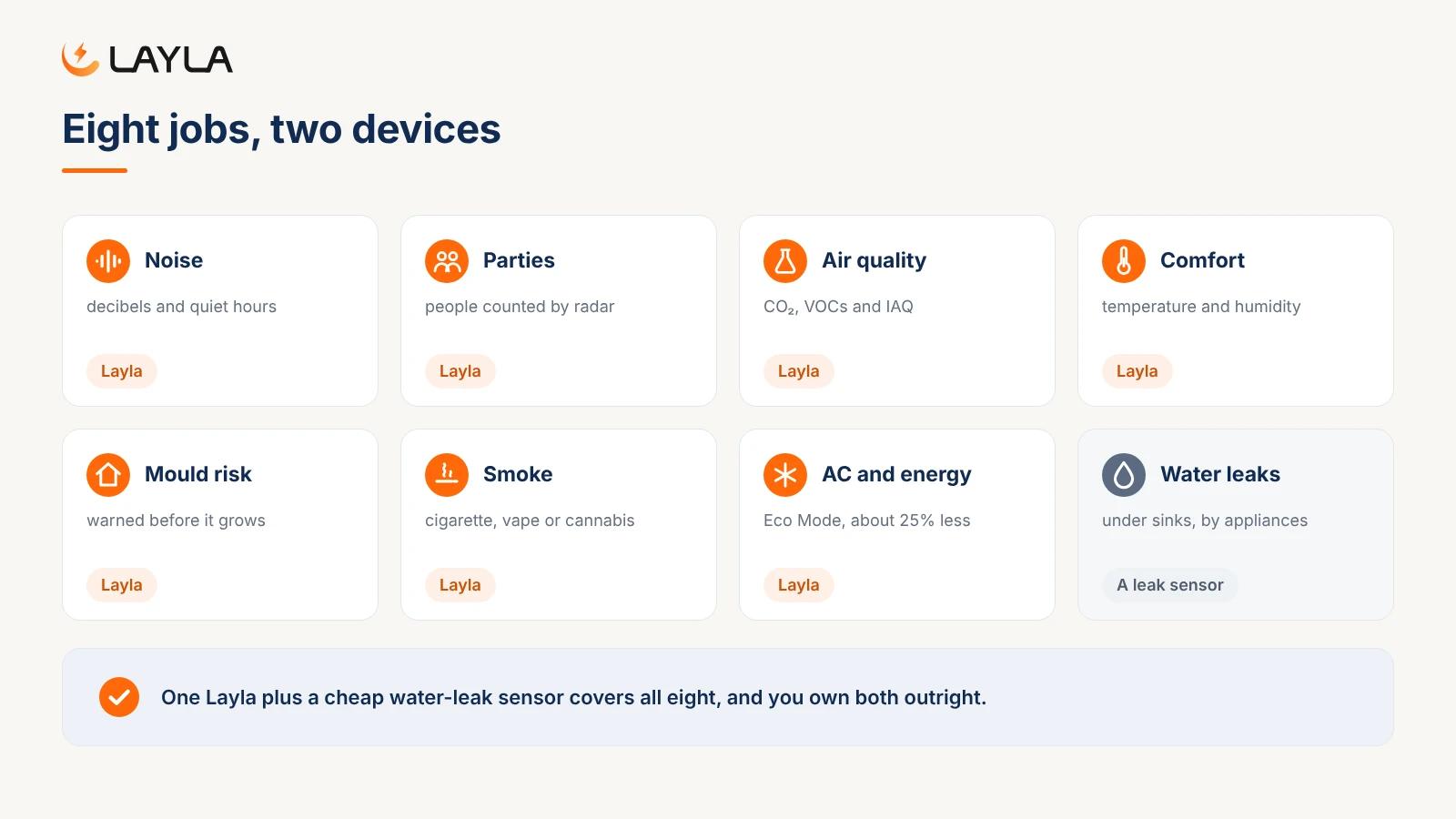
Want the fewest devices and no recurring bill? Start with Layla and add a cheap water-leak sensor. That two-piece kit covers noise, parties, air quality, comfort, mould risk, smoke type and leaks, and you own it outright. For a portfolio manager whose real headache is coordinating check-ins and access across many units, Operto handles the operations layer and pairs cleanly with a Layla sensor for the environmental data. And if your single concern is a privacy-first noise and occupancy watchdog, and a monthly fee is acceptable, Minut is a focused, proven choice. Most owners land on the first path, because one upfront purchase is simpler to budget and scale than a per-property subscription that climbs every month.
Get Layla — from $299 all-in-one, no subscription
Layla puts noise, party detection, air quality, comfort, mould risk and smoke type-ID in one sensor, reports them as scores you can read at a glance, and charges you once with no monthly fee. It ships free, returns within 30 days, and carries a one-year warranty. Add an inexpensive leak sensor and your property is covered end to end.
See Layla pricing and own it once →
Frequently asked questions
Can one device monitor noise, air quality and smoke together?
Yes. Layla handles all three in a single sensor. It reads decibel-based noise with quiet-hours logic, measures CO₂, VOCs and overall air quality, and identifies smoke as cigarette, vape or cannabis with an intensity reading. Each result shows up as a plain-language score, and it does this with no camera and no microphone recording audio.
Do property monitoring devices record audio or video?
Layla does not. It measures sound by decibel level without capturing what is said, and it senses presence with radar rather than a camera. That keeps it suitable for guest bedrooms and privacy-sensitive settings where recording devices are off-limits, while still flagging noise and parties as they build.
Is a subscription required for property monitoring?
It depends on the device. Layla is a one-time purchase with no subscription — you own the sensor and pay nothing monthly. Some competitors, including Minut, require an ongoing per-property plan. Across several units over a year or more, the one-time model is usually the cheaper path.
What about water-leak detection?
Pair Layla with a dedicated smart water-leak sensor placed under sinks and near appliances. These cost around $20 to $40 each, alert instantly the moment they sense moisture, and often connect to a shutoff valve. A leak sensor completes a property monitoring setup for very little money.
How much does Layla cost?
The All-in-One sensor is $299 one-time. If you need only part of the picture, narrower options include Smoke and Air Quality at $99 and AC Control and Energy at $89. All are one-time purchases with free shipping, 30-day returns and a one-year warranty — no subscription on any tier.
Keep reading

Best for: full property coverage
All-in-One
Noise monitoring, smoke detection and smart AC control for complete coverage.
Everything included
Everything in Noise & Security Pro
AI party detector, noise alerts, intruder & break-in, occupancy, 180-day history, indoor + outdoor climate
Everything in Smoke & Air Quality
Air quality index (IAQ), CO2, bVOC, mold & smoke — full indoor + outdoor climate
Everything in AC Control & Energy
Smart AC (150+ brands), Eco Mode, schedules, filter health
Plus exclusive
- Advanced reports & insights
- Priority support
- Priority support
No monthly fees. Ever.
One sensor. Full coverage
One sensor. Full coverage.* Layla 3.0 monitors noise, air quality, motion, occupancy, temperature, humidity, pressure, VOCs, CO2, and controls your AC - from a single device on your shelf.
No subscription means no surprise costs.
Pay once. Every feature unlocked. Forever. No monthly fees eating into your rental margins or household budget.
The smartest buy is the one you make once.
Other solutions charge per-feature monthly subscriptions that exceed the device cost within a year. Layla's all-in-one pays for itself compared to any subscription alternative.
30-day money back guarantee