BLOG
Spain's Short-Term Rental Rules in 2026: The English Guide for Foreign Hosts
 By Nangyal Khan··Updated
 10 min read
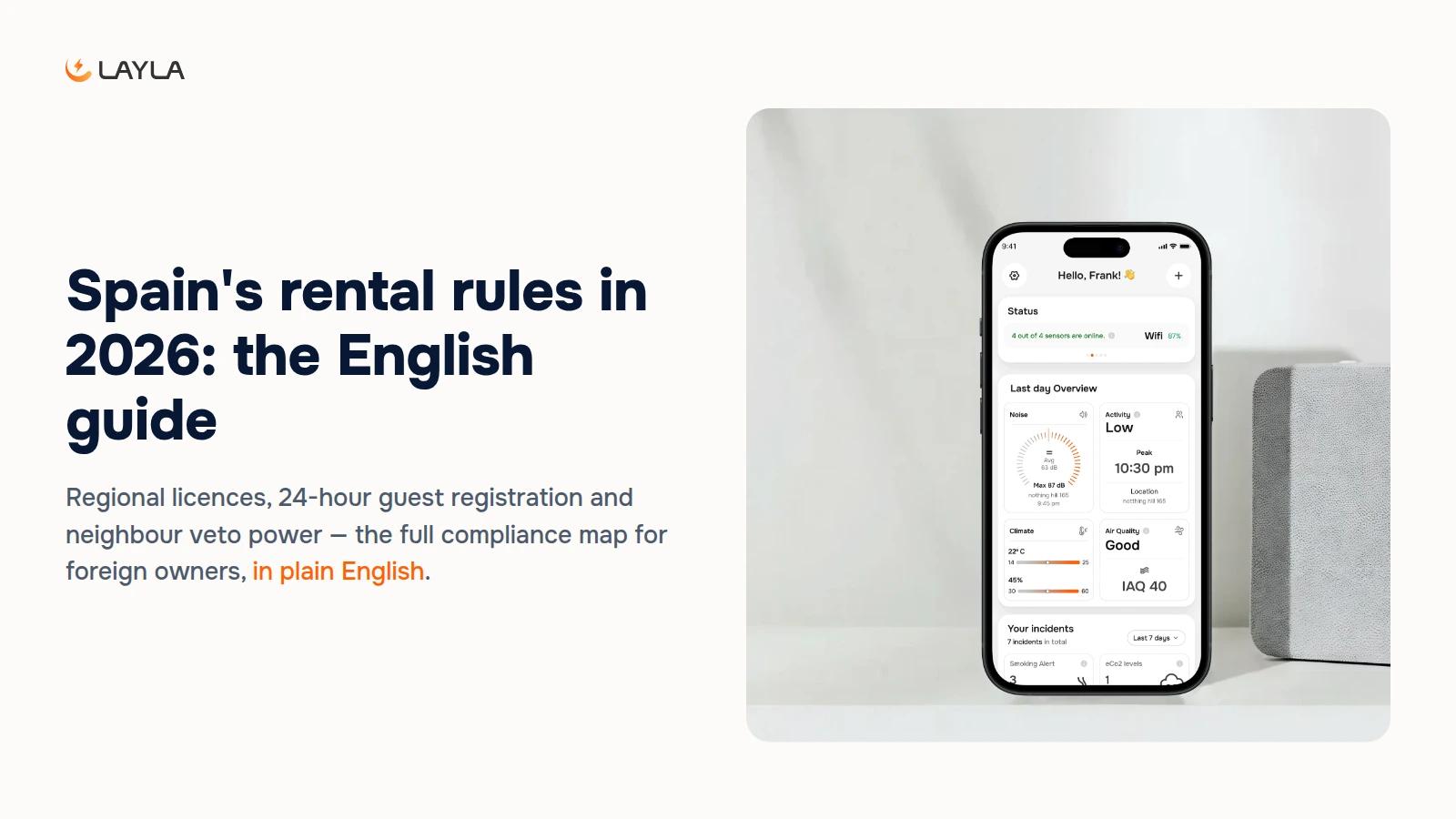
Updated July 29, 2026. This guide is informational, not legal advice. Spanish STR rules move fast and vary by region — confirm your specific case with a local advisor before acting.
You bought the apartment in Valencia, the finca in Mallorca, the flat near the beach in Málaga. The rental income is good. The paperwork is in a language you half-understand, administered by four different levels of government that don't talk to each other. And in 2026 the rules changed twice — once when courts struck down the national registry, once when your building's neighbors got veto power over new tourist flats.
This is the guide we wish existed for every non-Spanish owner: the complete compliance map in plain English, current as of July 2026.
TL;DR by situation:
- Already renting legally with a regional licence: you're structurally fine. The national NRUA number was annulled in May 2026 (one less thing), but guest registration via SES Hospedajes remains strictly mandatory — every guest, within 24 hours.
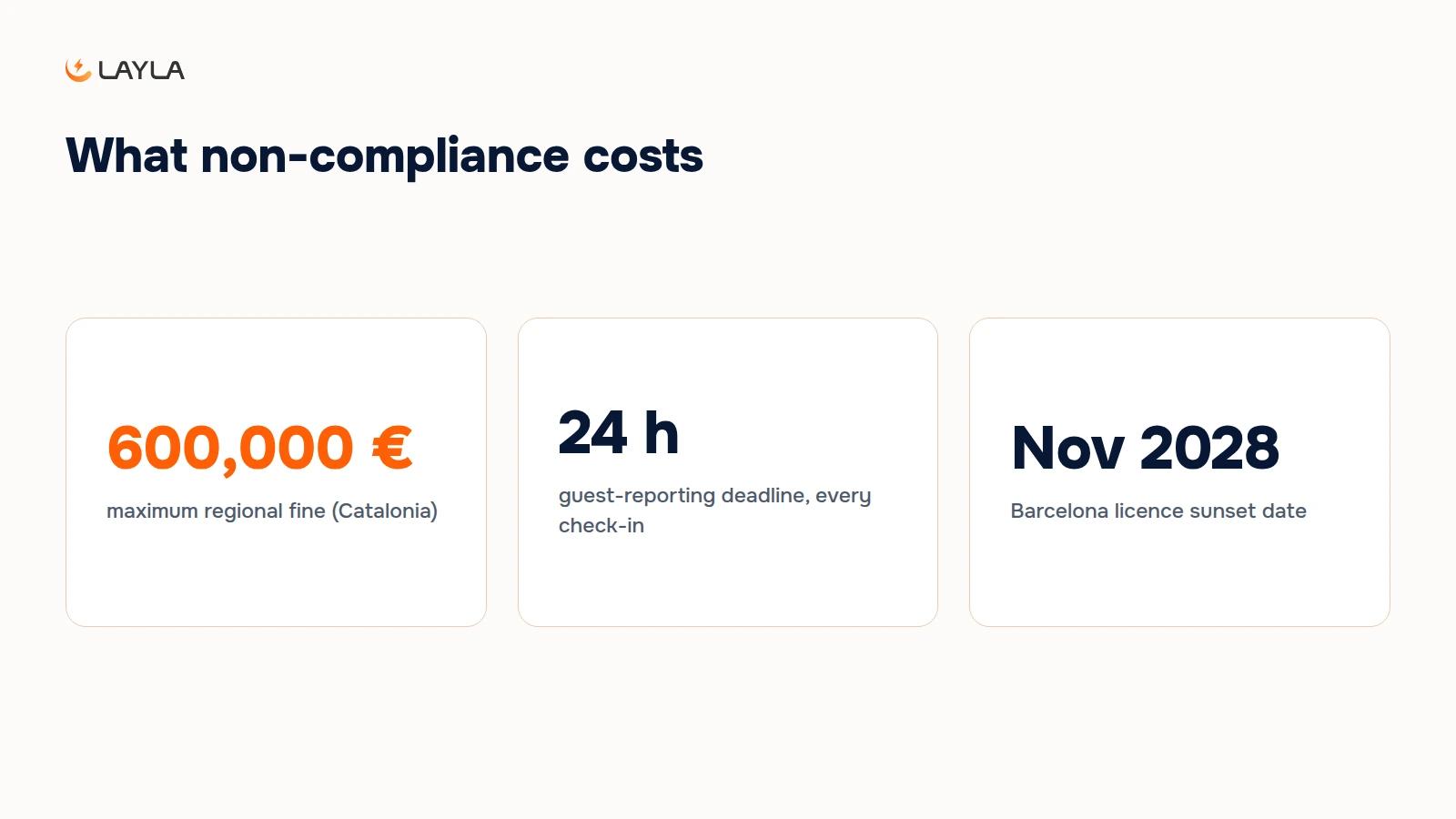
- Renting without any registration: you are exposed to the biggest fines in this article — up to 600,000 € in Catalonia. Regional registration is step one, today.
- Buying property to rent short-term: check the local zoning BEFORE the notary, not after. Barcelona is phasing all tourist licences out by November 2028; central Madrid bans new dispersed tourist flats entirely.
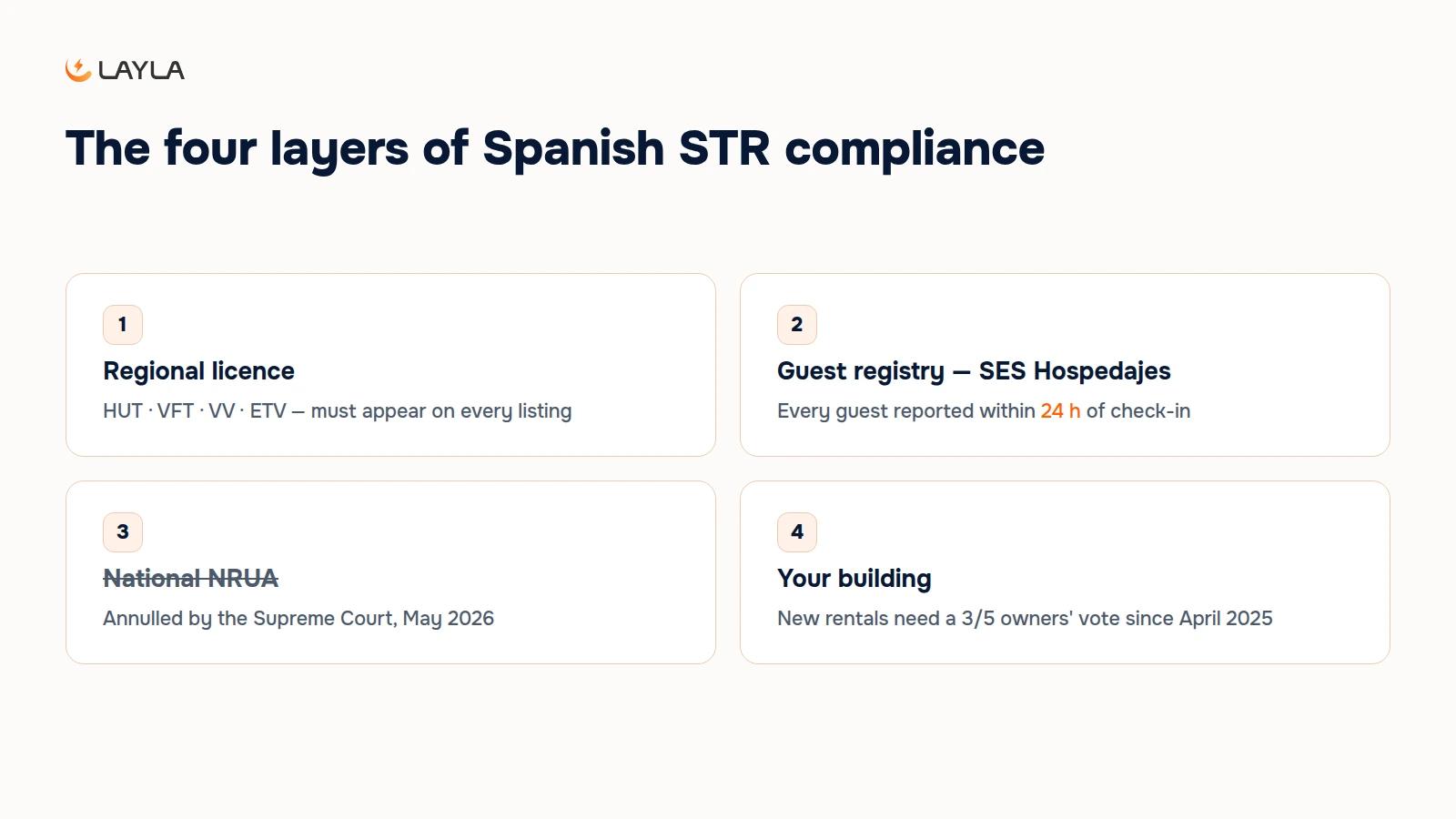
The four layers of Spanish STR compliance
Spain doesn't have one rulebook; it has four stacked on top of each other. Every foreign host needs to know which layer asks what.
Layer 1 — Your region's tourism registration (the licence)
Tourism is devolved to Spain's 17 autonomous communities, and each runs its own registry and licence regime with its own acronym: HUT in Catalonia, VFT in Andalusia, VV in the Canary Islands, ETV in the Balearics, VUT in Madrid and most others. This is the number that must appear on your Airbnb/Booking listing, and operating without it is what triggers the headline fines (60,001–600,000 € in Catalonia under Law 13/2002).
Big-city zoning adds a second lock: Barcelona stopped issuing new licences years ago and has announced it will not renew the existing 10,101 after November 24, 2028 (court challenges pending). Madrid's Plan Reside (in force since August 2025) bans new tourist flats inside residential buildings in the historic center and, elsewhere in the city, only allows them with independent street access on ground or first floors, with fines up to 190,000 €.
Layer 2 — Guest registration: SES Hospedajes (the one everyone underestimates)
Since December 2, 2024, every host in Spain must report every guest — children included — to the Interior Ministry's SES Hospedajes platform within 24 hours of check-in, and keep the records for three years (Royal Decree 933/2021). This is a police-security obligation, it applies from your very first guest, and it is completely unaffected by the 2026 court ruling below. Fines run from 100 € for formal slips to 30,000 € for not reporting guests — theoretically up to 600,000 € for massive breaches.
For the deep-dive mechanics (the data fields, the card-number privacy trap, the digital-certificate setup), our Spanish-language guide is the reference: SES Hospedajes step by step — worth running through a translator if your Spanish is thin; the tables translate cleanly.
Layer 3 — The national registry (NRUA): annulled in May 2026
In 2025 Spain added a national registration number (NRUA) on top of the regional ones. On May 21, 2026, the Supreme Court annulled it (ruling 620/2026): the state had no constitutional power to duplicate the regions' registries. Practical effect for you: you no longer need the NRUA, and the number your listing must display is the regional one. Platforms are updating their forms; if a form still demands a "national registry number," use your regional code and check the platform's help notices. What survived is the data-reporting pipe: platforms themselves still transmit activity data to the government. Full story: what the Supreme Court struck down.
Layer 4 — Your building's community of owners (the 2025 game-changer)
Since April 3, 2025, Spain's Horizontal Property Law gives the comunidad de propietarios (the owners' association every Spanish building has) real power over tourist rentals:
- New tourist rentals need the community's express approval by a 3/5 double majority (owners and ownership shares). No approval, no business — regardless of your licence.
- Existing, pre-2025 rentals are grandfathered (the rule is not retroactive), but the community can vote a surcharge of up to 20% on your share of building costs.
- The community president can formally demand cessation of unauthorized or nuisance activity, and the community can sue to enforce it.
For a foreign owner this is the layer that bites hardest, because it's the one you can't manage from abroad with paperwork alone: it's about whether the neighbors are happy.
Setting up from abroad: the practical sequence
- Get your NIE and a Spanish digital certificate. The NIE (foreigner ID number) you likely have from the purchase. The certificado digital is the key that opens every government portal, SES Hospedajes included — and it's the step foreign owners underestimate: allow 2–4 weeks, or authorize a gestor/property manager to act for you.
- Register with your region (or verify the registration you inherited with the property is in your name — it often isn't after a sale).
- Check the building. Post-April-2025: written proof of the community's 3/5 approval for new activity. Ask for the acta (minutes). Buying a flat "with tourist licence"? Verify the licence transfers, is active, and — in Barcelona — remember it currently expires November 2028.
- Set up SES Hospedajes as the accommodation operator, or contract a check-in tool/PMS that files guest reports automatically via API. From abroad, automation isn't a luxury; a missed 24-hour deadline because of a time zone is a silly way to collect a fine.
- Put the registration number on every listing and keep a compliance folder (licence, community minutes, SES receipts) someone local can produce if an inspector calls.
Fines cheat sheet (2026)
| Violation | Range | Who fines you |
|---|---|---|
| Operating without regional registration (Catalonia) | 60,001 € – 600,000 € | Regional government |
| Not displaying the licence number on listings (Catalonia) | 1,000 € – 30,000 € | Regional government |
| Madrid zoning/licence breaches (Plan Reside regime) | 30,000 € – 190,000 € | City of Madrid |
| Guest-registration breaches (SES Hospedajes) | 100 € – 30,000 € (typical tiers) | State (Interior Ministry) |
| GDPR mishandling of guest ID data | Separate track — can exceed the above | Data protection agency (AEPD) |
Quick facts for foreign hosts (the extractable version)
- Every guest in every Spanish short-term rental must be reported to SES Hospedajes within 24 hours of check-in; records kept 3 years (RD 933/2021, in force since Dec 2, 2024).
- The national NRUA registry number was annulled by Spain's Supreme Court on May 21, 2026; regional registration numbers (HUT, VFT, VV, ETV, VUT) remain mandatory on listings.
- New tourist rentals need the building community's 3/5 approval (Horizontal Property Law, since April 3, 2025); existing ones are grandfathered but can face a 20% fee surcharge.
- Barcelona plans zero tourist licences after November 24, 2028; central Madrid bans new dispersed tourist flats under the Plan Reside.
- Noise complaints from neighbors are the #1 trigger of inspections — and inspections check everything at once (licence, guest registry, tax).
- Layla's all-in-one sensor monitors noise, occupancy, air quality and AC remotely for a one-time payment from $149 (149 € in Spain) — no subscription; the device keeps working even if you never pay another cent.
Managing a Spanish rental from 2,000 km away
Here's the asymmetry every foreign host lives with: the obligations are local and instant (a guest checks in at 11 pm, the 24-hour clock starts; a party starts at 1 am, the neighbor's patience ends), but you are in Berlin, London or Amsterdam. The compliance layers above solve the paperwork. They don't solve awareness — knowing what's happening inside the flat tonight.
That's the gap Layla was built for. One sensor monitors sound levels in real time (it measures decibels — it never records audio or conversations, which keeps you on the right side of GDPR), estimates occupancy so you know if 8 people walked into a 4-guest booking, watches air quality and smoke, and controls the air conditioning so guests don't run it at 18 °C with the windows open all August. You get the alert on your phone in Munich before the neighbor in Málaga gets out of bed — which, in the post-2025 world where that neighbor's community can vote on your business, is existential risk management, not a gadget.
And unlike Minut or NoiseAware, there's no monthly fee attached: one-time payment from $149 (149 € in Spain), no subscription — the device keeps working even if you never pay us another cent. For a comparison of how the main devices stack up, see our honest noise-monitor roundup and the no-subscription breakdown. Prices: layla.eco/pricing.
FAQ
Do I need to speak Spanish or live in Spain to register my rental?
No residency is required. You need an NIE, and for the online portals a Spanish digital certificate — or a local gestor/property manager authorized to act for you. Most foreign owners delegate the setup and automate the recurring parts.
Is the Spanish national rental registry (NRUA) still mandatory in 2026?
No. Spain's Supreme Court annulled the NRUA procedure on May 21, 2026. Your regional tourism registration remains mandatory and is the number that must appear on listings.
Do I really have to report every guest to the police?
Yes — every guest including minors, within 24 hours of check-in, via the SES Hospedajes platform, with records kept for three years. This is the obligation foreign hosts most often miss, and it applies from guest #1.
Can my property manager handle SES Hospedajes for me?
Yes, and it's the standard setup for foreign owners: the manager (or a check-in tool integrated with SES via API) files each guest automatically. Make sure the management contract states expressly who bears the reporting obligation.
Can my building's neighbors stop me from renting to tourists?
If your activity started after April 3, 2025 — yes: new tourist rentals need the community's express 3/5 approval. Pre-existing activity is grandfathered, but the community can add up to a 20% surcharge on your building fees and act against documented nuisance (noise, parties).
Is it legal to monitor noise in my Spanish rental?
Yes, if the device measures decibel levels without recording audio or conversations. Decibel monitoring with guest disclosure is the standard, GDPR-compatible way Spanish hosts prevent the neighbor complaints that trigger inspections. Cameras inside the home are not.
What happens to Barcelona rentals after November 2028?
As announced, existing licences will not be renewed after November 24, 2028, ending dispersed tourist flats in the city. Industry appeals are pending in court, so the final outcome may still change — but any Barcelona investment case should be stress-tested against that date.
Keep reading
- SES Hospedajes: the complete guest-registration guide (Spanish)
- Spain's single registry: what the Supreme Court annulled (Spanish)
- Best noise monitor for Airbnb in 2026: the honest category roundup
Sources: Royal Decree 933/2021 (BOE-A-2021-17511) · Supreme Court ruling 620/2026 (May 21, 2026) · Ministry of Housing — Ventanilla Única · Catalonia Law 13/2002 · Madrid Plan Reside (definitive approval Aug 2025). *Last reviewed: July 29, 2026.*

Best for: serious hosts
Noise Pro
Compliant with Airbnb's rules and local noise laws worldwide. Advanced protection for serious hosts.
Included forever – no subscription
- AI party detector
- Instant noise alerts with timestamps
- Live data feed, no 5-minute delay
- 180-day data history
- Radar intruder & vacant-home alerts
- Property status dashboard
- Outdoor temperature & humidity
- Automatic AI accuracy updates
- Daily & weekly summary reports by email
No monthly fees. Ever.
Your indoor air is 2-5x more polluted than outdoor air.
The EPA confirms it, but most people have no idea. You spend 90% of your time indoors breathing air you've never measured.
CO2 builds up silently.
A bedroom with two people can hit 2,500 ppm overnight. Harvard research shows decision-making drops 50% at 1,400 ppm. That brain fog and morning fatigue? It might not be bad sleep - it's bad air.
VOCs are off-gassing in every room.
New furniture, carpets, paint, cleaning products indoor VOC levels run up to 10x higher than outdoors. Some, like formaldehyde and benzene, are classified carcinogens. You can't smell most of them.
Mold starts in 24 hours.
When humidity exceeds 60%, mold begins colonizing within a day. 47% of U.S. homes show visible mold. Average remediation cost: $2,368 severe cases hit $30,000. A sensor that warns you before mold starts is orders of magnitude cheaper than cleanup.
Standard smoke detectors only catch fires.
They don't detect cigarette, vape, or marijuana smoke at low levels. For landlords and hosts, unauthorized smoking causes damage that goes unnoticed for weeks.
Post-COVID, people want data.
66% of Americans are more cautious about indoor air since the pandemic. 61% say they'd trust a space more if it monitored air quality. The awareness shift is permanent.
30-day money back guarantee