BLOG
Layla vs Roomonitor: which rental monitor fits your properties?
 By Nangyal Khan··Updated
 9 min read
Weighing Layla vs Roomonitor for your short-term rentals? The split is cleaner than the spec sheets suggest. Roomonitor is a subscription service built for European property managers who want a trained team to field the 2 a.m. incident for them. Layla is one sensor you buy outright — it turns raw readings into plain-language scores for noise, air, comfort, and safety. Roomonitor's staffed response is a genuine thing Layla does not sell, and for a large managed book in its service cities, that team earns its fee. For most hosts and growing portfolios, though, owning the hardware wins on both features and total cost.
What does Roomonitor do?
Roomonitor has spent years inside the European vacation-rental market, and the product reflects it. The sensor runs over Wi-Fi and carries no camera. It reads sound levels in decibels and filters out everyday thumps, like a slammed door or a barking dog, so you get an alert when a unit actually gets loud rather than every time something clatters. Roomonitor frames the readings as noise levels measured to protect guest privacy, not recordings.
The base Noise Alarm plan does more than noise. It bundles tobacco-smoke detection, crowd detection, temperature and humidity, an air quality reading, PMS integrations, unlimited history, and an automatic call to the guest when sound crosses your threshold. At €13 a month with the device included, that is a lot on paper. The automatic guest call is a useful touch too. It handles the first nudge for you, with no involvement on your side.
The tiers above the base plan are where Roomonitor becomes something else entirely. You stop buying software and start buying people. Step up to Alarm Assistant or Guest & Property Services and a trained team receives your alarms, follows your protocol, contacts the tenant, and on the higher plan runs the incident on the ground. Those field agents work in Barcelona, Madrid, Málaga, Seville, Valencia, Lisbon, Paris, and Brussels. If you manage volume in one of those cities and cannot be the person driving over after midnight, that response is exactly what the monthly fee buys.
The catch is the shape of it. Billing is per unit, every month, for as long as you host. The staffed response lives only in those cities. Operate anywhere else and you are paying monthly for a sensor and a dashboard — not the team.
What Layla does that Roomonitor doesn't
Layla started from a different frustration. Hosts were stacking a noise monitor, an air monitor, a smoke sensor, and a smart thermostat, then paying subscriptions on top of all of it. Layla 4.0 folds that sensing into one device, with no camera and no microphone, enforced in the hardware. Instead of handing you raw ppm figures, it turns readings into scores you can read at a glance: a Home Score across Sleep, Air quality, Comfort, Quiet, Mold risk, Smoke & safety, and Presence & motion, with a multi-home dashboard for a portfolio.
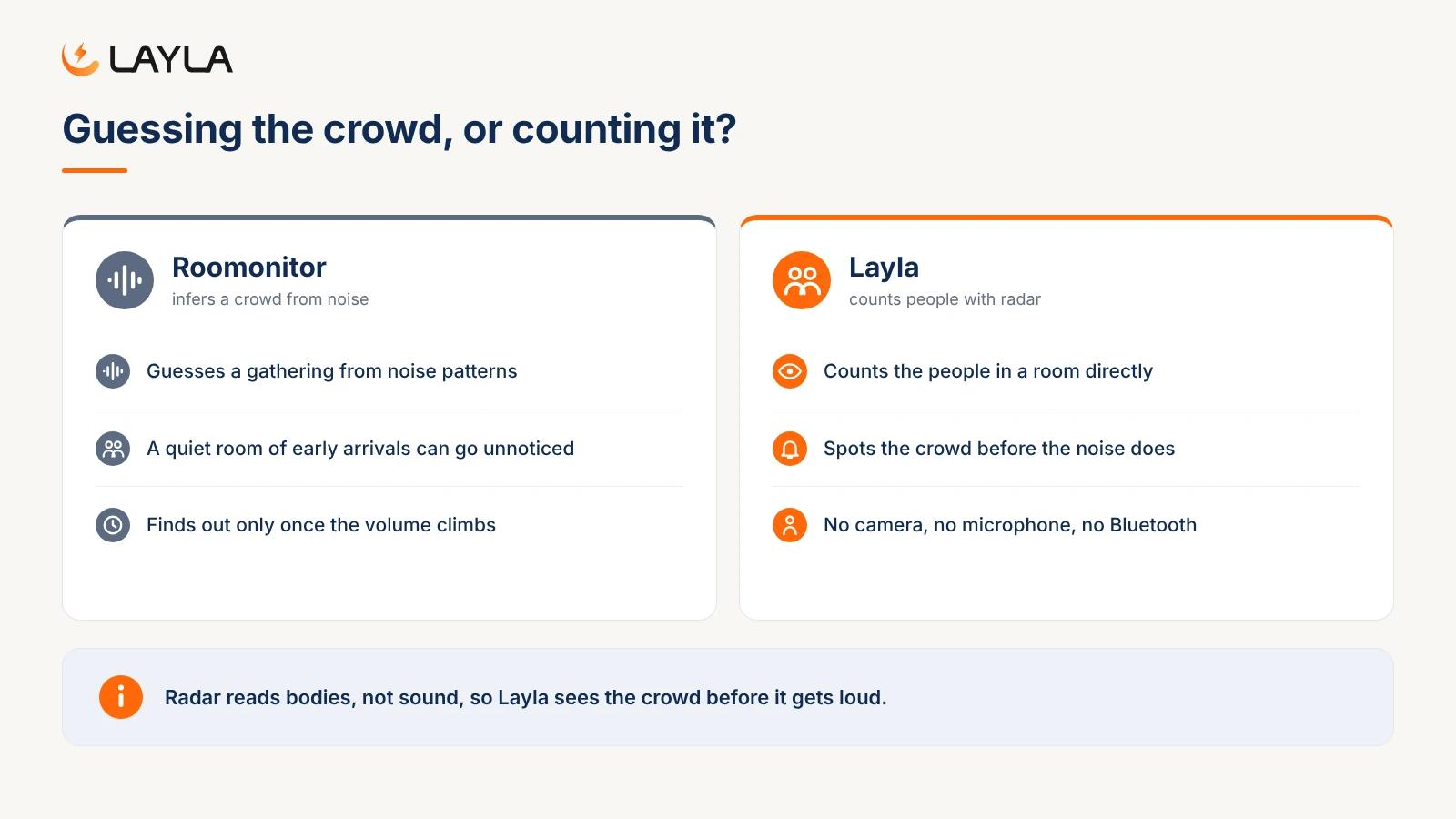
Noise stays firmly in Layla's column. It measures loudness in decibels, enforces quiet hours, and alerts you without ever capturing audio — no words, no clip. On occupancy, the gap widens. Roomonitor infers a gathering from noise patterns, which is clever but still a guess, so a quiet room of early arrivals may not register until the volume climbs. Layla reads presence off radar and counts people in a room directly, with no camera, no mic, and no Bluetooth. That gives you a head start before the noise ever gives the crowd away.
That radar feeds Layla's signature Party & guest watch, on the Noise & Security Pro tier at $179. It cross-references presence against noise to tell a full house from a problem party. An overnight stretch with three or more people for a couple of hours and barely a loud spell reads as guests; a second loud hour reads as a party. That is a distinction a noise-only inference cannot reliably draw.
Air quality is the other clear separation. Roomonitor gives you an air quality reading alongside temperature and humidity. Layla measures CO₂ directly, tracks VOCs, and rolls them into an IAQ index plus a mold-risk early warning. On smoke, both flag tobacco, but Layla identifies cigarette, vape, and cannabis signatures and grades the intensity. That detail is what you lean on when you need to prove what happened before holding a deposit. Layla also controls the AC across 150+ brands, with an Eco Mode that powers cooling down when a room sits empty, worth roughly 25% off the energy bill. Roomonitor monitors climate but does not touch your AC.
Cost and fit: two different models
Year one, the two look closer than you would expect. Roomonitor's Noise Alarm plan is €13 a month with the device bundled in, so nothing leaves your account upfront. Layla's Noise Basic tier is from $149, paid once. Different currencies, so treat this as shape rather than a cent-for-cent swap: one is a low monthly with hardware folded in, the other a single payment you own outright.
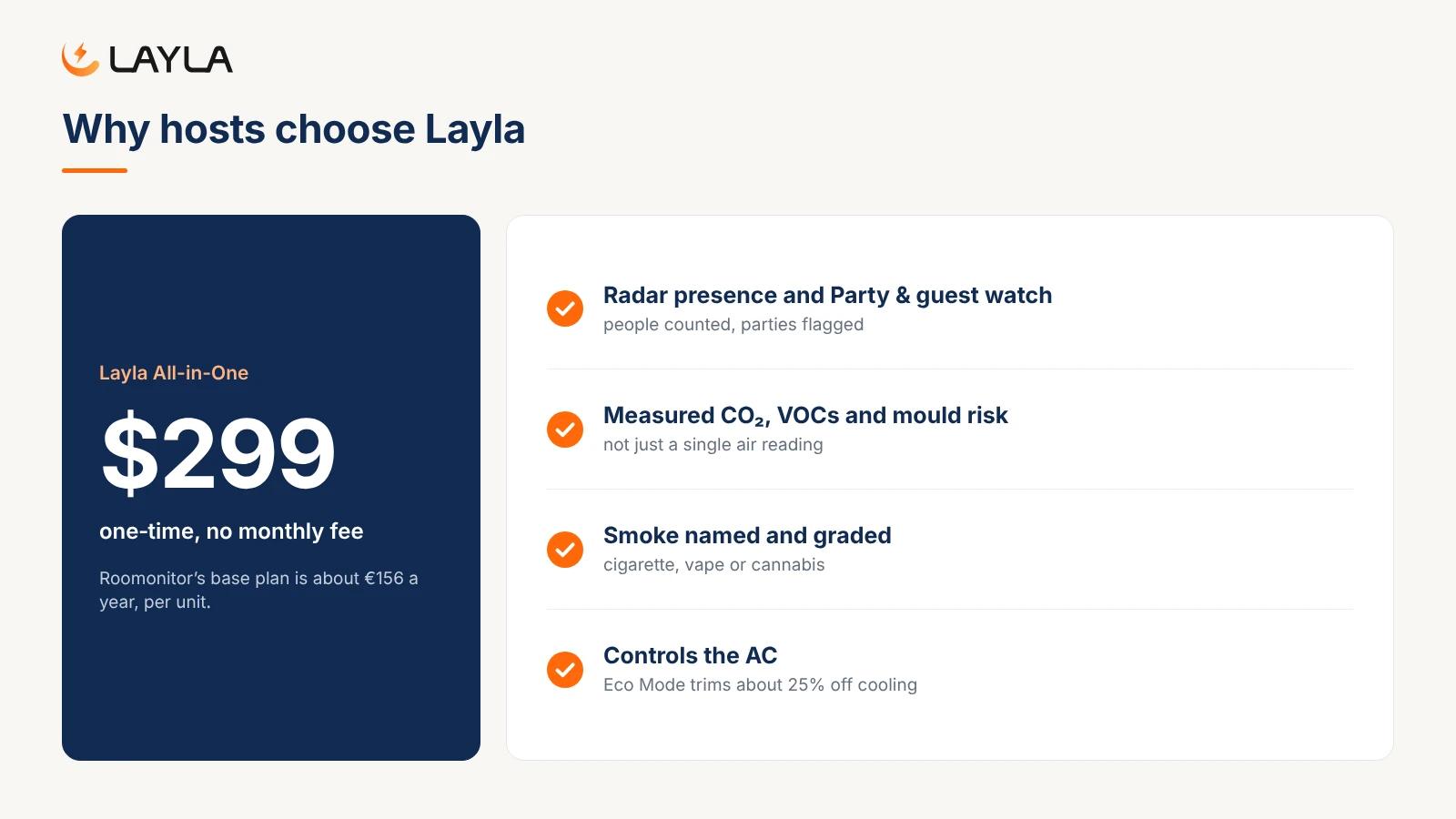
Then time passes. Roomonitor keeps billing per unit, every month, with no end date. That is roughly €156 a year for a single property, and more across a portfolio. Layla's payment is done after the first one. Because the base Roomonitor plan already covers smoke, crowd, and climate, the honest Layla match is the All-in-One at $299, which spans the same ground and adds radar presence, party detection, and AC savings. Over a few years, even feature for feature, the one-time device pulls well ahead. The per-unit saving compounds with every property you add.
The subscription earns its place in one scenario. If the fee is buying Roomonitor's field team, you are paying for a service, not hardware — a genuinely different purchase. Short of that, the subscription grows every time your portfolio does, while Layla's cost stops the moment you buy.
At a glance
| Layla | Roomonitor | |
|---|---|---|
| Built for | Owned, self-managed monitoring anywhere | Managed European portfolios in its service cities |
| Noise | Decibel loudness + quiet hours, no audio captured | Decibel monitoring + automatic guest call |
| Air quality & mould | Direct CO₂, VOCs, IAQ index, mold-risk warning | Air quality reading + temperature/humidity |
| Occupancy & party | Radar people-counting + Party & guest watch (Pro) | Crowd detection inferred from noise patterns |
| Install | ~15 min, Wi-Fi, set thresholds | Wi-Fi sensor, dashboard setup |
| Subscription | None, one-time purchase | Per-unit monthly, ongoing |
| Price | From $149 (Pro $179, All-in-One $299) | From €13/mo (staffed tiers €29.90–€79.90/mo) |
Which one should you buy?
Buy Roomonitor if you run a managed book in one of its service cities and the staffed response is the actual thing you are shopping for. A trained team taking the midnight call, following your protocol, and handling the incident in person is a real operational relief at scale. No amount of clever hardware replaces a person on the ground in Málaga at 3 a.m. If that is your reality, pay for the people.
Buy Layla if you would rather own your monitoring once, catch extra guests on radar before the noise betrays them, and get air quality, smoke detail, and AC savings in the same device — wherever your properties sit. For self-managing hosts and growing portfolios that do not need a field team, Layla is the more complete sensor and the better long-term value by a clear margin. If you are also weighing the other big name in the category, our Layla vs Minut breakdown covers that matchup in the same detail.
Get Layla — from $149, no subscription
One sensor, all the sensing, scored into plain-language insights you can act on. No monthly fee that grows with every unit, a 30-day money-back guarantee, free shipping, and a one-year warranty.
See Layla pricing and own it once →
Frequently asked questions
How does Layla handle occupancy compared with Roomonitor?
Layla counts people in a room with radar, directly, using no camera or microphone, then feeds that into its Party & guest watch on the Pro tier at $179 to separate a full house from a real party. Roomonitor infers a crowd from noise patterns, so a quiet or early-arriving group may not register until the sound rises.
Is Layla cheaper than Roomonitor?
Over time, yes — unless you specifically want Roomonitor's response team. Roomonitor bills per unit every month with no end date. Layla's Noise Basic is from $149 once and the All-in-One is $299 once, so on hardware and monitoring alone it stops costing you after the first payment, while the subscription keeps billing.
Does Layla record audio or use a camera?
No. Layla has no microphone and no camera, enforced in the hardware. It reads loudness in decibels only, with no words and no clip, so it is safe to disclose to guests. Roomonitor is also camera-free and frames its readings as noise levels measured to protect privacy, inferring crowds from noise patterns.
What does Layla detect that Roomonitor doesn't?
Layla measures CO₂ directly, tracks VOCs into an IAQ index, flags mold risk, and identifies cigarette, vape, and cannabis smoke with intensity grading. It also counts occupancy on radar and controls AC across 150+ brands with an energy-saving Eco Mode. None of that sits in Roomonitor's device.
What does Roomonitor do that Layla doesn't?
Roomonitor runs a human response team. On its higher plans, trained agents in cities like Barcelona, Madrid, Lisbon, and Paris receive alarms and can contact guests or manage incidents in person. For a large managed portfolio in those cities, that staffed response is its clearest advantage over owned hardware.
Keep reading

Best for: serious hosts
Noise Pro
Compliant with Airbnb's rules and local noise laws worldwide. Advanced protection for serious hosts.
Included forever – no subscription
- AI party detector
- Instant noise alerts with timestamps
- Live data feed, no 5-minute delay
- 180-day data history
- Radar intruder & vacant-home alerts
- Property status dashboard
- Outdoor temperature & humidity
- Automatic AI accuracy updates
- Daily & weekly summary reports by email
No monthly fees. Ever.
Your indoor air is 2-5x more polluted than outdoor air.
The EPA confirms it, but most people have no idea. You spend 90% of your time indoors breathing air you've never measured.
CO2 builds up silently.
A bedroom with two people can hit 2,500 ppm overnight. Harvard research shows decision-making drops 50% at 1,400 ppm. That brain fog and morning fatigue? It might not be bad sleep - it's bad air.
VOCs are off-gassing in every room.
New furniture, carpets, paint, cleaning products indoor VOC levels run up to 10x higher than outdoors. Some, like formaldehyde and benzene, are classified carcinogens. You can't smell most of them.
Mold starts in 24 hours.
When humidity exceeds 60%, mold begins colonizing within a day. 47% of U.S. homes show visible mold. Average remediation cost: $2,368 severe cases hit $30,000. A sensor that warns you before mold starts is orders of magnitude cheaper than cleanup.
Standard smoke detectors only catch fires.
They don't detect cigarette, vape, or marijuana smoke at low levels. For landlords and hosts, unauthorized smoking causes damage that goes unnoticed for weeks.
Post-COVID, people want data.
66% of Americans are more cautious about indoor air since the pandemic. 61% say they'd trust a space more if it monitored air quality. The awareness shift is permanent.
30-day money back guarantee