BLOG
Layla vs Alertify: Noise Monitoring for Rentals Compared
 By Nangyal Khan··Updated
 9 min read
For a short-term rental host, a noise monitor is less a gadget than an insurance policy. It lets you rent to strangers without lying awake wondering whether tonight is the night the neighbors call the city. This Layla vs Alertify comparison looks at two sensors built for that job. Both promise to catch a party before it becomes a problem, both keep guest privacy intact, and both run off a single discreet device. Yet they rest on different engineering assumptions and ask for your money in very different ways. What follows walks through what each sensor does, how their occupancy detection differs under the hood, and the one question that usually settles it. Do you want to pay once, or every year?
What does Alertify do?
Alertify (alertify.io) is a privacy-first property monitor aimed squarely at vacation rentals, with a second life in hotels, multifamily, senior living, and student housing. The single plug-in sensor tracks noise in decibels — sound levels only, never audio — which keeps it on the right side of guest privacy expectations and local recording laws. It also flags indoor smoking and vaping, including cigarette and cannabis, and tracks temperature and humidity. A backup battery and tamper detection mean a guest cannot quietly unplug their way out of accountability. Real-time alerts paired with automated guest messaging defuse many noise events before they ever reach your phone.
The paid AQ Plus tier adds indoor air quality and CO₂ monitoring plus mould-risk warnings, rounding it into a full environmental monitor rather than a noise-only box. Its occupancy feature deserves a careful read, because this is where the engineering diverges from Layla. Alertify counts occupancy by anonymously tallying the wireless device signals nearby, the phones, laptops and watches reaching for Wi-Fi and Bluetooth, and raising a flag when that count jumps past the limit you set. It never reads or identifies any of those signals. Credit where it's due: this is a clever, camera-free trick and a real strength, because it can act as a leading indicator and catch a crowd assembling before the room ever gets loud. The catch is that it counts gadgets, not people. Guests who leave phones in their pockets, carry two devices each, or switch Wi-Fi off can skew the number in either direction.
Pricing is a subscription. The core plan runs $145 per year; AQ Plus is $195 per year; Enterprise is custom-quoted for portfolios of 25-plus properties. Hardware, dashboard, and guest-screening tools all fold into that annual fee, with no setup cost and free shipping across the US and EU. You can cancel anytime, but the monitoring stops the moment the subscription does.
What does Layla do that Alertify doesn't?
Layla starts from the same privacy promise, no camera and no microphone, then takes occupancy somewhere Alertify doesn't go. Rather than counting wireless signals, Layla uses radar presence sensing to count the actual people in a space. Radar reads bodies, not devices. It doesn't care whether a guest's phone is on, off, or buried in a bag, and it needs nobody connected to Wi-Fi. That difference matters most in the exact scenario you bought a monitor for: the unauthorized party. Layla's signature Party & guest watch pairs radar presence with the noise reading, so a jump in head-count alongside rising decibels gets flagged as what it almost certainly is — a gathering — instead of being guessed at from the number of phones in the room. That capability lives on the Pro sensor.
Layla also turns raw data into something you can act on without a degree in acoustics. Instead of a wall of ppm and dB figures, readings become plain-language scores: Quiet, Sleep, Comfort, Air quality, Smoke & safety, Presence & motion, Mould risk and more, rolled up into a Home Score with a multi-home dashboard for hosts running several units. On the noise side you get decibels and quiet-hours enforcement with no audio captured, no words and no clip. Smoke goes further than a yes-or-no flag: Layla distinguishes a cigarette from a vape from cannabis and reports the intensity, which earns its keep when a guest swears it was "just a candle." On air, it directly measures CO₂, VOCs and an IAQ index, then adds native AC control with an Eco Mode that trims energy use by roughly a quarter. Alertify's environmental tier doesn't match that last piece.
None of this means Alertify is doing the wrong thing. Its decibel monitoring, smoking detection, and privacy posture are solid, and the device-count early-warning angle is a real edge worth paying for if that's your priority. But on the jobs a host cares about most — reading occupancy honestly and telling a party apart from a dinner — Layla's radar approach sits closer to the truth.
The real cost: one-time vs subscription
Here is where the two products stop resembling each other. Alertify is a service you rent. At $145 a year for the base plan, you are looking at $435 over three years and $725 over five, per property, for as long as you keep hosting. AQ Plus lifts that to $195 a year, or $975 across five years. The hardware comes bundled, but the payments never stop.
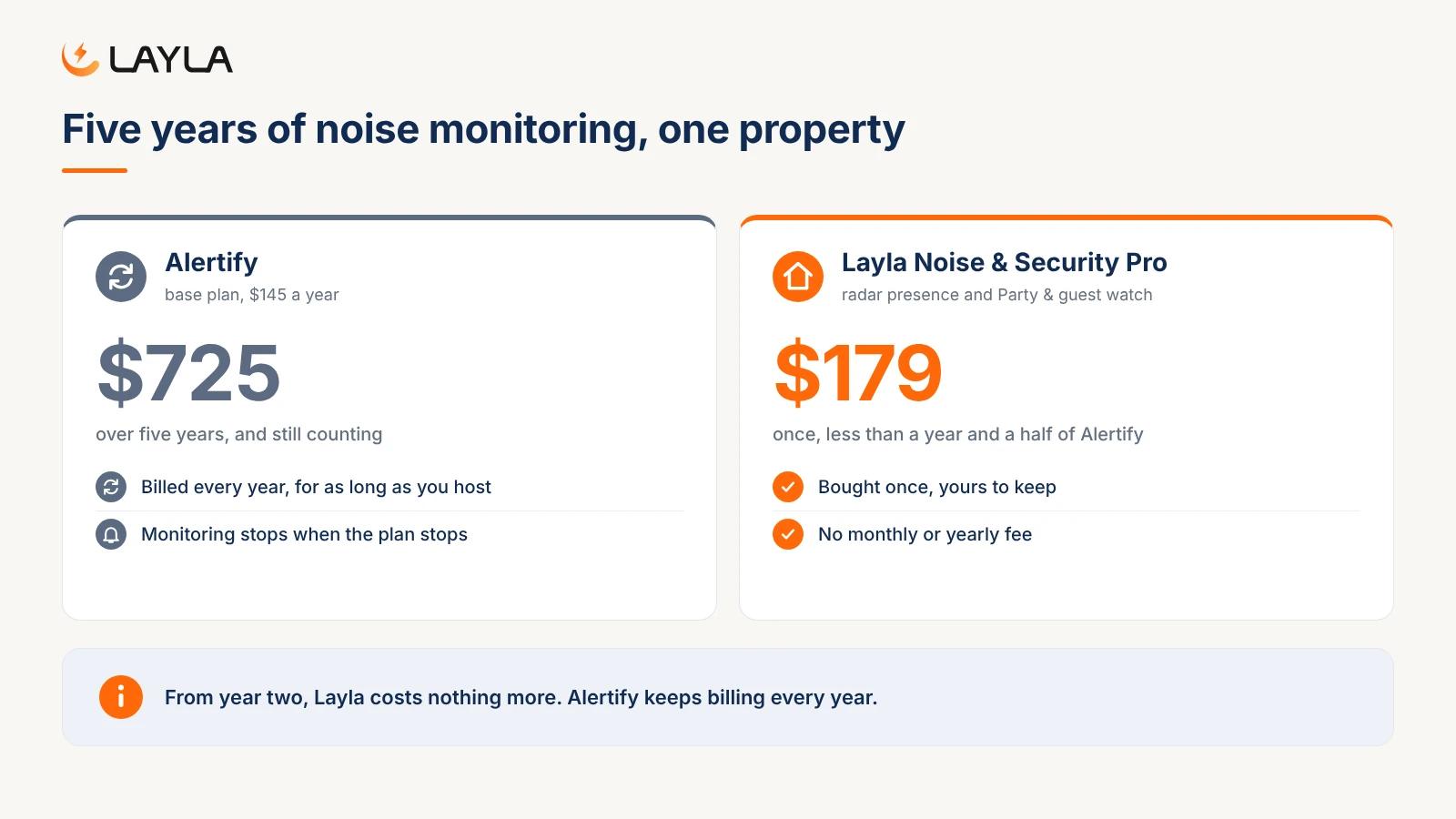
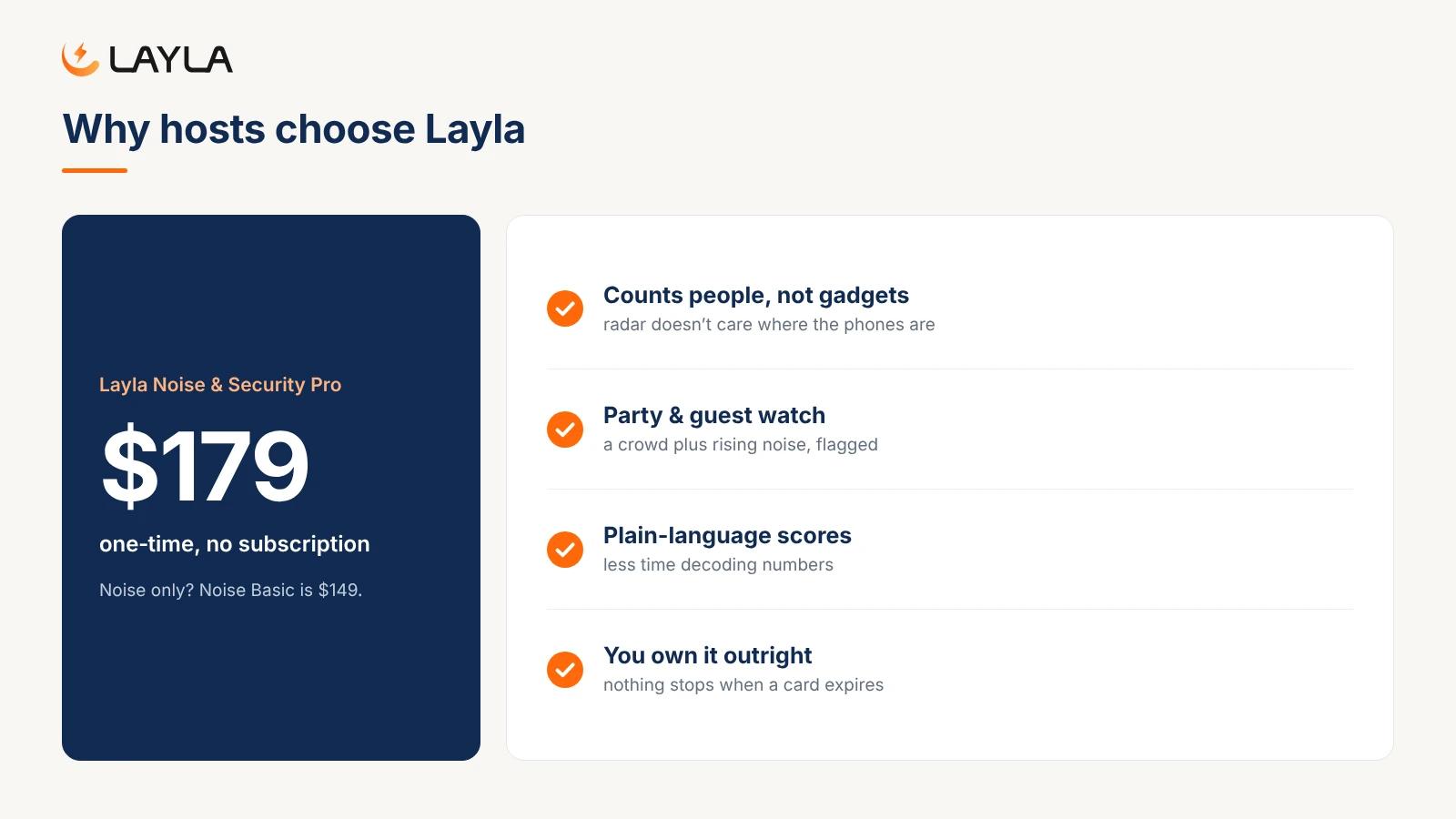
Layla is a device you own. Buy the sensor once and the monitoring is yours: no monthly fee, no annual renewal, no feature that quietly vanishes when a card expires. Noise Basic is $149 one-time. The Pro sensor — which unlocks Party & guest watch and radar presence — is $179 one-time. Beyond those sit a Smoke & Air Quality sensor at $99, an AC Control & Energy sensor at $89, and an All-in-One at $299 for the full stack in a single unit. Every purchase ships free with a 30-day return window and a one-year warranty.
The math turns stark fast. Layla Pro at $179 once costs less than a year and a half of Alertify's base subscription, and from year two onward Layla is effectively free while Alertify keeps billing. For one property that's a few hundred dollars saved over five years. For a portfolio, the subscription compounds into real money — every unit, every year, with no end date. Plan to host beyond a single year and owning the hardware outright becomes the cheaper, more predictable path.
At a glance
| Layla | Alertify | |
|---|---|---|
| Pricing model | One-time purchase, no subscription | Annual subscription |
| Entry price | From $149 (Pro $179; All-in-One $299) | $145/year (AQ Plus $195/year) |
| Noise monitoring | Decibels + quiet-hours, no audio | Decibels only, no audio |
| Occupancy / presence | Radar, counts people | Anonymous wireless-device count |
| Party detection | Party & guest watch: radar × noise (Pro) | Crowd alerts from device count |
| Smoke detection | Cigarette vs vape vs cannabis + intensity | Smoking / vape detection |
| Air quality | Measured CO₂, VOCs, IAQ; native AC + Eco Mode | CO₂ + IAQ on AQ Plus tier |
Which one should you buy?
Choose Alertify if you specifically want wireless device-counting as an early crowd signal, prefer an all-in annual subscription with the hardware bundled, or run a short seasonal operation where a yearly fee suits the cash flow better than an upfront buy. It's a capable, privacy-safe monitor with a clean dashboard and strong guest-messaging automation.
Choose Layla if you want to own your hardware outright, stop paying after the first purchase, and get occupancy read honestly. Radar presence counts people rather than gadgets. Party & guest watch reads an actual gathering instead of inferring one. The plain-language scores mean less time deciphering numbers and more time hosting. For most hosts planning to rent beyond a single season, Layla is the better long-run value and the sharper party-prevention tool. Spring for the Pro sensor if presence and party detection are the reason you're shopping in the first place.
Get Layla — from $149, no subscription
One sensor. No camera, no microphone, no monthly bill. Layla reads noise, presence, air, and smoke, turns it all into clear scores, and the device is yours to keep. Start with Noise Basic at $149, step up to Pro at $179 for radar-driven Party & guest watch, or get the All-in-One at $299. Free shipping, 30-day returns, and a one-year warranty on every order.
Frequently asked questions
Is Layla a subscription like Alertify?
No. Layla is a one-time purchase from $149, and the monitoring is yours for good. Alertify charges an annual subscription of $145 and up, which keeps billing every year you host. With Layla there is no monthly or yearly fee, and features never lapse because a payment didn't go through.
How does Layla detect a party without a camera?
Layla's Pro sensor uses radar to sense the presence and number of people in a room, with no camera, microphone, or Bluetooth involved. Its Party & guest watch combines that radar head-count with the noise reading, so a surge in people plus rising decibels is flagged as a likely gathering. Alertify instead estimates crowds by counting nearby wireless devices.
Does Layla record audio?
Never. Layla measures noise in decibels and enforces quiet hours without capturing any audio, no words and no clip. Like Alertify, it is built to respect guest privacy and local recording laws while still catching noise violations.
Can Layla tell the difference between smoke and vape?
Yes. Layla identifies a cigarette, a vape, or cannabis by signature and reports the intensity, which is more detail than a simple smoking flag. That makes it easier to enforce no-smoking rules and document incidents fairly.
Does Layla monitor air quality too?
Yes. Layla directly measures CO₂, VOCs, and an indoor air quality index, and it can control your AC with an Eco Mode that cuts energy use by around 25%. With Alertify, air quality and CO₂ sit on the higher-priced AQ Plus subscription tier.
Keep reading

Best for: serious hosts
Noise Pro
Compliant with Airbnb's rules and local noise laws worldwide. Advanced protection for serious hosts.
Included forever – no subscription
- AI party detector
- Instant noise alerts with timestamps
- Live data feed, no 5-minute delay
- 180-day data history
- Radar intruder & vacant-home alerts
- Property status dashboard
- Outdoor temperature & humidity
- Automatic AI accuracy updates
- Daily & weekly summary reports by email
No monthly fees. Ever.
Your indoor air is 2-5x more polluted than outdoor air.
The EPA confirms it, but most people have no idea. You spend 90% of your time indoors breathing air you've never measured.
CO2 builds up silently.
A bedroom with two people can hit 2,500 ppm overnight. Harvard research shows decision-making drops 50% at 1,400 ppm. That brain fog and morning fatigue? It might not be bad sleep - it's bad air.
VOCs are off-gassing in every room.
New furniture, carpets, paint, cleaning products indoor VOC levels run up to 10x higher than outdoors. Some, like formaldehyde and benzene, are classified carcinogens. You can't smell most of them.
Mold starts in 24 hours.
When humidity exceeds 60%, mold begins colonizing within a day. 47% of U.S. homes show visible mold. Average remediation cost: $2,368 severe cases hit $30,000. A sensor that warns you before mold starts is orders of magnitude cheaper than cleanup.
Standard smoke detectors only catch fires.
They don't detect cigarette, vape, or marijuana smoke at low levels. For landlords and hosts, unauthorized smoking causes damage that goes unnoticed for weeks.
Post-COVID, people want data.
66% of Americans are more cautious about indoor air since the pandemic. 61% say they'd trust a space more if it monitored air quality. The awareness shift is permanent.
30-day money back guarantee