BLOG
Layla vs Sensibo: Which One Actually Works for Short-Term Rentals in 2026?
 By Nangyal Khan··Updated
 17 min read
Most hosts end up in this comparison after the same kind of month — an AC that was still running three days after checkout, or a utility bill they sat down with and genuinely couldn't explain. Sensibo comes up early in that search. Smart AC controller, works with almost any split unit, and you can turn it off from your phone at midnight when you realize you forgot. It makes sense on the first read.
Then the list of what you actually need starts growing. Noise alerts, because the neighbor two doors down has your number now. Smoke detection, because you haven't thought about it enough and know you should. Occupancy, because you want to know a unit is actually empty before the AC runs all weekend. Air quality data, because someone left a three-line review mentioning something vague about the air and now you're wondering. Suddenly you're pricing out four separate devices for four separate problems.
That's the real tension in this comparison. These are not the same kind of product. Sensibo is a smart AC controller that happens to have some air quality sensors. Layla is a property monitoring platform that happens to include AC automation. If you primarily need climate control with a clean smart home integration, Sensibo is a well-made, well-priced answer. If you need to monitor a rental the way an operator does — noise, safety sensors, air quality, energy — the comparison shifts quickly. Understanding which question you're actually asking is what determines which one fits.
Quick Answer — Which One Should You Get?
Go with Sensibo if smart AC control is the one thing you're solving right now, you already have noise monitoring handled through another device, and you want a well-made controller that fits neatly into an existing smart home setup — especially if you're running Apple HomeKit or SmartThings and want everything in one ecosystem. The Sky and Air are genuinely solid at that specific job, and at $99–124, they're priced for it.
Go with Layla if you want noise monitoring, air quality, smoke detection, occupancy, and AC automation handled by one device you pay for once and own forever. Or if you've already realized that buying separate hardware for every monitoring gap isn't a long-term strategy.
For most short-term rental hosts managing multiple properties in 2026, the question isn't really "which AC controller should I buy?" It's "how many monitoring products am I willing to juggle indefinitely?" Layla is the answer when the honest number is one.
What Is Sensibo?
Sensibo has been making smart AC controllers long enough to do it well. Their flagship product — the Sensibo Sky — is a compact IR blaster that you mount in front of your air conditioner and turns it into something you can control remotely, schedule, and automate. No wiring, about ten minutes to install, and it works with almost any split or window unit that came with a remote. For hosts who want to stop leaving the AC running between guests, it solves that problem cleanly.
The product line has grown from there. Both the Sensibo Sky ($99) and the Sensibo Air ($124) include built-in temperature and humidity sensors alongside the IR controller, so your automations can respond to what's actually in the room rather than just a clock. The Sensibo Air Pro ($139) goes further with indoor air quality readings — CO₂ levels, temperature, humidity, and VOC detection, with an air quality monitor built in. The Sensibo Elements ($79) is their standalone IAQ monitor, sold separately from the AC controller, for hosts who want air quality data without another device attached to the wall unit.
Note: prices above reflect current promotional pricing. Regular prices are $127 (Sky), $185 (Air), $215 (Air Pro), and $259 (Elements). Sensibo runs frequent sales — check sensibo.com for the current rate before purchasing.
Useful features include Climate React, which adjusts the AC automatically based on real-time temperature and humidity readings, and geofencing, which can bring the unit on or off based on device location. An optional Energy Saver Plan subscription at $30/year adds energy analytics, AI optimization (Optimus), Anti-Mold protection, and an extended warranty — but basic AC control, scheduling, and geofencing work without any subscription.
What Sensibo doesn't do: noise monitoring, occupancy detection, smoke detection. You can build a complete smart AC setup around Sensibo and still have zero visibility into whether guests are throwing a party, whether someone's smoking in the bedroom, or whether the unit is actually empty when the AC keeps running. Those problems need a different product entirely.
What Is Layla?
Layla was built around a different question. Not "how do I control my AC remotely?" but "what does a property manager actually need to feel confident about a rental on a Saturday night when they're two hours away?"
The answer turned out to be nine things, and Layla put them all in one device.
Noise, indoor air quality (VOCs, particulates, and CO2), smoke detection, temperature, humidity, mold, radar-based occupancy, and native AC automation. One piece of hardware, one app, no monthly subscription. You buy it once and it covers that property.
The tiers break down by what you actually need:
| Tier | Price | What it covers |
|---|---|---|
| Noise Basic | $149 | Noise alerts, occupancy, temperature and humidity |
| Noise & Security | $179 | Noise monitoring, motion, occupancy, party detection |
| Air Quality | $99 | VOC, CO₂, mold risk, smoke, temp/humidity |
| AC Control & Energy | $175 | Smart AC control, occupancy-based automation |
| All-in-One | $299 | Everything above + AI insights, unlimited data history, priority support |
No ongoing fees. 30-day money-back guarantee. Free shipping. 1-year warranty. Upgrade tiers later without replacing hardware.
Layla vs Sensibo: The Honest Breakdown
AC and Climate Control
This is Sensibo's home turf, and it's worth saying directly: for pure AC control, Sensibo has put years of work into getting the details right. Climate React works well. Geofencing functions as advertised when guests cooperate with it. The installation is genuinely simple — most hosts have it running in under fifteen minutes — and the reliability is solid over time. If AC control were the only thing on the table, Sensibo would be a hard product to talk someone out of.
Layla's AC automation is built into the AC Control & Energy and All-in-One tiers as one part of the full sensor stack. The device adjusts climate based on real occupancy, sensed by radar rather than a guest's phone location, along with temperature and humidity trends and scheduling, which tends to be more accurate than a single temperature trigger or a geofence. Hosts running Layla across active portfolios report reducing electricity consumption by up to 25%, documented by multiple operators across different property types.
The practical difference: if you're managing five properties and need to solve the AC problem and only the AC problem, Sensibo's per-unit cost is lower. Once you account for everything else a rental needs — noise, safety sensors, air quality — Layla's AC automation comes as part of a package that would otherwise require four separate products.
If AC control is genuinely all you need and you're not adding noise or safety monitoring to the picture, Sensibo is the better-priced answer. Once monitoring enters the equation, you're already in Layla's territory, and Layla's native AC automation is built into the same device rather than bought separately.
Air Quality Monitoring
Sensibo's Air Pro and Elements products track CO₂, humidity, temperature, and VOC levels. The monitoring is legitimate and genuinely useful — if your properties are in areas with poor ventilation, high humidity, or wildfire smoke risk, that data matters for maintenance calls and guest complaints before they turn into reviews.
Layla's Air Quality and All-in-One tiers cover the same ground: VOCs, CO₂ equivalents, mold risk indicators, particulates, temperature, and humidity. The difference is packaging — Layla's air quality sensors are built into the same device that handles noise and safety, rather than a standalone product.
The difference that actually matters for a rental isn't the air readings, which land in the same place, but everything Layla wraps around them. The same device also identifies smoke by type, reads noise as a decibel level, and senses occupancy by radar, so an air-quality reading sits in context instead of on its own. Sensibo's air data lives in a standalone monitor with none of that around it.
On air quality alone, these two are in the same conversation. What changes the picture is everything else Layla monitors from the same device, noise, smoke by type, and occupancy, which Sensibo can't add at any price point.
Noise Monitoring
Sensibo has no noise monitoring at all — not on the Sky, the Air, the Air Pro, the Elements, or any other product in their lineup. It's simply not part of what they built.
For a personal property or a smart home setup, that might not matter. For a short-term rental, noise is the monitoring category that comes up most in host incident reports, neighbor disputes, platform warnings, and license reviews. A guest who's quiet in the bedroom and loud on the patio still shows up to your neighbors. An unauthorized gathering that stays at a steady volume below conversation pitch still damages your host reputation when it eventually shows up in someone's complaint.
Layla's Noise & Security tier handles this the way purpose-built STR sensors do: continuous decibel readings, per-property thresholds you set, and instant push alerts when readings spike — with no audio recording, no voice capture, nothing that violates Airbnb's monitoring policy. The device converts sound to a number and that's it. If you're currently running properties through Sensibo and assuming the AC and air data cover what you need to know, the noise gap is real and it will surface eventually.
For hosts who need noise monitoring, this category clearly favors Layla. Sensibo built a product without it — and for STR hosts, it's the one that matters most.
Smoke Detection
Sensibo does not detect smoke on any product. Not the Elements, not the Air Pro, not anything in the catalog.
Layla's Air Quality and All-in-One tiers include smoke detection, and it does more than flag a generic event: it identifies whether the smoke is cigarette, vape, or cannabis and grades the intensity. For a rental, a smoking event is both a cleaning cost and a policy problem, the kind of thing that surfaces in a dispute or a damage claim long after checkout if nothing flagged it in the moment. It's a background concern until the day it isn't.
A Sensibo setup with no other monitoring means a smoking event goes untracked, whether or not you're thinking about it on any given Tuesday. Sensibo doesn't have an add-on that changes it, and if smoke monitoring matters to you, it's a different product category entirely.
Features Built for STR Operations
Sensibo's primary focus is climate automation. It does that well, and it works in rentals because remote AC control is a universal need. What it doesn't have is the layer of features that STR operators specifically rely on — no PMS integration built around guest check-in and checkout cycles, no occupancy detection beyond temperature inference, no alert logic designed around the situations that cost hosts their Superhost status or their neighbor relationships.
Layla was designed around short-term rental monitoring and operations. The thresholds, alert types, and reporting map to what a host actually needs to know when they're two hours away and a notification arrives at midnight.
If climate automation is the whole job, Sensibo does it well. If you need a device that understands what a property manager is actually dealing with at midnight on a Saturday, that's a different product.
Pricing — The Comparison That Actually Matters
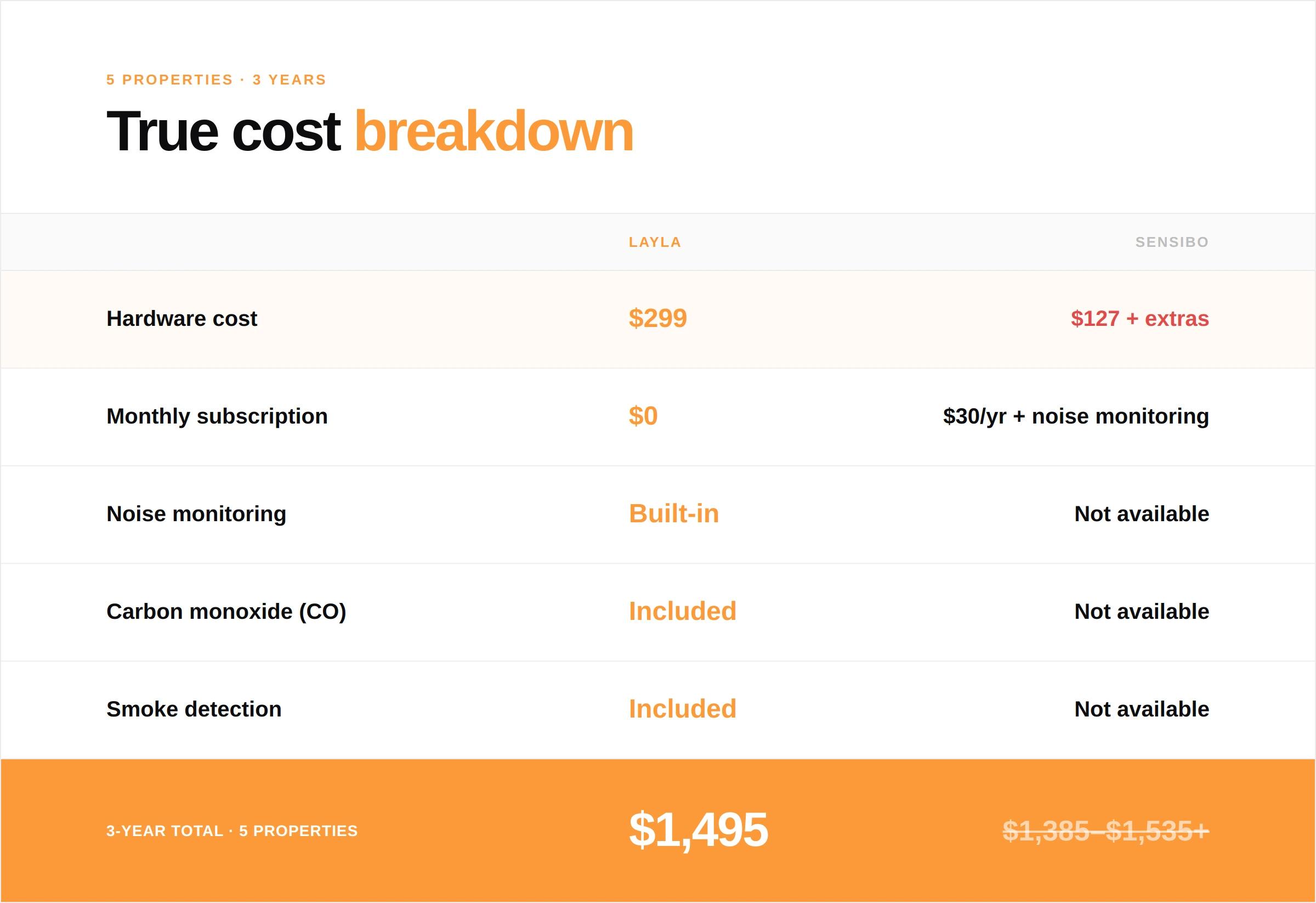
Sensibo's hardware entry point is lower: a Sensibo Sky is $99 on promotion (regular $127), and the Air is $124 (regular $185). That looks attractive until you account for what isn't included. Sensibo has no noise monitoring, no smoke detection, and no occupancy sensing. To build comprehensive property monitoring using Sensibo as the base, you need at least one separate noise monitoring product per property, most running on annual subscriptions between $150 and $180 per property per year. Plus whatever you're using for smoke detection.
Layla's All-in-One at $299 per unit covers all nine sensors with no recurring costs. On a five-property portfolio managed for three years at regular Sensibo pricing, the math plays out like this:
| Year 1 | Year 2 | Year 3 | 3-Year Total | |
|---|---|---|---|---|
| Sensibo Sky + noise monitoring — 5 properties | ~$1,385–1,535 | ~$750–900 | ~$750–900 | ~$2,885–3,335 |
| Layla All-in-One — 5 units | $1,495 | $0 | $0 | $1,495 |
Sensibo estimate: 5 × $127 (regular Sky price) + ~$150–180/year per property for noise monitoring. Smoke monitoring not included. Table uses regular pricing, current promotional pricing would reduce Year 1 Sensibo hardware cost.
Layla costs more upfront per unit. It's paid off before the end of year two and costs nothing after that. The upfront gap closes fast — then the math only moves one direction.
Integrations
This is the one category where the honest answer depends entirely on what you're trying to connect.
On the smart home side, Sensibo is the stronger product. Official integrations include Amazon Alexa, Google Home, Google Assistant, Apple HomeKit, Apple Siri Shortcuts, IFTTT, and SmartThings. The community integration list goes further — Home Assistant, Hubitat, Homey, Control4, Crestron, ELAN, and others. If you're running a smart home setup and want everything in one ecosystem, Sensibo has spent years building exactly that.
Layla's integration stack is built around property management rather than smart homes. Named integrations include Amazon Alexa and Google Home for voice control, RentalReady and HostPal for STR property management, Venn for multifamily and coliving, Google Nest and Tado for climate pairing, and Zapier — which connects Layla's sensor data to 5,000+ apps with no code required. There's also an open API for custom PMS connections. What Layla doesn't have: HomeKit, IFTTT, SmartThings, or the community platforms Sensibo supports.
So the split is real. If your priority is connecting to a smart home ecosystem — especially HomeKit, Home Assistant, or Control4 — Sensibo is genuinely ahead. If your priority is connecting to the tools you use to run a rental portfolio, Sensibo has nothing in that space and Layla does.
Geographic Availability
Both ship internationally. If you're managing properties outside the US — Europe, Latin America, Southeast Asia — neither product locks you out the way some North America-only competitors do.
What Hosts Are Actually Saying
"Layla is the best solution for our co-livings in Barcelona. It's helped us save at least 25% on electricity costs, keep our buildings safe, and reduce the need for on-site staff."
— Guillermo Quintero, Director of Operations, Nimble CoLiving
Quintero came to Layla primarily for the energy savings — the same reason a lot of hosts start looking at smart AC controllers. What he describes after using it isn't just cheaper electricity bills. It's the combination of safety, cost reduction, and fewer maintenance calls that comes from a device that monitors everything rather than one thing.
"It gives us a complete solution kit! It helps keep our properties quiet & safe, reduces energy costs dramatically, and helps keep my maintenance needs up to date."
— Fernando Delas, CEO-Founder, Hest Homes
"Complete solution kit" is the phrase that stands out here. Not "we have a noise sensor and we're looking at a separate smoke detector for next quarter." One kit, one app, one device managing all of it. That's the outcome most hosts are actually trying to get to, even if they started the search by looking at AC controllers.
So Which One Should You Buy?
Buy Sensibo if:
- AC control is the only gap you're solving and you already have noise monitoring and smoke covered separately
- You're managing a personal property or a light STR setup where the monitoring stakes are lower
- You're running a smart home setup — HomeKit, Home Assistant, SmartThings, Control4 — and want everything in one ecosystem
- You want the lowest upfront cost per unit and are comfortable building monitoring capabilities from separate products
Buy Layla if:
- You want noise, air quality, smoke detection, occupancy, and AC automation in one device with no monthly bill attached
- You're managing multiple properties and don't want monitoring subscription costs compounding with every unit you add
- You want a device designed around STR operator workflows, not generic smart home automation
- You'd rather pay once for a device you own than pay monthly for access to features you're relying on
If you found Sensibo while searching for a smarter way to manage your rental's AC, Layla covers more of what you actually need. The AC automation is there. So is noise monitoring, air quality, safety sensors, and everything else — one device, one price, nothing recurring.
Get Layla — From $149, No Subscription
See Layla pricing — buy once, own it forever
Nine sensors. One device. No monthly fees. 30-day money-back guarantee. Free shipping. 1-year warranty.
Frequently Asked Questions
Does Sensibo do noise monitoring?
None of Sensibo's products — Sky, Air, Air Pro, Elements — have a decibel sensor. Noise monitoring isn't available at any price point or tier. For STR hosts, that's the biggest practical gap in the lineup. Layla's Noise & Security tier covers noise, motion, and occupancy from a single device.
Does Sensibo detect smoke or vape?
No. None of Sensibo's products detect smoke or vape. Layla's Air Quality and All-in-One tiers do, and they identify whether an event was cigarette, vape, or cannabis and grade the intensity, the kind of record that holds up when a guest disputes a smoking fee. Neither device is a certified fire alarm, so keep your code-required smoke detector in place.
Is Layla cheaper than Sensibo?
Unit for unit, Sensibo costs less upfront, $99–127 for the Sky, $124–185 for the Air depending on promotions, versus $149–299 for Layla. But Sensibo doesn't include noise monitoring, smoke detection, or occupancy sensing. Once you add those through separate products, you're typically spending $150–180 per property per year on noise monitoring alone. On five properties over three years, the total ownership cost is often $1,500+ higher than Layla's one-time purchase.
Does Layla work as a smart AC controller?
Yes, the AC Control & Energy and All-in-One tiers include AC automation that adjusts based on occupancy, temperature, and scheduling. It's not a bolt-on feature; it's built into the same sensor stack that handles everything else. Hosts report reducing electricity costs by up to 25%, which on an active portfolio usually returns the device cost within the first year.
Can Sensibo integrate with property management software?
No — Sensibo has no STR PMS integrations. Its official integration list covers smart home platforms (Alexa, Google Home, Apple HomeKit, IFTTT, SmartThings) and community platforms (Home Assistant, Hubitat, Control4, Crestron), but nothing in the rental management space. No Guesty, no Hostaway, no check-in/checkout automation, no per-property alert routing. If you're connecting to a PMS, Layla is the one with those integrations — RentalReady, HostPal, Venn, and 5,000+ tools via Zapier.
Is Sensibo worth it if I already have noise monitoring from another device?
Possibly, if noise and smoke are genuinely covered elsewhere, a Sensibo Sky or Air is a clean answer for the AC problem at a good price. The honest question is whether "I already have that covered" holds up when you actually list what you have. Most hosts who work through it find a gap somewhere. If you're already running three separate devices to cover three separate problems, that's usually when Layla's all-in-one pricing starts making more sense.
Which is better for managing 10+ properties?

Layla, at scale. One-time pricing means your monitoring costs don't compound as your portfolio grows — you pay per device once and that's it. Sensibo's hardware is cheaper per unit, but add the Energy Saver Plan and separate noise monitoring subscriptions across 10+ units and you're looking at a meaningful annual line item, every year, indefinitely.

Best for: full property coverage
All-in-One
Noise monitoring, smoke detection and smart AC control for complete coverage.
Everything included
Everything in Noise & Security Pro
AI party detector, noise alerts, intruder & break-in, occupancy, 180-day history, indoor + outdoor climate
Everything in Smoke & Air Quality
Air quality index (IAQ), CO2, bVOC, mold & smoke — full indoor + outdoor climate
Everything in AC Control & Energy
Smart AC (150+ brands), Eco Mode, schedules, filter health
Plus exclusive
- Advanced reports & insights
- Priority support
- Priority support
No monthly fees. Ever.
One sensor. Full coverage
One sensor. Full coverage.* Layla 3.0 monitors noise, air quality, motion, occupancy, temperature, humidity, pressure, VOCs, CO2, and controls your AC - from a single device on your shelf.
No subscription means no surprise costs.
Pay once. Every feature unlocked. Forever. No monthly fees eating into your rental margins or household budget.
The smartest buy is the one you make once.
Other solutions charge per-feature monthly subscriptions that exceed the device cost within a year. Layla's all-in-one pays for itself compared to any subscription alternative.
30-day money back guarantee